Introduction
Promoting intake of calf starter is essential to promoting rumen development and allowing us to wean calves at an early age. Although calves generally begin to eat calf starter at an early age, there has been a lot of work to determine those factors that can promote early and aggressive starter intake. Palatability agents (flavors, aromas, ingredients etc.) have been evaluated extensively in starters. However, the one ingredient that has consistently been used to improve palatability of starters is molasses.
A research trial published in the Journal of Dairy Science by researchers at Pennsylvania State University (Lesmeister et al., 2004) has evaluated the application of either 5% or 12% molasses to a textured calf starter and its effects on intake, growth and rumen development.
The study
Liquid molasses (74% DM, 4.7% protein, 60.6% sugars as invert sugars, 12.2% ash) was used. The starter was a commercial textured starter that contained 5% molasses; the experimental treatment was produced by adding the additional molasses to the starter.
Holstein calves (n = 46) were used in the study, beginning at 2 days of age. Calves were fed colostrum prior to starting the study. All calves were fed ad libitum starter and water. A 20% CP, 20% fat commercial milk replacer was fed from 3 days until weaning at 28 days of age. Calves were monitored (intake, growth, health) until 42 days.
The results
Adding molasses to one calf starter effectively reduced all of the other components of the starter (i.e., protein, fiber) and increased the amount of sugar, potassium and ash. Molasses addition to 12% also increased the amount of starter retained on large screens (meaning fewer fines in the product).
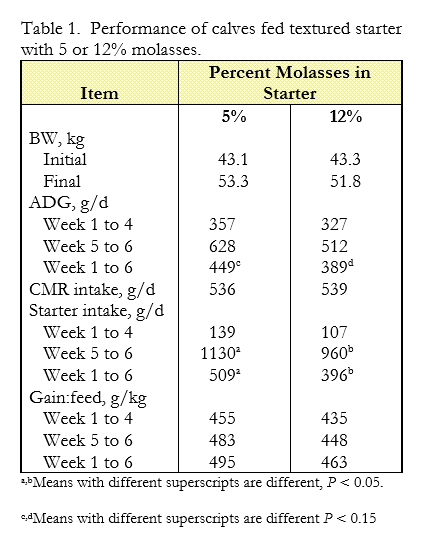
Adding molasses to starter tended to reduce body weight gain and reduced starter intake during the last two weeks of the trial. Overall starter intake (weeks 1 to 4) was also reduced significantly. Calves fed 12% molasses ate 22% less starter than calves fed starter containing 5% molasses. This caused a numerical reduction in gain to feed ratio, but these differences were not statistically significant.
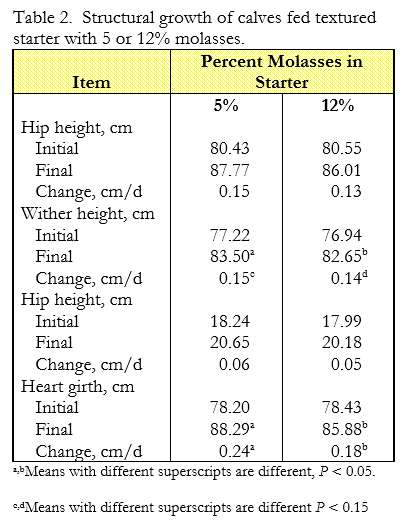
Changes in starter intake and body weight gain were probably responsible for differences in change in wither height and heart girth. Apparently, calves fed starter containing more molasses ate less starter and grew less rapidly. This reduced growth was observed not only in average daily gain, but also in height and width measurements.
Changes in rumen development were less clear. A subset of calves were sacrificed at 4 weeks of age and development of rumen papillae was determined. There were no statistical differences (probably due to the small number of calves), but there calves fed additional molasses tended (P < 0.20) to have longer and wider papillae. Blood VFA (also an index of rumen development) tended (P < 0.15) to be greater in calves fed additional molasses.
Summary
Tendencies for increased blood VFA and development of rumen papillae suggest that the additional molasses added to calf starter was rapidly degraded in the rumen, which increased the rate of rumen development and, thereby, increased blood VFA. However, this was not completely positive, since the added molasses depressed starter intake and growth. Therefore, the addition of large amounts (i.e., 12%) molasses is not recommended in conventional textured calf starters.
References
Lesmeister, K. E. and A. J. Heinrichs. 2005. Effects of adding extra molasses to a texturized calf starter on rumen development, growth characteristics, and blood parameters in neonatal dairy calves. J. Dairy Sci. 88:411–418.