Introduction
Mycoplasma bovis is a bacteria-like organism that causes persistent, chronic infections in calves and cows. It has also been associated with otitis (infection of the ear), pneumonia and arthritis in calves. Calves may become infected with M. bovis by drinking infected milk (the organism causes mastitis in dairy cattle) or direct contact with infected calves.
So, what predisposes calves to infections with M. bovis? A recent article in the Journal of Veterinary Diagnostic Investigations by Lamm et al. (2004) studied the characteristics of calves in California that were diagnosed with disease caused by M. bovis.
The study population was obtained from calves and cattle that were submitted to California Veterinary Medical Teaching Hospital or to the California Animal Health and Food Safety labs. A total of 20,525 animals were reviewed and 61 animals were identified as being positive for M. bovis by the presence of ear infection and positive cultures for the organism. This became the data set of animals that were evaluated in the study. A key objective of the study was to determine the characteristics of calves that were diagnosed as being positive for M. bovis by culturing the ear at necropsy.
Results
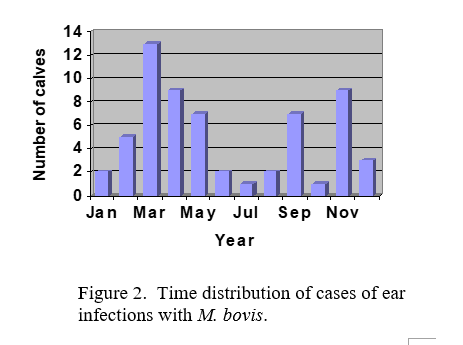
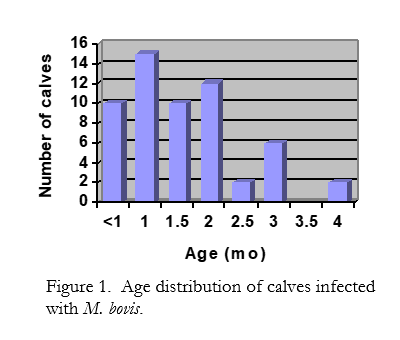
Most of the animals identified as positives were calves in the range of 2 weeks to 4 months of age with 77% of calves being 2 months of age or less (Figure 1). More males were infected with M. bovis than females in this survey. The reasons that more bull calves were infected than heifers is not clear. The authors suggested that more bull calves are fed hospital (waste) milk and, therefore, are at greater risk of infection. Alternatively, bull calves may not have received sufficient colostrum, and therefore, are more susceptible to infection. More calves were positive for M. bovis in March with fewer calves positive in July, so there was a definite seasonality about the observations (Figure 2). The seasonal effect of M. bovis (greater incidence at the end of winter) is consistent with greater rainfall and higher incidence of other diseases (e.g., mastitis) in late winter and spring in California. It’s also possible that greater incidence of mastitis in cows during this time resulted in more contaminated milk, which was subsequently fed to calves. Others (e.g., Martin et al., 1975) have reported increased calf mortality in Tulare, California during mid-summer (June, July, August) and winter (November, December, January) months.
In addition to clinical ear infection, numerous calves had a characteristic head tilt and/or facial nerve paralysis (64% of calves). Other signs included pneumonia (15% of calves), twitching or incoordination. Diarrhea was not typically reported as a clinical sign in these calves. As you monitor the health of your calves, keep in mind the characteristic signs of M. bovis infection. Talk with your vet about the best times for monitoring and any treatment protocol that s/he recommends.
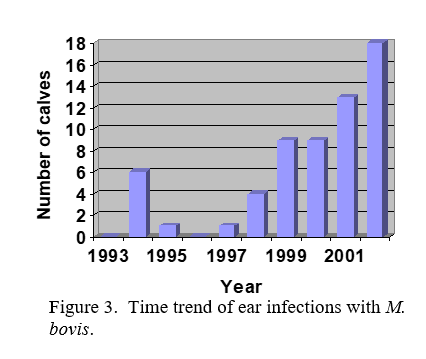
The number of cases increased over time according to the records evaluated in the study. Prior to 1994, there were no cases of M. bovis reported. By 2002, 18 cases were reported (Figure 3). The time trend was statistically significant. The authors suggested that a greater awareness of the disease resulted in more samples being submitted to the diagnostic labs for analysis. Another theory is that a more pathogenic strain of M. bovis developed since 1996.
Mycoplasma bovis has been shown to be transferred to calves by feeding infected mastitic milk. Information on milk feeding practices was available for only some of the calves in this study. Of the 14 herds that provided information on milk feeding, 50% fed non-heat treated milk, 14% fed milk replacer and 36% fed heat-treated milk (hospital milk).
What can you do? Be aware of the clinical signs. Talk with your vet about routes of infection and methods of control. Be aware that waste milk from infected cows is a key method of infection. Here are some web references related to M. bovis infection in calves from the University of California related to the characteristics of mycoplasma and less-known conditions associated with Mycoplasma infections. A nice article on control of mycoplasma infections from the University of Wisconsin is here, also. Finally, an article in the June 2002 issue of Jersey Journal discusses transmission of mycoplasma on the farm. This organism may be an increasing problem on dairy farm and calf ranches. It’s important to be familiar with the signs of the problem and to intervene appropriately. It appears that M. bovis is difficult to treat with antibiotics, so an appropriate plan for intervention is necessary before M. bovis becomes a problem on your farm.
References
Lamm, C, G., L. Munson, M. C. Thurmond, B. C. Barr, and L. W. George. 2004. Mycoplasma otitis in California calves. J. Vet. Diagn. Invest. 16:397-402.
Martin, S. W. C. W. Schwabe, and C. E. Franti. 1975. Dairy calf mortality rate: characteristics of calf mortality rates in Tulare, County, California. Am. J. Vet. Res. 36:1099-1104.