Introduction
We talk a lot about feeding liquid to calves prior to weaning. One obvious source of nutrients is waste milk. Several Calf Notes have discussed the use of waste milk in calf feeding programs, including #08, #35 and #98 which discuss various topics, including the risk of microbial contamination (#35) and the calculating the cost of the stuff (#98).
A study conducted by the University of Wisconsin evaluated the efficacy of on-farm pasteurization of waste milk. The study was reviewed in the April, 2005 issue of Midwest Dairy Business Magazine. The objectives of the study were to determine typical protein and energy content of waste milk; to develop an assay to assess the efficacy of on-farm pasteurizers; and to determine if quality of raw waste milk influences the quality of pasteurized waste milk or the pasteurizing process.
The study
A total of 62 milk samples (31 raw and 31 pasteurized) were evaluated for the presence of several indicators of the quality of pasteurization, including:
- Alkaline phosphatase – an enzyme that is destroyed at pasteurization temperatures
- Plate counts
- Somatic cell counts
- Presence of specific bacteria, including salmonella, E. coli, coliforms, Strep. agalactiae, streptococci, Staph. aureus, total staphylococci, and enterococci.
Samples were also evaluated for chemical composition and presence of antibiotics.
The results
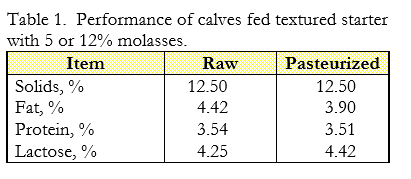
The chemical composition of raw and pasteurized waste milk are in Table 1. Generally, there was a wide variation in the composition of waste milk, particularly between dairies. For example, for waste milk, the range in protein concentration was from 2.89 to 5.10%. Fat ranged from 2.79 to 4.70% in the same samples.
Just as an example, if we feed 5 kg of waste milk (about 11 lbs.) per day to a calf, this range means that the calf could consume from 145 to 255 grams of protein per day – a difference of 176%. Note that this doesn’t measure day to day variation, since samples were taken from different farms on one day.
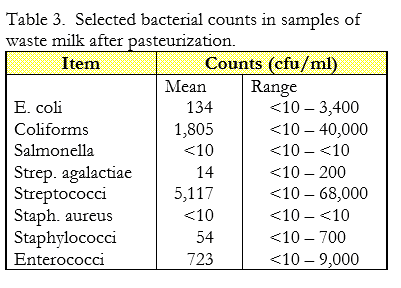
Alkaline phosphatase is a heat-sensitive enzyme that is found in milk. It is destroyed when milk is heated to normal pasteurization temperatures, so it is an indicator of pasteurization in saleable milk. In this study, the enzyme was found in all waste milk samples prior to pasteurization, but in only 4 after pasteurizing. According to the researchers, this was the easiest and quickest indicator of pasteurization that could be used on the farm.
About 65% of the samples of waste milk were positive for antibiotics. There was a similar presence of antibiotics in both raw and pasteurized samples, indicating that pasteurization had little effect on the antibiotics in the waste milk.
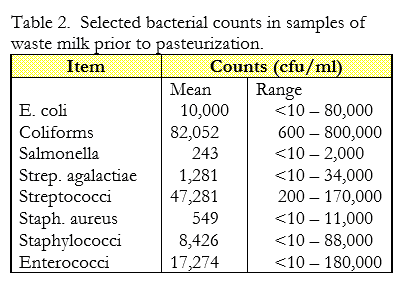
There was huge variation in the counts of bacteria in samples of waste milk prior to pasteurization (Table 2). Somatic cell counts prior to pasteurization averaged 1.8 million/ml and ranged from 110,000 to 3.8 million. Clearly, there was some pretty poor quality waste milk!
Summary
Generally, the pasteurizers used in this survey heated waste milk to temperatures sufficient to denature the indicator enzyme alkaline phosphatase. However, not all pasteurization processes were effective as indicated by residual microbial counts. Also, waste milk had a highly variable nutrient content. Clearly, if waste milk is to be fully utilized, it should be tested routinely for nutrient content prior to feeding.