Introduction
Calf starter quality is important to ensuring good rumen development and to allow early weaning. Calf starters fed to calves may be meals (unpelleted), pelleted or textured type feeds. Ingredients used in calf starters generally reflect the type of starter. Textured feeds, for example, generally contain a pellet, which contains protein, carbohydrate sources plus vitamins and minerals, along with other grains, such as rolled oats and corn.
It is the nature of the corn that is the topic of this Calf Note. There has been a lot of interest to know which type of corn is optimal to promote early and aggressive intake and to allow the calf to be weaned at an early age. Many feed manufacturers use steam-flaked corn (SFC), which is considered highly digestible and palatable to young calves. Many consider it the “gold standard” for calf starters and an indication of a high quality product. Others use rolled corn (RC), which is less expensive than steam-flaked.
Which method of processing is best for calves? Which promotes intake and rumen development? In the October 2004 issue of the Journal of Dairy Science, Lesmeister and Heinrichs reported on a study where four different methods of corn processing were compared in calf starters.
The experiment
Experiment 1. Calves (n = 92; 52 males) were 2 days of age at the start of the study. Calves were fed colostrum prior to the start of the study. Calves were fed a 20% protein, 20% fat calf milk replacer (12.5% DM) at 10% of birth body weight until weaning at 28 days of age. They were housed in a calf barn bedded with shavings.
The researchers measured fecal scores and days scoured, intake and growth (body weight, wither height, hip height and width and heart girth).
Experiment 2. Twelve Holstein calves that were 7 days of age were cannulated for the collection of rumen fluid to measure rumen pH and VFA production. They were fed and managed similarly to that in Experiment 1, except that rumen fluid and blood were collected for determination of rumen and blood VFA, rumen ammonia and pH.
The starters
The calf starters used in the study were all texturized and contained a pellet (46.1%), oats (15.5%), molasses (5.1%) and 33.3% of the experimental processed corn. The corn was either whole corn (density 0.72 kg/L), dried rolled corn (0.76 kg/L), roasted-rolled (0.43 kg/L) or steam-flaked (0.38 kg/L). The roasted corn was processed at 131 C for 90 seconds, hot water conditioned for 15 min, then coarse rolled and cooled. Steam-flaked corn was processed as described in the review by Theurer et al. (1999). Corn was steamed for 30 to 60 min in a chamber to increase grain moisture to 18 to 20% followed by flaking between large rollers to a specific density. Rollers become hot as the steamed grain passes through, which is important in the flaking process.
The results
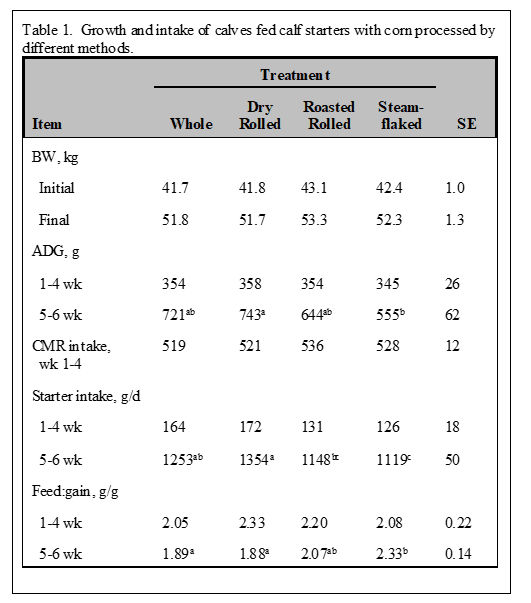
As can be seen in table 1, calves fed whole and dry rolled corn grew faster during the last two weeks of the study (wk 5-6). This increased growth was due to greater starter intake. Calves fed roasted or steam-flaked corn generally ate less starter during the last two weeks and therefore grew slower.
Feed efficiency of calves fed whole or dry rolled corn were also greater compared to other calves.
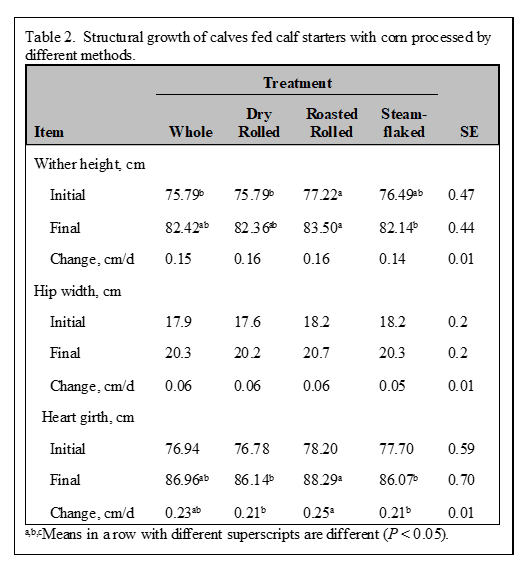
Changes in structural growth (Table 2) were consistent with changes in overall growth but generally were less significant. Change in heart girth was greatest in calves fed roasted rolled and steam flaked corn compared to other treatments.
Rumen development
Lesmeister and Heinrichs suggest that heat processing might influence the site of digestion. Other researchers have also suggested that heat processing increases the amount of post-ruminal energy availability. In this study, it appears that steam flaking may have increased the rate of development of rumen fermentation, since concentrations of rumen and blood VFA tended to be greatest in calves fed steam flaked corn and lowest in calves fed whole corn. It is possible that the rapid rate of rumen fermentation had at least a short-term negative effect on intake and growth during the 5-6 week period (Table 1).
Changes in papillae
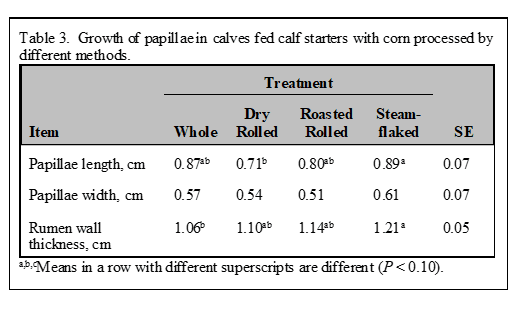
Feeding different forms of processed corn affected development of the rumen wall in different ways (Table 3). There were changes in length of the rumen papillae – greatest when calves were fed steam-flaked corn and least when calves were fed dry rolled corn. Calves fed steam-flaked corn also tended to have greater thickness of the rumen wall compared to calves fed whole corn. These observations suggest that steam flaking made available more readily available carbohydrate that was rapidly fermented to propionate and butyrate, which stimulate the growth of the rumen papillae.
Conclusions
This study clearly shows that ingredient selection and ingredient processing can have a significant effect on how quickly the rumen develops and the effect of available carbohydrate (like that in steam flaked corn) can influence not only development of the rumen, but also intake and growth as well.
There are many good quality calf starters that successfully utilize steam flaked corn. Although it was not tested in this study, it is quite possible that the conditions of processing of the corn used in all treatments in this study affected the rate of fermentation in the rumen, which, in turn, would affect the parameters measured. Other products which use different processing conditions may result in different results. It is also important to keep in mind that this study terminated at 42 days of age. As calves age, their ability to “manage” the rumen environment (e.g., by producing saliva with increased amounts of bicarbonate) improves. They may also have access to forage following weaning, which would also alter the rumen environment. It’s quite possible that the short-term differences in rumen development observed in this study would not be measurable if the calves were followed for a longer period of time.
References
K. E. Lesmeister and A. J. Heinrichs. 2004. Effects of corn processing on growth characteristics, rumen development, and rumen parameters in neonatal dairy calves. J. Dairy Sci. 87:3439–3450.
Theurer, C. B., J. T. Huber, A. Delgado-Elorduy, and R. Wanderley. 1999. Summary of steam-flaking corn or sorghum grain for lactating dairy cows. J. Dairy Sci. 82:1950–1959.