Introduction
Whey protein concentrate (WPC) is one of the most commonly used ingredients in calf milk replacers (CMR) used in the U.S. Amounts used in the formula will vary according to the protein content of the product and availability and cost of alternative ingredients. Dried skim milk, buttermilk, casein and other milk-based ingredients typically do not contribute significantly to milk replacer formulas used in the U.S., but may be used in countries where excess skim milk is available by subsidies. Other CMR formulas may use soy protein to replace WPC to lower cost. Because whey is such an important component of diets for young calves, it’s useful to understand a little about this essential ingredient.
Formulations with WPC
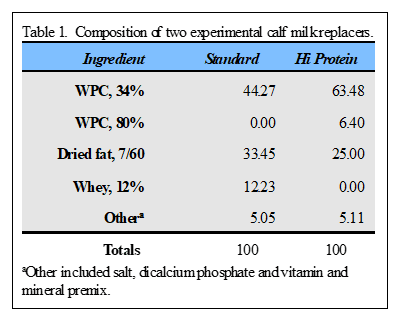
Two formulas used in a recent experiment are in Table 1. Formulas were prepared to contain 20% crude protein and 20% fat (Standard) and 28% protein and 15% fat (Hi Protein). The formulas used both 34% protein WPC and 80% protein WPC. These formulas are quite simple and are probably not typical of more complex commercial formulations. However, they make the point that whey protein concentrate (WPC) can be used as the primary protein ingredient in CMR formulas.
Why WPC?
Whey is a by-product (or co-product) of cheese manufacturing and is produced after coagulation of the casein fraction of milk. The liquid whey (which is about 12% protein on an air-dry basis) is then processed to remove some of the lactose, fat and minerals to produce a product that ranges from 34 to 80% protein (air-dry basis). Whey protein isolate is the most highly concentrated source of whey protein (about 92% CP) and is generally too expensive for use in CMR formulas. For many years, whey was viewed as a waste product with little value. It was spread on fields, onto roads (to control dust) and fed to cattle and pigs. Recent developments in technology have allowed us to begin to take advantage of the many unique proteins in WPC.
Whey protein concentrate is used in CMR formulations due to its high nutritional value (good amino acid profile), excellent digestibility, and relatively low cost. Very young calves (< 3 wk of age) have lower digestive capacity due to the immaturity of the intestine, so digestion of non-milk proteins is limited; therefore, WPC is a logical choice for CMR formulas.
Performance of calves fed WPC
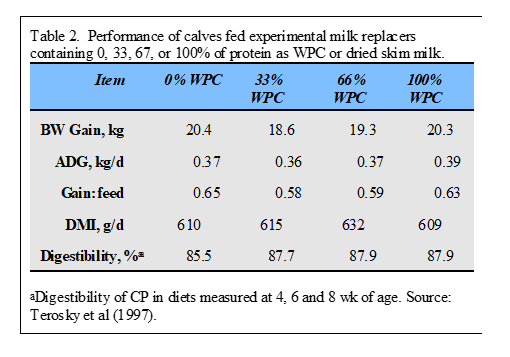
Researchers at Penn State University compared the use of WPC with dried skim milk in two trials. The first (Terosky et al., 1997) fed calves diets containing 0, 33, 66 or 100% of the protein from WPC or dried skim milk. Calves were fed the experimental CMR at 10-12% of body weight to 8 wk of age. Diet digestibility were measured at 4, 6 and 8 wk of age. As can be seen in Table 2, there was no effect of performance of the calves, nor was digestibility affected by various amounts of WPC.
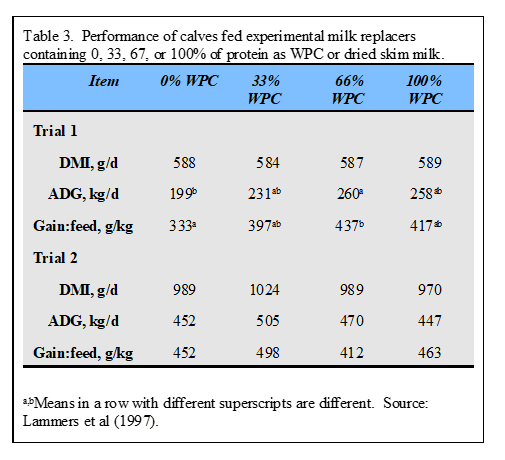
A second trial (Lammers et al., 1998) fed calves similar diets as the previous trial (also at 10-12% of BW) in two trials. In the first, calves were fed only CMR to 6 wk of age. In the second trial, calves were fed CMR plus ad libitum access to calf starter. The results (Table 3) indicated that in trial 1 (when calves only consumed CMR), performance was greater when calves consume 67% or 100% WPC compared to skim milk. On the other hand, when calves were fed calf starter, there was little difference among the four treatments.
In total, these data suggest that WPC is an excellent ingredient in CMR diets. However, we must remember that these diets tested only two lots of WPC (one in each trial) – presumably from a high quality manufacturer. Also, calves in these studies were fed diets at 10 to 12% of body weight. When calves are fed higher protein diets or fed greater amounts of CMR, then variation in amino acid profiles may be more significant to the calf.
What’s in whey protein?
Let’s look at 34% WPC, which is the most commonly used protein ingredient in CMR in the U.S. The typical composition of 34% WPC is (air-dry basis): dry matter = 97%; protein = 34%, lactose = 50%, fat = 3%, ash = 10%.
The primary whey proteins include β-lactoglobulin, α-lactalbumin, immunoglobulins, bovine serum albumin, glycomacropeptide, lactoferrin, lactoperoxidase, and lysozyme. The most abundant proteins are β-lactoglobulin, which comprises about 50% of the whey protein and α-lactalbumin, which comprises about 20-25% of whey protein. Each of these proteins varies in amino acid composition, digestibility and value to the calf. Researchers have shown that different manufacturers produce WPC with somewhat different proportions of each fraction, depending on the process used. Therefore, the value of WPC may vary somewhat due to the source of product and processing.
Variation in whey protein
The amount and types of protein in whey protein concentrate depends on type of cheese manufactured, the culture used and processing conditions of the cheese. Changes in milk composition may also affect WPC quality. Application of excess heat during processing (especially drying) can affect color (presence of scorched particles) and solubility of the powder. The USDA has specific specifications for WPC, which outlines requirements for the product.
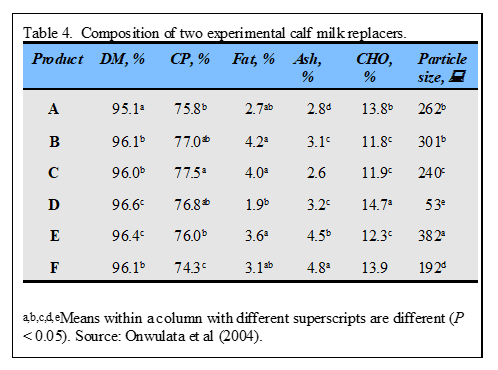
USDA researchers (Onwulata et al., 2004) recently reported the results of a study evaluating six different sources of 80% WPC (a high quality WPC that is used in human food applications). Samples of WPC were obtained commercially and evaluated by proximate analysis, microscopic evaluation and other tests. The authors reported statistically significant differences in protein, fat, moisture, ash, and carbohydrate concentration. The physical characteristics of each sample (e.g., particle size, etc.) varied also. Results of the proximate analysis data are in Table 4. All proximate nutrients varied significantly among different products (manufacturers of each product were not identified in the report). However, there was no indication of the amount of variation among samples from the same manufacturer.
Absolute differences appear small (range of crude protein from 74.3 to 77.5) in this sample of manufacturers. Indeed, calculation of differences in protein intake when included in a CMR indicate only small differences in protein made available to the calf. For example, if a calf is fed 500 grams of CMR powder that contains 15% WPC (80%) and provides a total of 22% crude protein (remaining protein comes from whey and dried fat), then 500 grams x 0.15 x (77.5 – 74.3) / 100] = 2.4 grams of protein difference per day from highest to lowest samples in Table 4. There is probably greater variation in total amounts of protein fed to the calf due to spillage and variation in amount fed.
Samples of WPC that are less highly refined will usually have greater variation in overall characteristics. For example, solubility of 34% WPC samples have been shown to vary from 25 to 82%. The solubility is an index of heat damage – the lower the solubility, the greater the extent of damage. Clearly, samples of WPC with 25% solubility will be unacceptable ingredients in CMR formulas. Not every lot of WPC will meet specifications for nutrients (e.g., moisture, ash, protein), color, solubility and microbiological specifications. So, every commercial CMR manufacturer has an intensive quality assurance program to test incoming ingredients to ensure that they meet their specifications.
Mineral content of WPC can also vary. Total ash content of WPC may vary from <1% in highly purified products to over 12%. Of course, some of this ash may be useful in providing essential minerals (e.g., Ca) to the calf, but some ash may be acids added during processing. Also, German researchers (Kamphues and others) found that the amount of sulfate in whey products varied from 0.3 and 43 g/kg of DM and commercial CMR formulas ranged from 2 to 12 g SO4/kg of DM. Higher amounts of sulfate in the CMR resulted in greater number of calves with diarrhea. These data would suggest that ash or profile of minerals in samples of WPC used in CMR formulations would be essential in reducing variability in animal performance.
Other uses for whey protein
For many years, whey was considered a waste product and CMR manufacturers had access to unlimited amounts of cheap whey and WPC. Developments in isolation of components of whey (proteins, lactose) and the recognition of the nutritional quality of WPC for human consumption has spawned a growing market for WPC and whey protein isolate for human applications. Whey proteins are used for their functional properties in various food applications. Whey proteins can be used for gel formation, to change the solubility of the protein matrix (emulsification), and to produce foaming.
Recent research has also shown that several whey proteins support the immune system in humans and animals, which makes these proteins increasingly attractive. A quick search of the Internet will show you myriad web sites hawking human-grade whey protein concentrates for improved body building and health.
Effects on CMR formulations
The normal variation in WPC nutrient content should not be a significant concern if you purchase commercial CMR from a reputable manufacturer. On the other hand, if you purchase whey or WPC for use in an on-farm formula, the variation in WPC quality should be a consideration. If you purchase WPC, you should have a quality assurance program in place to test incoming shipments for key nutrients (ash, moisture, protein), organoleptic qualities (e.g., odor, color), solubility and microbial load. Every load should be tested to make sure that it passes and retain samples should be kept. If you don’t have the resources to establish a QA lab, there are a number of commercial labs that can set up a program with you. Best of luck!
References
- Heinrichs, A. J. S. J. Wells and W. C. Losinger. 1995. A study of the use of milk replacers for dairy calves the United States. J. Dairy Sci. 78:2831-2837.
- Lammers, B. P. A. J. Heinrichs, and A. Aydin. 1998. The effect of whey protein concentrate or dried skim milk in milk replacer on calf performance and blood metabolites. J. Dairy Sci. 81:1940–1945.
- Onwulata, C. I., R. P. Konstance, and P. M. Tomasula. 2004. Minimizing variations in functionality of whey protein concentrates from different sources. J. Dairy Sci. 87:749-756.
- Terosky, T. L. , A. J. Heinrichs, and L. L. Wilson. 1997. A comparison of milk protein sources in diets of calves up to eight weeks of age. J Dairy Sci. 80:2977-2983.