Introduction
It is in the best interest of every calf producer to raise and market calves that are top quality and free from unacceptable levels of growth promoters and antibiotics. Unfortunately, with very young calves, this can sometimes be easier said than done. However, it’s important (and the law) to carefully monitor the types of feeds used and adhere to requirements for withholding periods to minimize the risk of violative residues.
A recent FDA Update indicated that in 2003, more than 1,800 residue violations were reported to FDA for enforcement action. The largest proportion of these violations (44%) were caused by neomycin residues in bob veal.
Bob veal
Bob veal is defined as calves from a few days to 150 lbs. that are fed primarily milk-based diets.
Source of residues
So, where do these residues come from? The answer is simple – from medicated milk replacer. According to FDA, four states (Pennsylvania, New York, Maryland, Ohio, and Virginia) were responsible for over 90% of all these violations. In just so happens that a greater proportion of producers in these states feed medicated milk replacer versus non-medicated milk replacer (Heinrichs et al., 1995).
Farms and Sampling
Farms used in the study were located in Pennsylvania (3 farms), Vermont, New York, Maryland, North Carolina and Florida (2 farms each). A total of 971 fecal samples were collected from different calves by collecting feces directly from the calf and determining the specific cryptosporidial species present in the sample (if any). Samples were transported to the laboratory and then evaluated for the presence of oocysts and then the species of the specific organism was determined.
Calves ranged from 5 days of age to 2 months. The fecal samples were collected over a two year period (2002 and 2003). Farms were randomly selected, so they represented a wide variety of management, feeding, housing and biosecurity practices typical of both large and small dairy farms in the Eastern U.S.
Results
The most important observation made during the study was that the researchers found cryptosporidium oocysts in feces of calves on every farm studied. This confirms previous reports from various researchers that crypto is a very common enteric organism in calves. Most of the positive samples (73%) were found in preweaned calves (defined in the study as calves less than two months of age). Prior to weaning, most (about 86%) of the crypto observed was C. parvum, which is the species that typically causes diarrhea in calves and humans. After weaning, however, very littleC. parvum was observed (about 1% of samples positive for crypto contained C. parvum). Other species of crypto, including C. Bovine B, C. deer-like and C. andersoni were more prevalent in older calves.
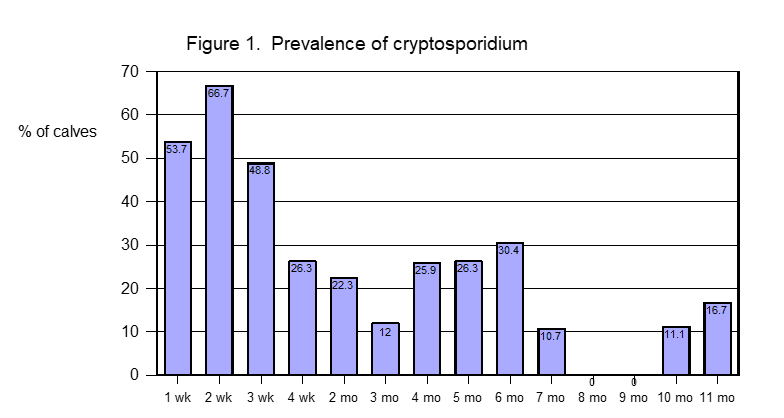
The prevalence of calves that had feces containing crypto oocysts is in Figure 1. As you can see, the greatest prevalence occurred in the first two weeks of life and then declined to 8 to 9 months. It’s important to note that after two months of age, C. parvum (the parasite that causes diarrhea) was not typically found in fecal samples from calves.
This study has a lot of practical implications. Since C. parvum is the most common pathogen that causes diarrhea in young calves, this report may assist us in management of calves to minimize the effects of infection.
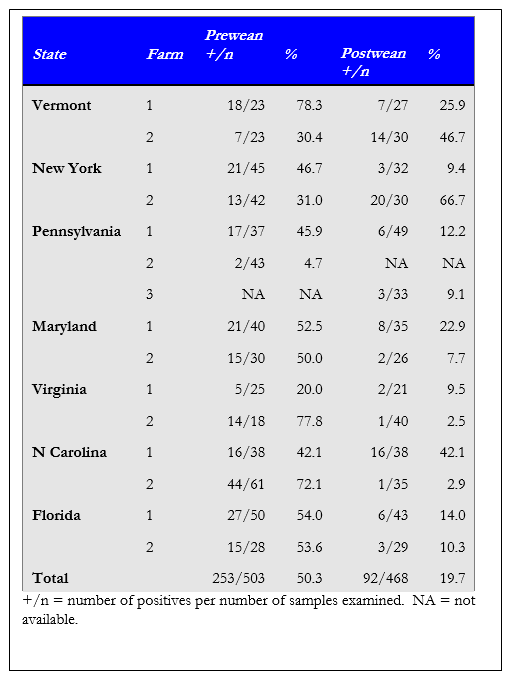
Cryptosporidium was found on every farm tested. It occurred regardless of method of housing (hutches, barns, pens), management or biosecurity practices. However, there were large differences in prevalence among farms – one Pennsylvania had only 4.7% of samples tested positive (2 samples of 43 tested), whereas three farms (one each in Vermont, Virginia, and North Carolina) had more than 70% of samples from calves positive for cryptosporidium. Clearly, there are factors that influence the prevalence of the organism on the farm. Generally, these would include a high degree of sanitation, separation of the calf from the calving environment shortly after birth and separation of management of cows and calves.
Also, the presence of crypto on farms prior to weaning does not appear to affect presence after weaning. Two of the farms with the greatest percent of positive samples prior to weaning (see table) had lowest percent positive in samples tested after weaning. However, there does not appear to be other research that suggests a relationship (or lack thereof) of pre-weaning and post-weaning prevalence of crypto.
The data also indicate that although we normally consider cryptosporidium a problem of very young calves, there is the chance that calves will become infected with crypto species (not C. parvum) later in life. Indeed, the peak post-weaning prevalence occurred at six months of age in this study. However, the effects (if any) of these infections later in life with species other than C. parvum is not clear.
The Bottom Line
The data in this useful paper reiterate the importance of cryptosporidium, but especially C. parvum on the health of young calves. It is most common in very young calves – prior to four weeks of age. After weaning, crypto infections do occur, but implications of these infections is not clear.
The wide differences in prevalence of C. parvum in young calves on dairy farms suggests that there are practices that can reduce the risk of infection. However, this particular paper did not set out to determine those factors. On the other hand, other researchers indicate that crypto is found on most, if not all, dairy farms where calves are raised. Calves as young as 2 to 7 days of age have been shown to shed the organism, which indicates that infection occurred very early in life. The maternity area and dam are normally considered reservoirs of infection, which is one reason that diligent sanitation of the calving area and prompt separation of calf from the cow is so important.
The USDA National Animal Health Monitoring System web site has some excellent background on cryptosporidium and infections on dairy farms. Check out their web site for more information. In addition, several issues of Calving Ease address the issue.
References
Heinrichs, A. J., S. J. Wells and W. C. Losinger. 1995. A study of the use of milk replacers for dairy calves in the United States. J. Dairy Sci. 78:2831-2837.