Introduction
Oligosaccharides are a class of carbohydrates that are not absorbed or digested in the small intestine of man and animals. Therefore, oligosaccharides reach the colon unaltered. In the colon, oligosaccharides are readily fermented by the intestinal microflora. This may result in changes in this flora, thereby increasing the number of (potential) beneficial microorganisms, while repressing the number of (potential) harmful bacteria. This possible change in the intestinal flora may be beneficial to the health of man and animal. In addition, the production of VFA by bacteria fermenting oligosaccharides in animals may improve energy efficiency and alter (improve) intestinal morphology. These changes in the microbiology and chemistry of the large intestine is, in large part, the method of action of oligosaccharides.
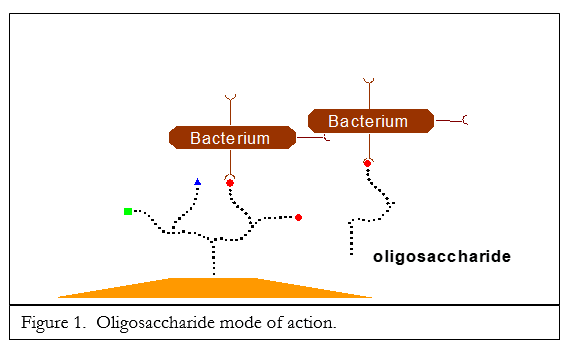
Oligosaccharides have also been shown to reduce the binding of pathogens in the intestine of animals. The theory of this action is shown in Figure 1. Certain bacteria attach to intestinal epithelium (cell surface) using mannose specific attachments called fimbrae. In Figure 1, fimbrae are shown as chains with attachments shown as a red ball. Oligosaccharides resemble the fimbrae, which serves as a “decoy” attachment. Bacteria that attach to the oral oligosaccharide do not attach to the intestinal epithelium, thereby reducing the risk of infection.
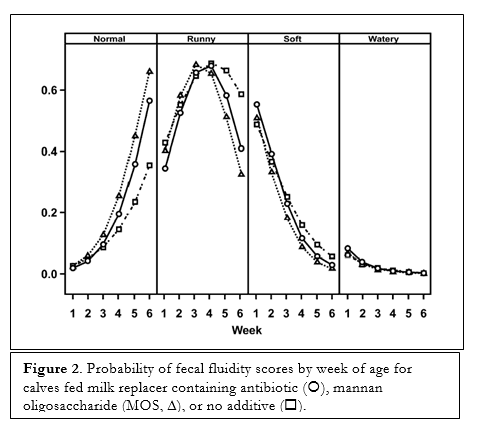
Several classes of oligosaccharides are found in nature — fructooligosaccharides, mannanoligosaccharides, galactooligosaccharides, glucooligosaccharides and others. Others are produced chemically and are used as functional foods, or prebiotics. These products are available for inclusion in milk replacer or calf starter diets. Most commonly available oligosaccharides are fructooligosaccharide (FOS) and mannanoligosaccharide (MOS). Products are available and have been tested in a wide number of animals species, including calves. Fairchild et al. (2001) reported improved health and growth of poultry when challenged with E. coli and fed Bio-Mos (Alltech, Inc., Nicholasville, KY). Heinrichs et al. (2003) recently reported that addition of Bio-Mos to milk replacer improved intake and reduced scours in calves as can be seen in Figure 2. Another potential product includes galactosyl-lactose, which has been shown to reduce scours and improve growth in calves (Quigley et al., 1997).
Oligosaccharides have been added to calf milk replacers to reduce the potential growth of enteric pathogens and to promote the growth of “beneficial” bacteria. While data with milk-fed calves is generally scarce, results in other species (pigs, humans, pets) suggests that inclusion of oligosaccharides can alter populations of bacteria and improve or stabilize enteric health of calves.
Should you use oligosaccharides?
A number of calf feed supplements contain oligosaccharides – either FOS or MOS. Most are added to milk replacers to provide an effective dose of 2 to 10 grams of oligosaccharides per day. Many of these products contain other additives such as added vitamins and minerals or antibodies. The cost of the products can range from a few pennies per calf daily to as much as $0.40/calf daily.
Oligosaccharides are most likely to be effective when bacterial pathogens are a problem on the farm. Before you make the decision to use these products, it is important to determine if bacterial pathogens are the cause of your calf problems. Also, it is important to consider other options to reduce pathogen load – such as cleaning and disinfection.
It is important to ensure that an active dose of oligosaccharide is provided in each dose of product. Unfortunately, many products include a dose of product that is too small to have activity in the calf. If you have any doubts, ask your feed supplier.
References
- Fairchild, A.S., J. L. Grimes, F. T. Jones, M. J. Wineland, F. W. Edens, and A. E. Sefton. 2001. Effects of hen age, Bio-Mos, and Flavomycin on poult susceptibility to oral Escherichia coli challenge. Poult. Sci. 80:562-571.
- Heinrichs, A. J., C. M. Jones, and B. S. Heinrichs. 2003. Effects of mannan oligosaccharide or antibiotics in neonatal diets on health and growth of dairy calves. J. Dairy Sci. 86:4064–4069.
- Quigley, J. D., III, J. J. Drewry, L. M. Murray, and S. J. Ivey. 1997. Body weight gain, feed efficiency, and fecal scores of dairy calves in response to galactosyl-lactose or antibiotics in milk replacers. J. Dairy Sci.80:1751‑1754.