Introduction
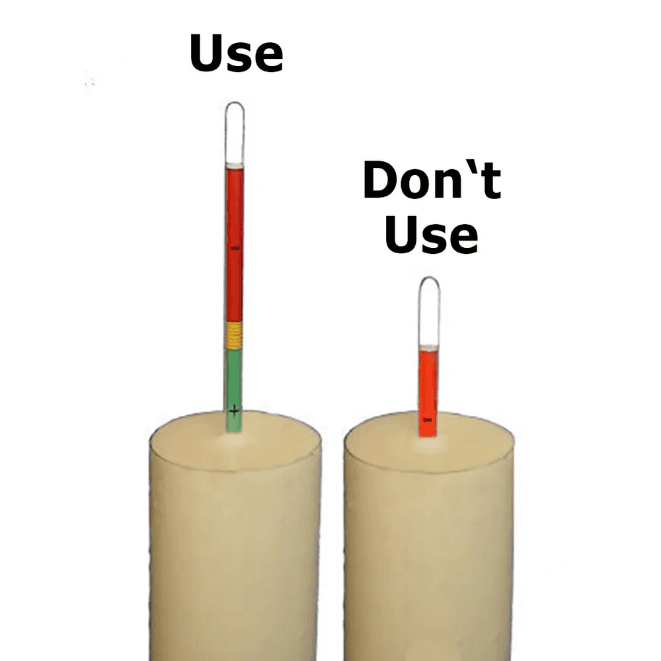
For many years, dairy producers had a relatively simple system for evaluating colostrum. We used a colostrometer, floated it in a container of colostrum, and looked at the color. Colostrum that measured more than about 50 g of IgG/L was in the green zone and was considered “good quality.” Colostrum below that concentration was considered marginal or poor. The recommendation to feed about 2 L soon after birth, followed by another 2 L several hours later, was common, and the goal was to get enough IgG into the calf to achieve successful passive transfer.
At the time, successful passive transfer was also defined by a simple breakpoint. Calves with serum IgG concentrations of at least 10 g/L were considered to have adequate passive transfer, whereas calves below 10 g/L were classified as having failure of passive transfer. Thus, we had a qualitative breakpoint for the colostrum and another qualitative breakpoint for the calf. If the colostrum was “good,” we fed enough of it early enough, and serum IgG exceeded 10 g/L, the program had worked. The system was easy to understand and, more importantly, it fit reasonably well with the goals we had at the time.
Let’s do the math
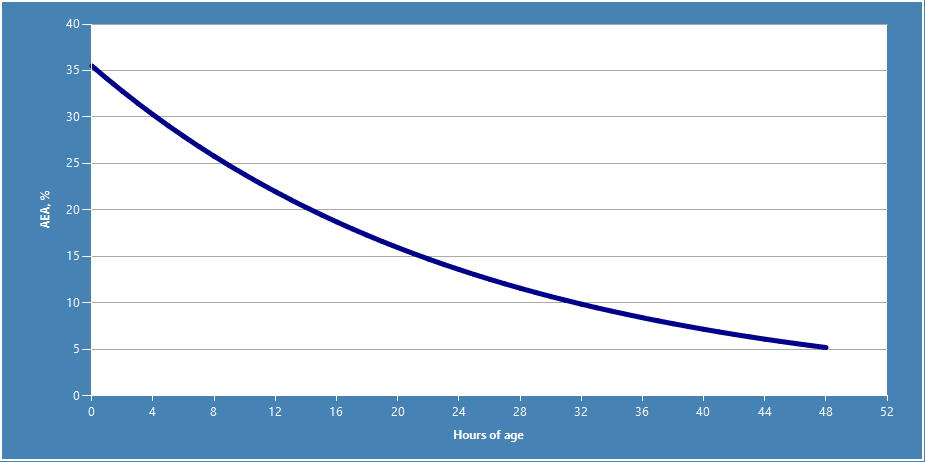
Consider a 40-kg Holstein calf fed 2 L of colostrum containing exactly 50 g of IgG/L at 2 hours of age and another 2 L of the same colostrum at 12 hours. Each feeding supplies 100 g of IgG, so total IgG intake is 200 g. Of course, the calf does not absorb all 200 g, and absorption is more efficient at the first feeding than at the second. Using the relationship between age, cumulative IgG intake, and apparent efficiency of absorption shown in Figure 2, predicted AEA is about 38.2% for the first feeding and 23.1% for the second.
The first 100 g of IgG therefore contributes about 38.2 g of absorbed IgG, and the second contributes another 23.1 g, for a total of approximately 61.3 g entering the circulation. If plasma volume is estimated as 8.9% of body weight, our 40-kg calf has a plasma volume of about 3.56 L. The resulting predicted serum IgG concentration is therefore about 17.2 g/L.
Under our traditional definition of successful passive transfer, this is a very satisfactory result. The calf is well above the old 10-g/L breakpoint. We fed “good-quality” colostrum twice, supplied 200 g of IgG, and achieved successful passive transfer. There was little reason to question either the feeding program or the definition of good-quality colostrum.
Then the goal changed
The consensus recommendations published by Lombard and colleagues in 2020 changed how we think about passive immunity. Instead of simply separating calves above and below 10 g/L, the recommendations defined four categories of serum IgG: Excellent at ≥25 g/L, Good at 18.0 to 24.9 g/L, Fair at 10.0 to 17.9 g/L, and Poor at <10 g/L. More importantly, these categories were accompanied by herd-level targets. The recommendation was for more than 40% of calves to be Excellent, approximately 30% Good, approximately 20% Fair, and fewer than 10% Poor.
Our 40-kg calf has not changed, nor has the colostrum feeding program. However, the predicted serum IgG concentration of 17.2 g/L now places that calf in the Fair category. A feeding program that looked quite successful when 10 g/L was the primary goal looks much less satisfactory when we want a substantial proportion of the herd to exceed 25 g/L. The important change was not in the biology of IgG absorption; it was in our understanding of the serum IgG concentrations associated with better herd-level outcomes.
This raises an interesting question about the other breakpoint in our traditional system. If 50 g/L is the concentration that defines “good-quality” colostrum, why does a quite reasonable feeding program using that colostrum produce only 17.2 g/L of serum IgG in our example calf? The problem is not that 17.2 g/L represents failure of passive transfer. It does not. The problem is that our definition of a successful colostrum program has changed, whereas our definition of good-quality colostrum has remained essentially where it was.
We could simply feed more
One obvious solution is to feed more of the 50-g/L colostrum. Using the same calf, the same ages at feeding, and the same assumptions about IgG absorption, we can calculate how much would be required for predicted serum IgG to reach 25 g/L. If equal quantities are fed at 2 and 12 hours, approximately 3.3 L at each feeding, or about 6.6 L total, are required. The calf would consume approximately 329 g of IgG.
The calculation is useful, but I don’t think its primary lesson is that we should routinely feed 6.6 L of colostrum to every 40-kg calf. In fact, recent research gives us good reasons to be cautious about solving every passive immunity problem simply by increasing feeding volume. The calculation instead illustrates the weakness in the terminology. If we need to feed 6.6 L of something called “good-quality colostrum” to get a representative calf to the lower boundary of the Excellent category, perhaps the term “good quality” is not telling us what we think it is telling us.
There is also an important distinction between getting the predicted serum IgG of one representative calf to 25 g/L and achieving the herd-level targets proposed by Lombard et al. Calves vary in body weight, IgG absorption, age at feeding, physiological condition, colostrum intake, and other factors. Designing a feeding program that produces a predicted value of exactly 25 g/L does not mean that more than 40% of calves in a herd will necessarily exceed 25 g/L. A practical herd program needs some allowance for this biological variation.
Is more always better?
This question has received increasing attention recently. Sockett and colleagues at the University of Wisconsin–Madison suggested in 2023 that smaller quantities of colostrum with greater IgG concentrations might be preferable to simply feeding large volumes. Their work with BRIX refractometry proposed using higher BRIX categories to identify colostrum likely to contain larger minimum concentrations of IgG and specifically raised the possibility of feeding 2 to 3 L of more concentrated colostrum rather than routinely feeding larger volumes.
The concern became much more tangible in a 2024 case report from Sockett and colleagues. A Holstein calf weighing approximately 38.5 kg was tube-fed 4 L of colostrum about 30 minutes after birth and another 2 L six hours later. The calf subsequently developed severe abdominal distension and colic, and postmortem examination identified a very large, firm colostrum curd in the abomasum. This was a case report and should be interpreted as such; it does not tell us how frequently this occurs. However, it demonstrates that there can be physiological limits to how much colostrum we should attempt to put into a newborn calf over a short period.
More direct evidence came from Frederick and colleagues in 2025. In a controlled experiment with 88 Holstein calves, calves received a single colostrum feeding equal to 6, 8, 10, or 12% of birth body weight. Serum IgG increased as more colostrum was fed, but AEA declined progressively from 47.8 and 46.2% in calves fed 6 and 8% of birth weight to 41.0 and 36.3% in calves fed 10 and 12%. Gastric emptying was also slower at the larger feeding volumes, and colic-like kicking behavior was observed only in the 10 and 12% groups. The authors concluded that feeding approximately 8 to 10% of birth weight represented a reasonable compromise among serum IgG, absorption efficiency, gastric emptying, and calf behavior.
These observations have also begun to appear in Extension and popular dairy publications. Wisconsin Extension has explicitly suggested reconsidering very large colostrum meals and emphasized delivering an adequate mass of IgG in a smaller volume, and a 2025 Farm Progress article discussing the work of Sockett and Ryan Breuer made the same argument. The point is not that the industry was wrong to encourage producers to feed more colostrum. Underfeeding colostrum has caused enormous problems over the years. Rather, the emerging question is whether increasing volume indefinitely is the best way to increase IgG intake.
So, what does “50 g/L” actually tell us?
There is nothing biologically magical about 50 g/L. A calf does not treat colostrum containing 49 g/L as poor and colostrum containing 51 g/L as good. IgG concentration is continuous, as are IgG intake, AEA, and serum IgG concentration. The 50-g/L value was a useful management threshold because it simplified a complicated biological process into something that could be measured easily on the farm.
The BRIX refractometer has largely replaced the colostrometer, but we often use it in much the same way. A reading near 22% BRIX has commonly been interpreted as the dividing line between acceptable and unacceptable colostrum because it has been associated with approximately 50 g/L of IgG. That is convenient, but it again converts a continuous measurement into a yes-or-no decision. A reading of 21.8 does not suddenly make colostrum biologically unsuitable, nor does 22.2 guarantee that the colostrum will provide enough IgG for a particular calf and feeding program.
There is another reason to be cautious about converting an individual BRIX measurement directly into an exact IgG concentration. Sockett et al. reported a strong overall relationship between BRIX and laboratory-measured IgG, but the prediction error for an individual sample was large. They proposed that BRIX values of approximately 19, 22, 25, and 30% could instead be used as practical thresholds indicating minimum IgG concentrations of approximately 25, 50, 75, and 100 g/L, respectively. That approach is interesting because it begins to move us away from a single definition of “good” and toward using the information contained in the measurement.
From judging colostrum to managing a program
Perhaps the useful question is no longer whether a particular container of colostrum is good or bad. We can measure its BRIX value, consider how much IgG it is likely to provide, decide how much to feed and when to feed it, and then determine whether the resulting program achieves the distribution of serum IgG concentrations that we want in the herd. Colostrum containing 50 g/L of IgG may be perfectly useful, but its usefulness depends on the amount available, calf body weight, timing of feeding, and the passive immunity goal we are trying to achieve.
This also changes the role of BRIX measurement. Instead of using the refractometer simply to sort colostrum into two piles—good and bad—we can retain the measured value and use higher-BRIX colostrum strategically. Colostrum containing substantially more IgG allows us to deliver a greater mass of IgG without necessarily increasing meal volume, which may become increasingly important as we try to achieve higher serum IgG concentrations without exceeding the comfortable or physiological capacity of the newborn calf.
The old 50-g/L definition was useful, and it helped improve colostrum management enormously. However, it was developed in an era when our principal goal was to prevent serum IgG from falling below 10 g/L. We now have more ambitious herd-level goals, better tools for measuring colostrum, and a better appreciation of the effects of feeding volume, timing, and variation among calves. It seems reasonable that the way we describe colostrum should evolve as well.
For now, my suggestion is simple: don’t become too attached to the words “good-quality colostrum.” Measure the BRIX value, know how much the calf receives and when it receives it, and monitor serum IgG or serum BRIX in the herd to determine whether the overall program is achieving the desired passive immunity profile. A qualitative breakpoint such as 50 g/L—or its approximate BRIX equivalent—cannot answer that question by itself.
If 50 g/L is no longer an adequate definition of “good-quality” colostrum, then what should good quality mean? We’ll consider that question in the next Calf Note.
References
Frederick, G., M. Wieland, A. Singh, R. Ewing, M. A. Steele, H. Somula, and S. Mann. 2025. Effects of feeding colostrum volume at 6%, 8%, 10%, or 12% of birth body weight on efficiency of immunoglobulin G absorption, gastric emptying, and postfeeding behavior in Holstein calves. J. Dairy Sci. 108:13680–13690. doi:10.3168/jds.2025-27228.
Lombard, J., N. Urie, F. Garry, S. Godden, J. Quigley, T. Earleywine, S. McGuirk, D. Moore, M. Branan, M. Chamorro, G. Smith, C. Shivley, D. Catherman, D. Haines, A. J. Heinrichs, R. James, J. Maas, and K. Sterner. 2020. Consensus recommendations on calf- and herd-level passive immunity in dairy calves in the United States. J. Dairy Sci. 103:7611–7624. doi:10.3168/jds.2019-17955.
Sockett, D., R. M. Breuer, L. W. Smith, N. S. Keuler, and T. Earleywine. 2023. Investigation of BRIX refractometry for estimating bovine colostrum immunoglobulin G concentration. Front. Vet. Sci. 10:1240227. doi:10.3389/fvets.2023.1240227.
Sockett, D. C., A. E. Pohly, K. M. Deering, and R. M. Breuer. 2024. Severe colic in a newborn dairy calf caused by a large colostrum curd: a case report. Front. Vet. Sci. 11:1348084. doi:10.3389/fvets.2024.1348084.