Introduction
Blood beta-hydroxybutyrate (BHB; also reported as BHBA) is commonly used as an indicator of rumen development in young calves. That interpretation is useful, but it can be too simple. BHB does not rise only because microbes in the rumen have begun to ferment starter and produce butyrate. For BHB to appear in blood, the rumen epithelium must also develop the structure and metabolic machinery needed to absorb and metabolize volatile fatty acids (VFA). In this sense, blood BHB reflects a sequence of events occurring in the rumen wall itself.
A useful way to think about this development is in three related parts. First, the absorptive surface of the rumen increases as papillae grow. Second, the epithelium develops greater capacity to move VFA from the rumen lumen into and through the epithelial cells. Third, the epithelial cells become increasingly capable of metabolizing butyrate to ketone bodies, particularly BHB. Butyrate participates in all three processes, although the evidence suggests that not every part of epithelial maturation is simply ‘turned on’ by butyrate.
Papillary growth
At birth, the rumen is small and the epithelial surface is relatively undeveloped. The papillae are short, and the amount of surface available for absorption is limited. As calves begin to consume starter, microbial fermentation increases and the concentration of VFA in the rumen rises. Butyrate and propionate have long been recognized as important stimulators of rumen mucosal development, with butyrate generally producing the stronger response.
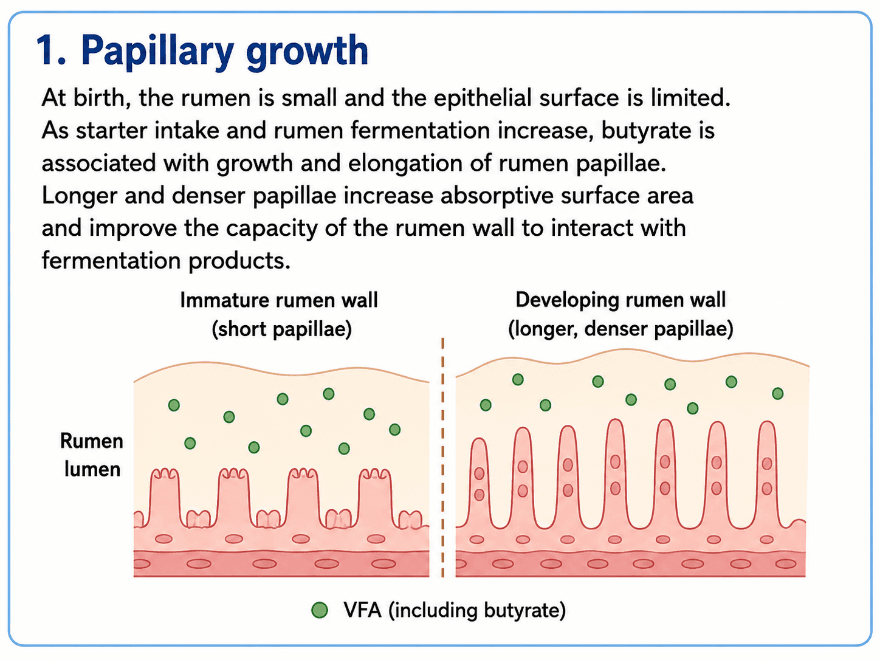
The classic experiments of Sander et al. (1959) showed that supplying butyrate or propionate directly to the rumen stimulated papillary development in young ruminants. Later work helped explain how this occurs. Mentschel et al. (2001), for example, reported markedly greater papillary length in calves receiving butyrate and concluded that one important mechanism was a reduction in epithelial-cell apoptosis. Thus, butyrate affects the balance between cell proliferation and cell loss and, in doing so, changes the size of the absorptive surface.
This structural change matters because rumen development is not simply an increase in organ size. Longer and more numerous papillae greatly increase contact between rumen contents and the epithelium. The result is a larger surface through which fermentation products can be absorbed. Starter intake therefore contributes to rumen development not only by providing nutrients to the calf, but by providing fermentable substrate that generates the metabolites to which the rumen wall must adapt.
VFA transport
Producing VFA in the rumen is only part of the process. Acetate, propionate, and butyrate must cross the rumen epithelium before they can be used by the calf. Some VFA can cross membranes in the undissociated form, but transporter-mediated movement and intracellular acid-base regulation are also important. The mature rumen wall is therefore not simply larger than the neonatal rumen wall; it is functionally better equipped to handle a large and continuous flux of fermentation products.
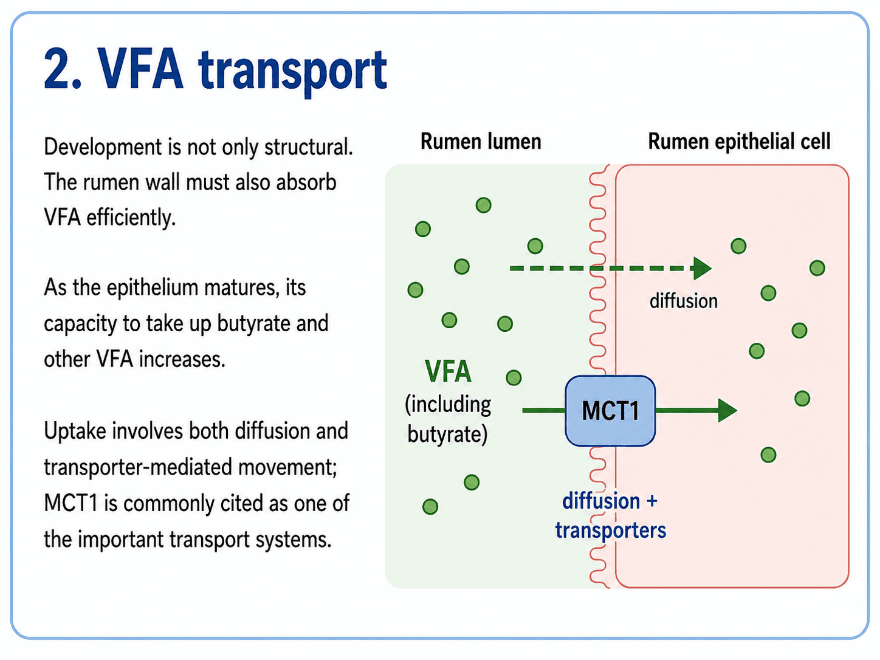
Monocarboxylate transporter 1 (MCT1) is one of the transport systems that has received considerable attention in rumen epithelium. Other transport and pH-regulating proteins also participate, including additional monocarboxylate transporters, anion exchangers, sodium/hydrogen exchangers, and proton-handling systems. The important point for the calf is not the name of any one transporter, but that transport capacity changes as the rumen matures.
The response to butyrate can be seen experimentally. Liu et al. (2019) infused sodium butyrate into neonatal lambs from 10 to 49 days of age. In addition to greater papillary length, width, and surface area, butyrate increased expression of MCT1 and DRA, genes involved in epithelial VFA transport. The experiment is especially useful because it connects the structural response to butyrate with a functional response of the epithelium. The rumen wall was not merely becoming larger; it was also increasing its capacity to move fermentation products.
This distinction is important when interpreting blood BHB. A calf may produce butyrate in the rumen, but the amount of BHB appearing in blood also depends on how much epithelial tissue is present and how effectively that tissue takes up and metabolizes the butyrate. Blood BHB therefore reflects more than the concentration of one fermentation product in rumen fluid.
Ketogenesis
Once butyrate enters a rumen epithelial cell, much of it is metabolized before it ever reaches the circulation as butyrate. The mature rumen epithelium is highly ketogenic. Butyrate is activated to butyryl-CoA and oxidized through mitochondrial pathways that generate acetyl-CoA and acetoacetyl-CoA. Acetoacetyl-CoA is then converted through the HMG-CoA pathway to acetoacetate, which can be reduced to BHB. The result is that a substantial portion of absorbed butyrate leaves the rumen wall as ketone bodies rather than as unchanged butyrate.
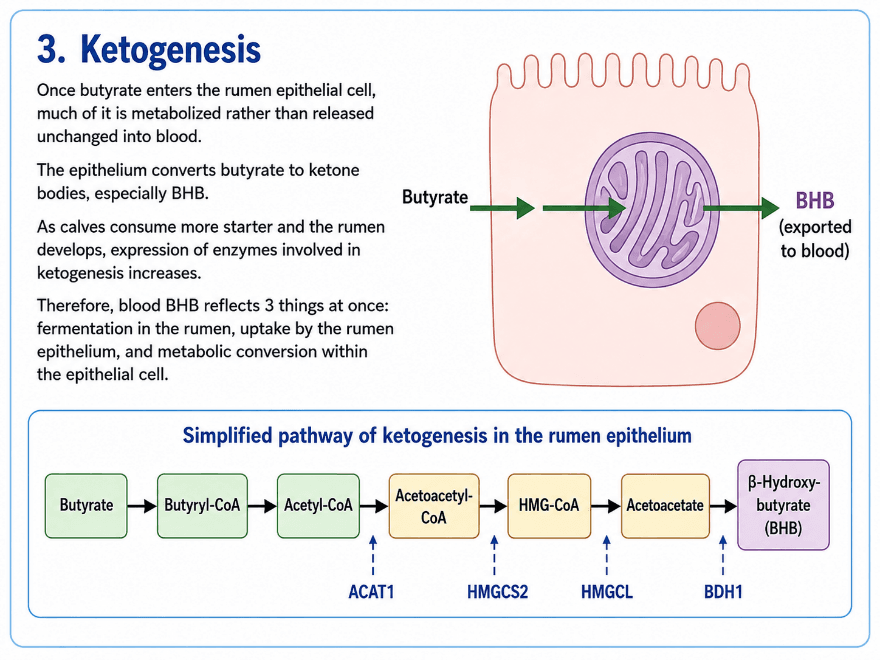
Several enzymes are useful markers of this ketogenic capacity. Acetyl-CoA acetyltransferase (ACAT1) participates in formation and interconversion of acetyl-CoA and acetoacetyl-CoA. Mitochondrial 3-hydroxy-3-methylglutaryl-CoA synthase (HMGCS2) is a central control point in ketogenesis, and HMG-CoA lyase (HMGCL) produces acetoacetate from HMG-CoA. Beta-hydroxybutyrate dehydrogenase (BDH1) catalyzes the reversible conversion between acetoacetate and BHB.
Butyrate exposure can increase the expression of at least some of this machinery. In the Liu et al. (2019) experiment, sodium butyrate increased expression of HMGCS2 and HMGCL in rumen epithelium, along with the increase in blood BHB. This supports the idea that butyrate acts as both a substrate and a signal associated with increasing ketogenic capacity.
As discussed in Part 1 (Calf Note #281), development of ketogenic capacity is not entirely dependent on ruminal butyrate exposure. Studies in milk-fed lambs showed that expression and activity of ketogenic enzymes increased substantially with age even when normal ruminal fermentation was minimized. Thus, butyrate appears to stimulate and accelerate an underlying developmental process rather than acting as its sole trigger.
Thus, it is probably too strong to say that butyrate simply induces the entire ketogenic pathway. A better model is that epithelial maturation contains an age-dependent developmental component, while butyrate and other products of fermentation stimulate, accelerate, and shape that maturation. The distinction becomes important when we use BHB as a biological indicator.
Putting the three pieces together
Papillary growth, VFA transport, and ketogenesis are closely connected. Increasing starter intake increases fermentation and the supply of butyrate. Butyrate promotes growth of the papillae, expanding absorptive surface area. At the same time, the epithelium develops greater capacity to transport VFA and to maintain intracellular pH while doing so. Once inside the cell, butyrate is increasingly routed through ketogenic metabolism to acetoacetate and BHB.
This is why blood BHB is a useful indicator of rumen development. It integrates several events that must occur together: fermentation must be producing butyrate; there must be enough functional epithelial surface to absorb it; and the epithelial cells must possess the metabolic capacity to convert it to ketone bodies. An increase in blood BHB therefore tells us more than ‘the calf is fermenting starter.’ It tells us that the calf is moving toward the metabolic phenotype of a functioning ruminant.
At the same time, BHB should not be treated as a direct meter of papillary size or starter intake. Age, amount and type of solid feed consumed, ruminal fermentation pattern, epithelial mass, transport capacity, ketogenic-enzyme expression, and peripheral use of ketone bodies can all influence the concentration measured in blood. BHB is best viewed as an integrated functional marker rather than a direct measurement of any single component of rumen development.
What does this mean for calf management?
The practical message remains familiar: calves need adequate dry feed intake before weaning. Starter supplies the fermentable carbohydrate required to establish active rumen fermentation and exposes the rumen wall to the VFA load that accompanies the transition from preruminant to ruminant digestion. But the biology behind that recommendation is richer than the old sequence of ‘starter produces butyrate, and butyrate grows papillae.’ The rumen is simultaneously changing its surface area, its transport systems, and its intracellular metabolism.
This also helps explain why age alone and starter intake alone are imperfect descriptions of readiness to wean. Age contributes to the intrinsic maturation of epithelial metabolism, while starter intake supplies the substrate and metabolic challenge that accelerate functional adaptation. A calf ready to make the transition away from milk needs both: sufficient biological maturity and enough solid-feed intake to sustain fermentation and nutrient supply after milk is removed.
The bottom line
Blood BHB in the young calf is more than a passive marker that fermentation has begun. Butyrate produced from starter fermentation participates in a coordinated maturation of the rumen epithelium that includes papillary growth, increased capacity for VFA transport, and increased ketogenesis. Butyrate can stimulate each of these processes, although the development of ketogenic capacity also has an important age-dependent component. Consequently, blood BHB is most useful when viewed as an integrated indicator of functional rumen development rather than simply as a measure of how much butyrate is present in the rumen.
References
Giesecke, D., U. Beck, S. Wiesmayr, and M. Stangassinger. 1979. The effect of rumen epithelial development on metabolic activities and ketogenesis by the tissue in vitro. Comp. Biochem. Physiol. B 62:459-463.
Lane, M. A., R. L. Baldwin VI, and B. W. Jesse. 2002. Developmental changes in ketogenic enzyme gene expression during sheep rumen development. J. Anim. Sci. 80:1538-1544. doi:10.2527/2002.8061538x.
Liu, L., D. Sun, S. Mao, W. Zhu, and J. Liu. 2019. Infusion of sodium butyrate promotes rumen papillae growth and enhances expression of genes related to rumen epithelial VFA uptake and metabolism in neonatal twin lambs. J. Anim. Sci. 97:909-921. doi:10.1093/jas/sky459.
Malhi, M., H. Gui, L. Yao, J. R. Aschenbach, G. Gabel, and Z. Shen. 2013. Increased papillae growth and enhanced short-chain fatty acid absorption in the rumen of goats are associated with increased ruminal butyrate concentration. J. Dairy Sci. 96:105-115.
Mentschel, J., R. Leiser, C. Mulling, C. Pfarrer, and R. Claus. 2001. Butyric acid stimulates rumen mucosa development in the calf mainly by a reduction of apoptosis. Arch. Anim. Nutr. 55:85-102. doi:10.1080/17450390109386185.
Niwinska, B., R. Klebaniuk, and K. Bilik. 2016. The role of butyric acid in the functional development of rumen epithelium in calves. Rocz. Nauk. Zoot. 43:113-123.
Sander, E. G., R. G. Warner, H. N. Harrison, and J. K. Loosli. 1959. The stimulatory effect of sodium butyrate and sodium propionate on the development of rumen mucosa in the young calf. J. Dairy Sci. 42:1600-1605.