Introduction
The Calf Notes family of educational resources has grown to include the new video series “What’s Happening?” – a series of videos that describe an interesting – and educational – photo or video that Jim collected during his 40+ year career in working with young calves. This series of Calf Notes will reprise the first “season” of What’s Happening? episodes… this Note will review Episode #5 – “How Much Molasses Is Too Much”.
Episode #5
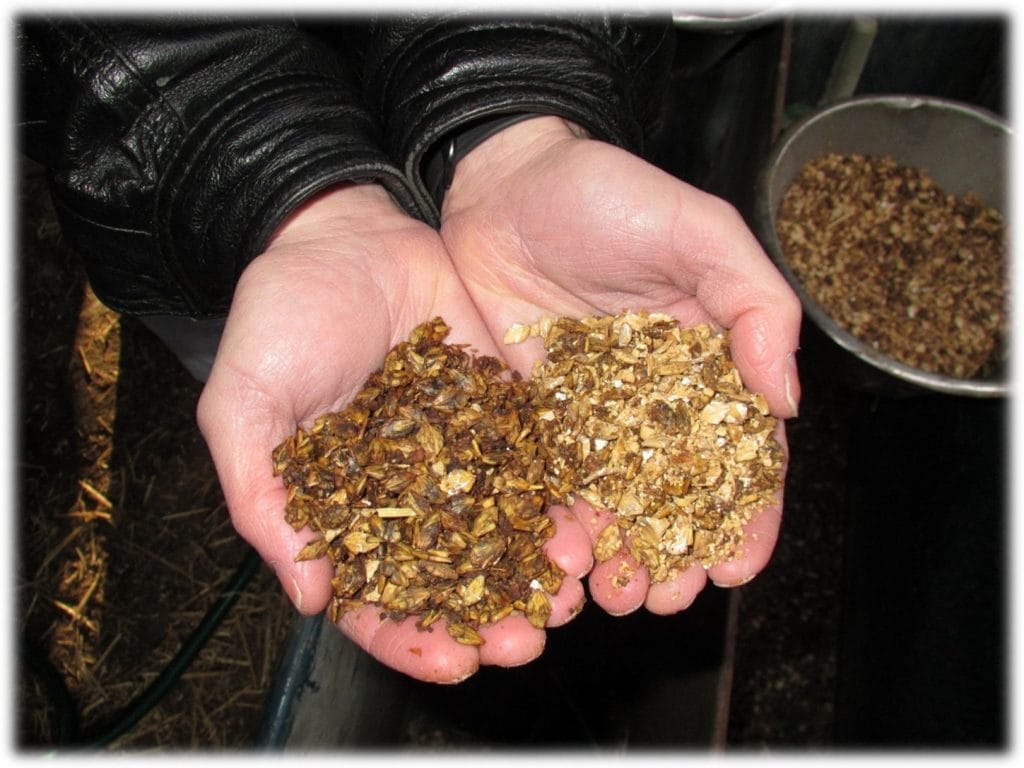
During a late-fall visit to a 1,000-cow dairy in Pennsylvania, the farm manager described how they produced their own calf starter. The mix consisted of pellets, corn, and oats blended in a cement mixer, with molasses added during the mixing process.
In the photo from that visit, two samples of starter are shown side-by-side. The sample on the left was mixed that day; the sample on the right was mixed the previous day. The difference was striking. The “today” mix was noticeably darker, indicating a higher molasses inclusion compared to the previous day’s batch.
While some color change can occur as molasses dries over time, the magnitude of the difference suggested more than simple drying. It indicated a meaningful variation in molasses’ inclusion from day to day.
Think of it this way: today you receive plain Corn Flakes for breakfast; tomorrow it’s Frosted Flakes. That kind of variability may be amusing for people — but for calves, inconsistency in feed composition can create real problems.
Why Too Much Molasses Can Be a Problem
Molasses serves an important purpose in calf starters. At modest levels, it:
- Improves palatability
- Reduces dust
- Encourages early intake
However, more is not better.
Excess molasses can:
- Reduce palatability (overly sweet or sticky feeds may actually discourage intake)
- Increase the risk of rumen acidosis due to elevated sugar intake
- Create sticky, clumped feed that is harder to consume evenly
Research, including work conducted at Penn State University, has shown that excessive molasses can negatively affect rumen health.
As discussed in Calf Note #109, molasses inclusion should remain below 12% of the mixture. In practice, a more appropriate range for handling and palatability is typically 5–6% of the total mix.
The Hidden Issue: Nutrient Variability
Beyond total inclusion rate, the second major issue observed in this case was inconsistency.
If molasses inclusion varies from 5% one day to 10% the next, sugar intake changes dramatically. That variation:
- Alters energy intake
- Affects rumen fermentation patterns
- Complicates growth monitoring
- Makes intake predictions less reliable
Calves thrive on consistency. Sudden changes in nutrient profile — even when ingredients remain the same — can disrupt intake patterns and rumen development.
Consistency in starter formulation is just as important as consistency in milk feeding schedules. When nutrient supply fluctuates daily, growth becomes more difficult to manage.
Practical Concerns: Handling and Flies
Excessive molasses also creates very practical problems on the farm.
High-molasses starters tend to be:
- Sticky and prone to clumping
- More difficult to handle and transport
- Likely to bridge in bins or feeders
- Harder to flow evenly during mixing and delivery
In warm weather, additional concerns arise. House flies and stable flies are strongly attracted to sugary feed ingredients such as molasses. Over-application can increase fly pressure in calf housing areas, particularly in summer months. Increased fly activity contributes to calf stress, reduced feed hygiene, and potential disease transmission.
Thus, beyond rumen health and intake consistency, excessive molasses can create environmental management challenges.
Bottom Line
Molasses is a useful ingredient in calf starter — in moderation.
- Target inclusion: 5–6% of the total mix
- Avoid exceeding 12%
- Maintain day-to-day consistency
- Monitor handling characteristics
- Consider seasonal fly pressure
A little of a good thing can improve palatability and intake. Too much can create nutritional, management, and environmental problems.
Remember: calves crave consistency — especially at breakfast.