Introduction
The Calf Notes family of educational resources has grown to include the new video series “What’s Happening?” – a series of videos that describe an interesting – and educational – photo or video that Jim collected during his 40+ year career in working with young calves. This series of Calf Notes will reprise the first “season” of What’s Happening? episodes… this Note will review Episode #4 – “Water via Nipples”.
Episode #4
In this episode of What’s Happening?, we revisit a photo taken at a large calf ranch in California’s Central Valley — one of the most productive agricultural regions in the world and home to a substantial portion of U.S. milk production. At first glance, the image shows long rows of traditional wooden calf hutches. But a closer look reveals something unusual: nipples installed in every pen.
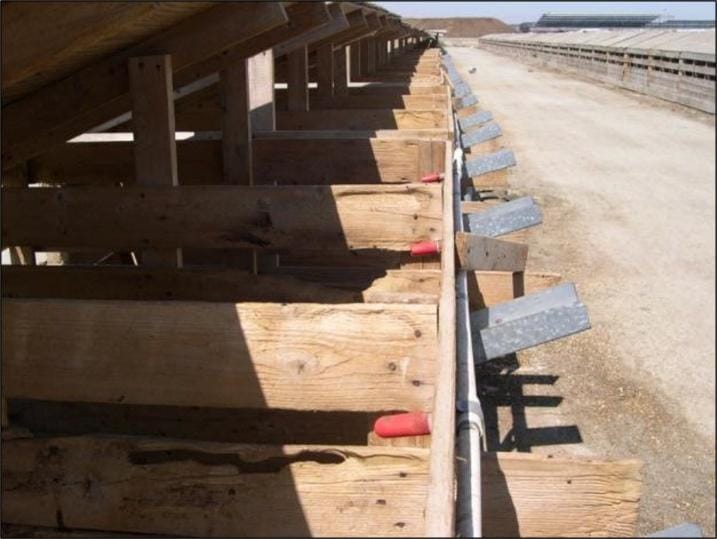
These nipples are not attached to milk bottles. Instead, they are connected to PVC pipes running along the outside of each row of hutches. So, what’s happening?
The farm manager faced a practical challenge. With several thousand calves housed in individual hutches, providing clean, fresh water was labor-intensive. Delivering water manually or by truck required time, labor, and fuel. In a warm climate where calves consume significant amounts of water — especially when eating starter — the need for a reliable, scalable system was critical.
The solution was both simple and ingenious. Each hutch pen was fitted with a piglet-style nipple waterer inserted through the wooden wall of the hutch. The waterers were connected to PVC pipe that ran along the length of each row. To encourage proper drinking behavior, a calf nipple was placed over the piglet nipple and secured with a zip tie. Each row of hutches had its own shutoff valve, allowing staff to manage water flow as needed.
One important discovery during implementation was that water must move continuously through the system to prevent overheating in the California sun. Through trial and error, the team adjusted flow rates to maintain palatable water temperatures without excessive waste.
The results were impressive. The system reduced labor, eliminated the need for water trucks in calf areas, and provided calves with constant access to clean water. As we know, early and consistent water availability is essential for rumen development, starter intake, and growth. Calves crave water — and when they have free access to it, they eat more starter and grow more efficiently.
The lesson from this episode is straightforward: innovative management doesn’t always require complex technology. Sometimes it simply requires thoughtful adaptation of existing tools to solve a real problem. In this case, a piglet nipple and PVC pipe transformed water delivery for thousands of calves.
A simple photo. A practical solution.
A meaningful improvement in calf welfare and performance.
That’s the story behind the media. The video is just over four minutes in length and informative as well as entertaining. Don’t miss it! You can view Episode Three and links to the entire first Season of What’s Happening? in English and Spanish here.
What’s Happening? has been great fun to make and a new contribution to the Calf Notes mission of “Helping Calves grow”. Stop by and take a look at Episode Three and the rest of the first Season. I’m sure you’ll enjoy them!