Introduction
Everyone understands (or should understand) the importance of colostrum. There are a tremendous amount of information (including Calf Notes) that discuss the importance of colostrum to the health of the young calf. So, we know that feeding colostrum is critical.
We also know that colostrum can be an important vector for many important disease-causing pathogens, like Mycobacterium avium paratuberculosis (the organism that causes Johne’s disease), Salmonella, Mycoplasma, Listeria, E. coli and many others. When the newborn calf consumes contaminated colostrum it is particularly sensitive to disease, since their own immune system is quite undeveloped at this age. One approach to reducing the risk of infecting newborn calves with contaminated colostrum is by pasteurizing the colostrum prior to feeding.
What is pasteurization?
The process of pasteurizing has been around since Louis Pasteur developed this method in 1864 to reduce the transmission of diseases to people by contaminated wine in France. Prior to the develop of Mr. Pasteur’s process (which was named “pasteurization” in his honor), drinking wine or milk could be dangerous, since modern methods of sanitation, chilling and handling had not been developed.
Pasteurization is a method of exposing liquids to elevated temperatures for a period of time as a means of reducing the bacterial contamination of the product. The process was developed to kill bacteria in liquids (including beer, wine, milk and fruit juices) that can cause diseases in humans.
Pasteurization is not sterilization. Pasteurized milk still contains measurable amounts of bacteria, which are typically reduced to low levels following heating. A key factor is the elimination of disease causing bacteria, which is effectively done with pasteurization. Pasteurization is one of the most important developments in food safety. It has reduced the transmission of disease and saved millions of lives since its widespread adoption in the late 1800’s.
Types of pasteurization
There are two common methods of pasteurizing milk – batch pasteurization and high temperature – short time (HTST) pasteurization. Batch pasteurization is accomplished when a batch (usually a vat or tank) of milk is heated to 63ºC for 30 minutes. Thereafter, the milk is cooled and can then be processed (or in the case of milk for calves, fed).
The process of HTST is different – milk is heated to 72ºC for 15 seconds. This type of pasteurization may be accomplished “in-line” by circulating the milk in heated coils or tubes for the appropriate time.
There are other times, temperatures, etc. that are used, so check with the local authorities in your part of the world if you have any questions about the times and temperatures required for pasteurization.
Effects of pasteurization on colostrum
The primary consideration regarding pasteurizing colostrum is the destruction of functional proteins, especially the immunoglobulins. Most of the research that has been done to date has explored the effects of pasteurization on the amount of destruction of IgG.
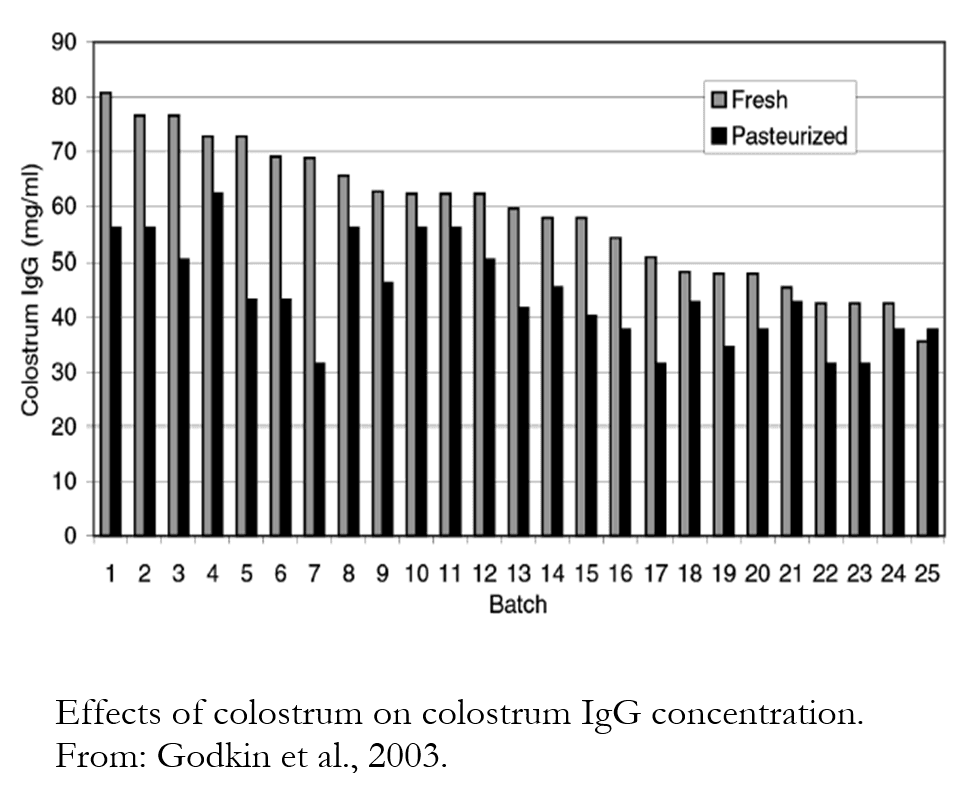
Godden et al. (2003) reported that batch pasteurization (63 C for 30 min) reduced the IgG content of colostrum by an average of 26.2% when compared to pre-pasteurized colostrum samples. There was an effect of the size of the batch, with larger batches (95 L) producing a greater reduction in colostral IgG content than smaller batches (57 L).
Meylan et al. (1995) also tested effects of batch pasteurization on survival of colostral IgG, but in a laboratory setting. Their data indicated that IgG in pasteurized colostrum was reduced by more than 12% compared to unpasteurized samples.
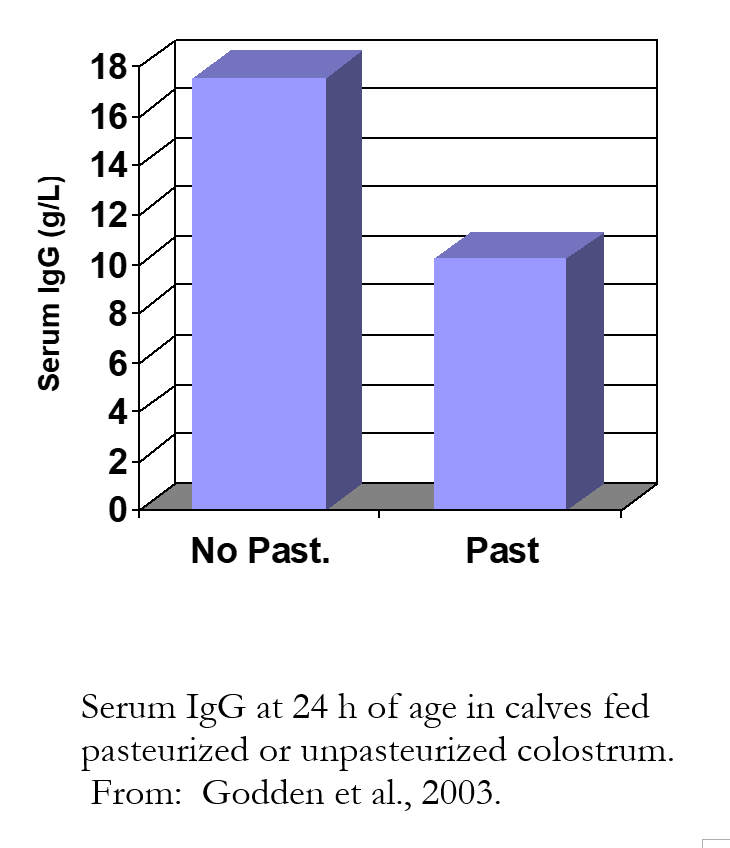
These two studies indicate that the current state of pasteurization does not lend itself to providing adequate IgG concentrations in newborn calves. However, some commercial companies now suggest that they can effectively pasteurize colostrum little or no destruction of IgG (a simple Google search on the terms “pasteurization” and “colostrum” will lead you to the web sites for these companies). There are no published studies as of this writing to document the improvements in the pasteurization process that allows pasteurization without IgG destruction.
Other proteins
Most of the research looking at pasteurization has used IgG and the indicator molecule for determining the degree of damage caused by pasteurization. However, there are many other proteins in colostrum that may be damaged upon exposure to heat. A few researchers have looked at the effects of heating on some of these “other” proteins. For example, German researchers (Steinbach et al., 1981) reported that heating colostrum to 55 C for 30 min had no effect on either IgG or IgM; however, heating to 60 C for 10 min reduced IgM dramatically. Others (Liebhaber et al., 1977) reported that pasteurization reduced IgA in human colostrum by 33% and viable immune cells were reduced by over 50%. On the other hand, Jansson et al. (1985) reported that activity of the growth factor EGF (epidermal growth factor) was not affected by pasteurization. Clearly, more research has to be done to better understand the effects of pasteurization on overall colostrum quality.
Possible pitfalls with pasteurized colostrum
- Maybe the greatest challenge with on-farm pasteurization of colostrum is maintaining the equipment in proper repair and properly calibrated so that the proper time and temperature is achieved. Home fabricated equipment is commonly used on many larger dairies and calf ranches. All equipment – whether home manufactured or purchased – must be properly calibrated and the manufacturer’s specifications must be strictly followed.
- Colostrum should not be poor quality prior to pasteurization. It should not contains clots, clumps, blood, or excessive amount of bacterial growth. Remember, pasteurization reduces bacterial counts, it does not sterilize colostrum. If colostrum contains tremendously high counts of bacteria, it is possible that normal pasteurization might not kill all disease causing bacteria.
- Pasteurizing can thicken colostrum. This is probably due to denaturing of proteins that begin to fall out of solution, causing thickening and clumping. In extreme cases, colostral proteins will begin to form large clots, which can plug equipment and make a big mess. This appears to be particularly true with HTST pasteurization, which exposes the proteins in colostrum to higher temperatures. Coagulated proteins are very difficult to feed to the calf, and, of course, no longer provide immune protection, so the colostrum simply becomes a source of nutrition.
- The cost of equipment can be substantial, and the capital cost as well as the cost of managing the process should be carefully evaluated. If your operation does not have the management skill to properly purchase, install and utilize a pasteurizer, then it is important to make this determination prior to making the capital investment.
Godden et al. (2003) recommended the following steps to successfully implement a successful colostrum pasteurization program:
- Use only high quality colostrum (goal > 60 mg/ml) measured using a colostrometer.
- Collect and store colostrum under sanitary conditions, and keep pre and postpasteurized colostrum chilled if there is any delay in pasteurization and/or feeding.
- Pasteurize only small-to-moderately sized batches (maximum 57 liters, or 15 gallons).
- Monitor pasteurizer function by routinely culturing samples of pasteurized colostrum.
- Pay attention to equipment maintenance and day-to-day cleaning.
- Feed 4 L of colostrum as soon as possible after birth.
- Provide a second feeding of 2 L of colostrum within 6 h of the first feeding.
- Monitor serum IgG concentrations as well as morbidity and mortality rates in calves.
- Pay strict attention to sanitation and hygiene in the maternity pen, feeding procedures, and the environment, to minimize calf challenge with infectious pathogens.
Recommendations
If you are going to conduct on-farm pasteurization of colostrum, it is essential that you consider the reduction in colostrum IgG concentration and feed calves a greater quantity of colostrum to overcome this deficiency. If you’re starting with poor quality (low IgG) colostrum to begin with, then I would consider looking for another source of colostrum or alternatives to colostrum instead of pasteurization. Based on the research from Godden and workers, batch pasteurization appears to be a more useful approach to pasteurization, but both methods appear to be very sensitive to management. New technologies may make pasteurization more robust to variability in management, but there are no published studies to document their effectiveness. It is very easy to damage and destroy IgG and other functional proteins in colostrum by exposure to heat. My recommendation, based on the current published research, is not to pasteurize colostrum unless you have no other options. If you choose to pasteurize colostrum, be careful!
References
- Godden, S. M., S. Smith, J. M. Feirtag, L. R. Green, S. J. Wells, and J. P. Fetrow. 2003. Effect of On-Farm Commercial Batch Pasteurization of Colostrum on Colostrum and Serum Immunoglobulin Concentrations in Dairy Calves J. Dairy Sci. 86:1503–1512.
- Liebhaber, M., N. J. Lewiston, M. T. Asquith, L. Olds-Arroyo and P. Sunshine. 1977. Alterations of lymphocytes and of antibody content of human milk after processing. J. Pediatrics. 91:897-900.
- Jansson, L., F. A. Karlson, and B. Westermark. 1985. Mitogenic activity and epidermal growth factor content in human milk. Acta Paed. Scand. 74:250-253.
- Meylan, M., M. Rings, W. P. Shulaw, J. J. Kowalski, S. Bech-Nielsen, and G. F. Hoffsis. 1995. Survival of Mycobacterium paratuberculosis and preservation of immunoglobulin G in bovine colostrum under experimental conditions simulating pasteurization. Am. J. Vet. Res. 57:1580–1585.
- Steinbach, G., B. Kreutzer, and H. Meyer. 1981. Effect of heating on the immunobiological value of bovine colostrum. Monat. Fur Veter. 36:29-31.