Introduction
In the past couple of years, programs of “intensified” or “accelerated” feeding (AF) of higher protein (usually 26 to 30% crude protein) have been introduced to increase the rate of BW gain. Very young calves are particularly efficient in depositing lean tissue (protein) gain and feeding greater amounts of protein (particularly highly digestible protein with a good amino acid profile) should be used very efficiently for growth. Feeding additional CMR powder provides additional energy, vitamins and minerals, which can also contribute to improved growth.
An AF program generally consists of feeding the higher protein CMR at varying rates. For example, one AF program recommends feeding a variable rate of CMR (454 grams per day during the first week to 918 grams per day at 21 days), with weaning at 42 days. Another recommends feeding 817 grams per day of a 28% protein CMR, increasing to approximately 1.1 kg of powder per day. Calves are weaned at 42 or 49 days of age. The amount of water that is used to mix the CMR generally varies to keep the DM of the final mixture at 13 to 18%.
There is little doubt that calves fed additional CMR will be bigger. This has been shown in several studies where calves are fed AF programs (see Figures 1 and 2). Providing additional nutrients DOES result in increased growth. Studies have also showed that calves will be taller, slicker looking, heavier and longer when fed in an AF program. These calves “look good” and generally do well.
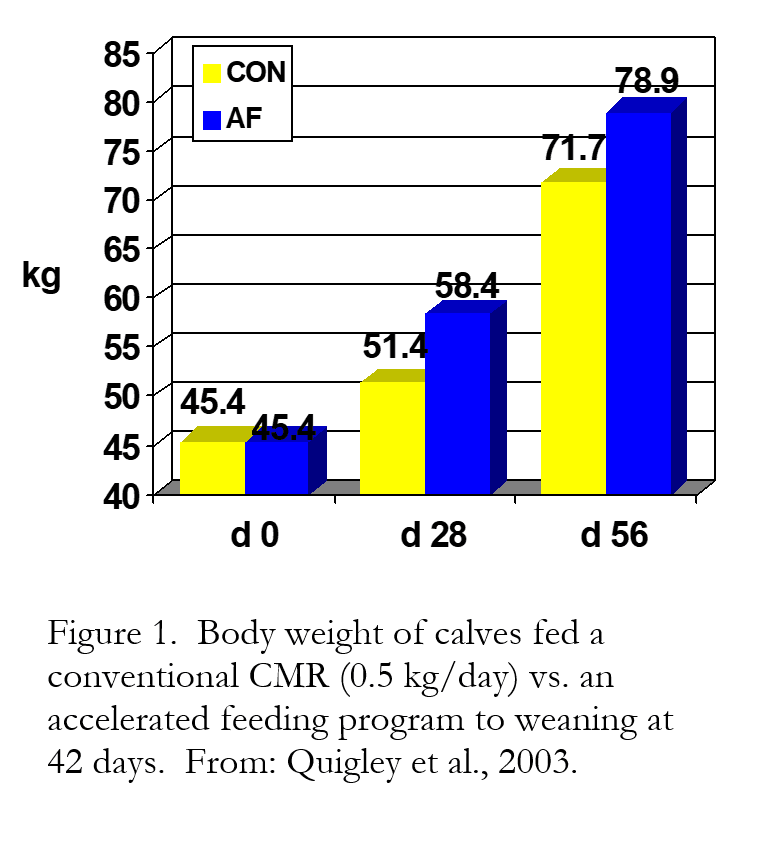
Growth by calves fed in an AF appears to be lean tissue (protein) gain rather than fat deposition. This is important in that deposition of fat during the first few months of life appear to have a negative effect on long-term milk production later in life.
Also, data to date indicates that calves fed in an AF program will maintain the increase in BW at least to four months of age, if fed higher protein calf starter (22% protein versus the “conventional” 18% protein starter). Other data suggests that if proper management is not followed (i.e., improved nutrition following weaning) that calves fed in an AF program will quickly revert back to sizes typical for calves fed limited CMR prior to weaning.
What is your goal?
To determine whether an AF program is appropriate for your management of calves, it is important to consider very carefully your goals in a calf and heifer feeding program. Many calf growers have many different goals when it comes to raising calves – including an acceptable death loss, to maximize growth or to minimize cost. Let’s look at these goals individually and try to determine if they can assist in deciding whether an AF program is for you.
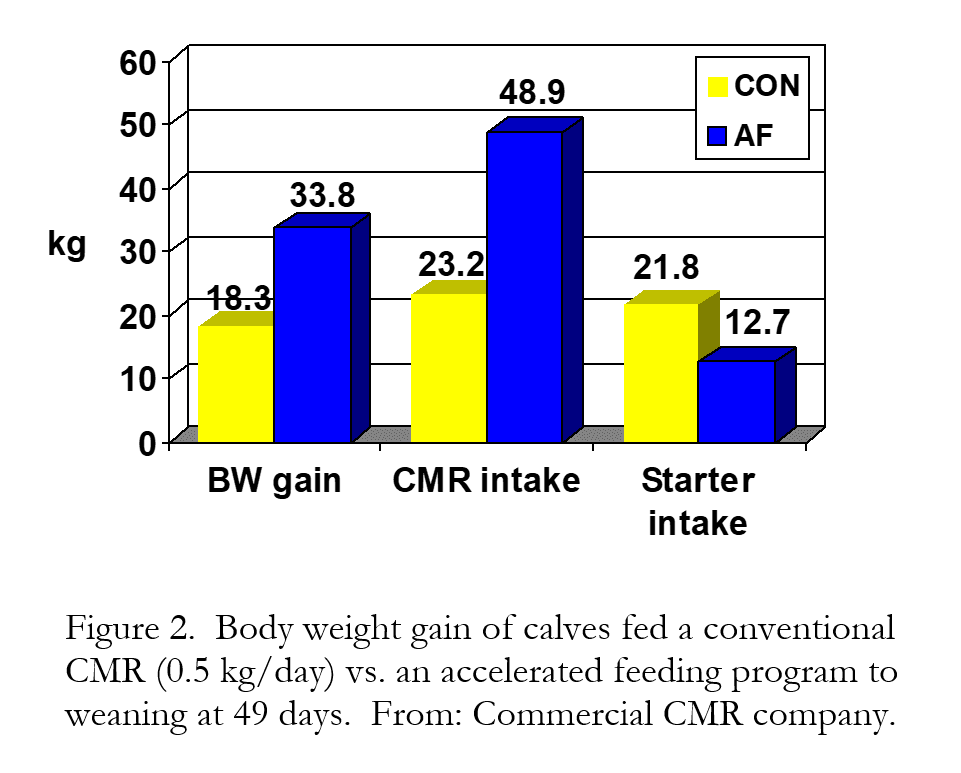
- Bigger calves. If your goal is to increase the weight, heights and/or length of your animals, then you should consider an AF program. The data available in the literature to date suggest that calves WILL be bigger when fed in an AF program. There are data to suggest that calves will be bigger at weaning – from 8 to 15 kg (17 to 32 lbs.). Several commercial milk replacer manufacturing companies have web sites that document many of these differences in animal size when they were fed conventional or AF programs.
Data also suggest that – with an appropriate post-weaning nutrition program – calves will retain the increased body weight and length throughout the growing period. This may be of value in promoting earlier breeding and calving (see below). - Earlier breeding and calving. As of this writing, no published data are available to prove that calves fed in an AF program from day 1 to day 42 (or 49) can be bred earlier or will calve earlier. It seems logical, however, if calves are heavier by as much as 15 kg at 49 days of age, they should be heavier, taller and ready for breeding earlier.
A factor that should be considered in the decision to use an AF program is risk. If the growing period of a heifer is considered in a time line, then the additional inputs of the AF program (i.e., the increased costs of AF feeding) are incurred early in the time period. It will take approximately 20 to 22 months to recoup the initial investment. Although the present (future) value of this incurred expense is not great, the more important risk is that there will be some defect in nutrition or management that causes a loss in the early investment. For example, if calves are fed in an AF program and then are weaned onto low protein starter (e.g., 16% protein) and poor quality forage, the chances for improved age at breeding are small. Similarly, if other aspects of the farm’s management are less than optimal, then it is less likely that a producer will recover the money invested in an AF program. Therefore, it is very important that producers with less than optimal post-weaning management should carefully consider the risk associated with investment in an AF program. There are probably cheaper alternatives to reduce age at breeding and calving through post-weaning nutrition if you are not feeding your weaned heifers optimally.
On the other hand, if your calving age is <24 months and post-weaning nutrition is quite good, then it may be possible to magnify the changes in body weight gain that are observed early in life. Data from commercial CMR companies suggest that, in well managed herds, calves will maintain or increase the difference in size that is achieved in the first 6 to 8 weeks of life. - Low cost per unit of gain. Farmers in the swine and poultry industries often calculate the feed cost per unit of body weight gain as an indication of the efficiency of their nutritional program. This statistic determines the cost of inputs that the producer must invest to get a unit of output (gain). More efficient producers have a lower feed cost to gain, which means that they are spending less money to achieve a level of productivity in their operation. These producers are also the ones that generally earn the most money. By minimizing cost per unit of body weight gain, producers can increase their economic efficiency and produce a valuable product with a minimum of inputs.
Feed cost per unit of body weight gain is the ratio of total feed costs (e.g., amount of CMR fed x cost of CMR + amount of starter fed x cost of starter + cost of forage fed x cost of forage) divided by the number of units of body weight gain per animal. For example, if a calf is fed 12.7 kg of CMR (28 days x 0.454 kg/day) plus 42 kg of starter (56 days x 0.75 kg/day) and the cost of these feeds is $1.67 per kilogram ($38 per 50 lb. bag) and $0.276 / kg for starter ($250 per ton), then the total feed cost is 12.7 x 1.67 + 42 x 0.276 = $32.80. If the calf gains 30 kg during the first 56 days when fed this program, the feed cost per unit of gain is $32.80 / 30 = $1.093 per every kilogram of body weight gain.
In a recent trial conducted at the APC research facility, costs per kilogram of body weight gain were $1.75 and $2.55 for calves fed a conventional (454 g/day of CMR) and an AF program, respectively, during the first eight weeks of life. Other estimates of growth and intake of calves fed in an AF program (data from commercial CMR company) indicate that feed costs per kilogram of body weight gain were increased by 30% (from $2.51 to 3.58/kg of body weight gain) when calves were fed an AF program to 42 days. Even when feed costs were calculated to approximately 6 months of age, the increase in feed cost per unit of body weight gain was increased by nearly 15%. These calculations indicate that is more costly to use an AF program to achieve a certain level of gain. This makes sense, because energy and protein from grain and forage sources is normally cheaper than energy and protein from CMR. When an objective of the commercial calf raising program is to minimize costs associated with production, the use of AF programs must be carefully evaluated. - Financial return to the investment to AF. There is no guarantee that the additional amount that a farmer invests in AF will actually be realized by improved animal production. Calves are fed CMR early in life; the economic value due to feeding an AF program (reduced age at breeding or increased milk production) is not realized until several months later. Economic returns to an AF program require that money must be invested for a period of time before returns are achieved. For example, let’s say that a producer uses the AF program and invests an additional $50 in an feeding greater amounts of a high protein CMR, which is fed during the first 49 days of life. Costs include the additional money to buy the CMR as well as additional labor to feed and manage calves fed the CMR.
Let’s also select a minimum acceptable return on the additional investment. A minimum acceptable return is the minimum amount of money that we want to make on the money that we have invested in the AF program. In most agricultural industries, a minimum return on investment (ROI) is 3:1. That is, for every $1 we invest, we expect to earn $3. This additional return is needed to make up for variability in production that reduces the overall return. So, if the AF program is going to be viable, it needs to return the producer $150 ($50 invested x 3:1 return). If we spend an additional $50, then we need to make $150 to have an acceptable investment.
If we assume that our goal is to reduce age at breeding, and we also assume that it costs $1.50 per day to raise a heifer from weaning to breeding, then we would need to reduce the age at breeding by 100 days ($1.50 per day x 100 days = $150) to reach our acceptable ROI. Of course, these calculations depend on your specific cost per day of raising weaned heifers, cost of the AF program and your minimum acceptable ROI. However, it is important to conduct an economic evaluation and calculate the required improvement in performance (whether in reduce age at breeding or increased milk production after calving). Naturally, the longer it takes to recover the initial investment, the greater the ROI needs to be to account for increased variability and chances for failure in some animals. - Improved health. Some have suggested that AF programs might result in improved health, since additional nutrients would be available to support the immune response. However, a recent paper by Nonnecke et al. (2003) reported that calves fed in an AF program had similar indices of immune response (i.e., number of circulating leukocytes and composition of peripheral blood mononuclear cell populations) were similar to calves fed conventionally. These data would suggest that conventional CMR feeding programs provide sufficient energy and protein to support the normal development of the immune system.
Our recent data (Quigley et al., 2003) suggested that calves purchased from sale barns and exposed to a pathogenic challenge had greater morbidity and mortality when fed in an AF program compared to calves fed conventionally. This experiment was designed to replicate the situation on large calf ranches where purchased calves are normally removed from the dairy and shipped to a ranch within a few hours of birth.
The effect of nutrition on animal health is probably much more closely related to the feeding of colostrum than feeding during the first 42 days of life. Calves with adequate supplies of colostrum intake may be able to take advantage of additional nutrients in an AF program, whereas our data would suggest that calves deprived of adequate colostrum intake are less likely to be able to use the nutrients.
What is your goal? Feeding additional CMR in an accelerated feeding program to increase growth makes perfect sense if you want bigger, longer, taller heifers and you believe that bigger, taller, longer heifers will result in earlier calving or improved milk production. If your goals are economic or related to animal health, then feeding additional CMR must be thoroughly evaluated in your operation to determine whether such a program makes sense for you.
References
- Nonnecke, B. J. M. R. Foote, J. M. Smith, B. A. Pesch, and M. E. Van Amburgh. 2003. Composition and functional capacity of blood mononuclear leukocyte populations from neonatal calves on standard and intensified milk replacer diets. J. Dairy Sci. 86:3592–3604.
- Quigley, III, J. D., T. A. Wolfe, and T. H. Elsasser. 2003. Effects of plasma IgG concentration and milk replacer feeding on hormone and growth responses in stressed calves. J. Anim. Sci. . Anim. Sci. 81(Suppl. 1):135.