Introduction
Colostrum is often considered the “perfect food” for newborn calves. No doubt that colostrum contains immunoglobulins to protect calves from diseases in the environment as well as proteins, hormones, fat, vitamins and minerals that newborn calves need to establish homeostasis and to grow. However, it is important to remember that colostrum may not be of a quality that can or should be fed to calves. Colostrum is an animal protein, that (like other animal proteins) must be handled and processed to minimize the risk of contamination, including microbiological contamination, antibiotic residues, and the presence of exogenous products (flies, manure, etc.). A recent article in the Journal of Dairy Science by Dr. Sheila Andrew of the University of Connecticut (Journal of Dairy Science, 2001, 84:100-106) indicates that colostrum quality is remarkably variable and management during the dry period can affect the quality of colostrum.
Dr. Andrew evaluated the degree of contamination in colostrum collected from cattle on the University dairy and on a cooperating dairy. The colostrum and transition milk was obtained from first calf heifers and was tested for the presence of mastitis pathogens, composition (including IgG) and for the presence of antibiotics using several commercial cow-side screening tests. Heifers were used to because they had not received previous dry cow treatments. Therefore, any positive test result on the antibiotic screening tests would have been due to factors other than antibiotics in the colostrum.
The results
The composition of the colostrum sampled during the study is shown in the table. The amounts of fat and protein were much higher than is found in normal milk – which is typical of colostrum composition. Colostrum is much higher in fat and protein and serves as a source of nutrients for the calf.
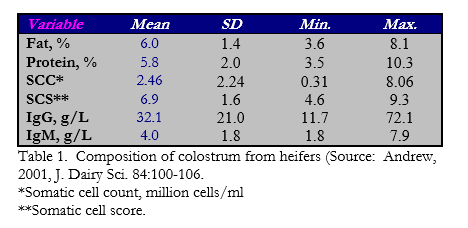
The somatic cell counts of colostrum were dramatically higher than is found in milk. The average somatic cell count (SCC) was 2.46 million/ml. This is much higher than is allowed in normal milk. Of course, colostrum contains a large number of immune cells that may provide some additional immunity to the calf. Therefore, a high SCC should not necessarily be considered a problem. On the other hand, if the SCC is elevated due to an intramammary infection, then the SCC is a problem. Unfortunately, it is not easy to determine the difference between elevated SCC due to mastitis (which may not be healthy for the calf) and “normal” elevated SCC. It is important not to feed colostrum from cows that is apparently infected (the presence of blood, flakes, clumps).
The mean IgG concentration was 32.1 g/L. This is particularly interesting, because many dairy professional have concluded that there is a need to feed at least 150 to 200 grams of IgG within the first 24 hours and at least 100 grams of IgG in the first feeding. If we apply this rule to the colostrum collected in this study, then the calves would have to consume between 4.7 and 6.2 liters of colostrum within the first 24 hours and 3.1 liters in the first feeding. It might be very difficult for a calf to voluntarily consume this much colostrum.
Antibiotic screening tests (Charm Cowside, CITE Snap, Delvotest SP, Penzyme) gave several false positive tests when colostrum was tested. The specificity of the screening tests ranged from 0.16 to 0.88 (the FDA requires that a test should have a specificity of 0.9 or greater). It appears that the tests gave false positive results due to the differences in composition between colostrum and milk. It is important to note that the research did not use colostrum or transition milk from heifers that had any clinical signs of mastitis. Therefore, these data may slightly underestimate the prevalence of mastitis in the total heifer population. Dr. Andrew concluded that “screening for antibiotic residues in milk from recently freshened cows should not occur before the sixth milking after parturition”.
The conclusions of this study have important implications. If you’re not sure that the colostrum you are about to feed may contain antibiotic residues – particularly if the cow was treated with antibiotics during the dry period and the dry period was shorter than usual – you should consider not using that colostrum. The presence of antibiotic residues can be a problem for the industry. If bull calves are fed colostrum contaminated with antibiotics and those animals are slaughtered for bob veal, there is a very real risk of antibiotic residues. In addition, the use of cow-side antibiotic residue screening tests will give false positives in many cases. Therefore, testing of colostrum and transition milk should be limited until after the sixth milking.