Introduction
In previous Calf Notes – and throughout both the scientific and popular literature – it is possible to find many articles that document the variation in the quality of colostrum that we obtain from dairy cows. The quality is normally measured as colostrum immunoglobulin G or IgG concentration and it’s well established that colostral IgG concentration can vary according to a large number of factors. But, what about other components of colostrum? Does the content of other components in colostrum vary depending on factors such as age of the cow, volume of colostrum produced, etc.? Well, a study published in the Journal of Dairy Science in 2007 addressed the question of quality of colostrum. In the study by Kehoe et al. (2007), a sample of colostrum from one cow on each of 55 dairy farms in Pennsylvania was sampled and analyzed for various components, including functional proteins such as IgG1, IgG2 (note: the sum of IgG1 and IgG2 = IgG, which is commonly reported), IgA and lactoferrin as well as nutrients such as vitamin E, thiamin, calcium, phosphorous and iron.
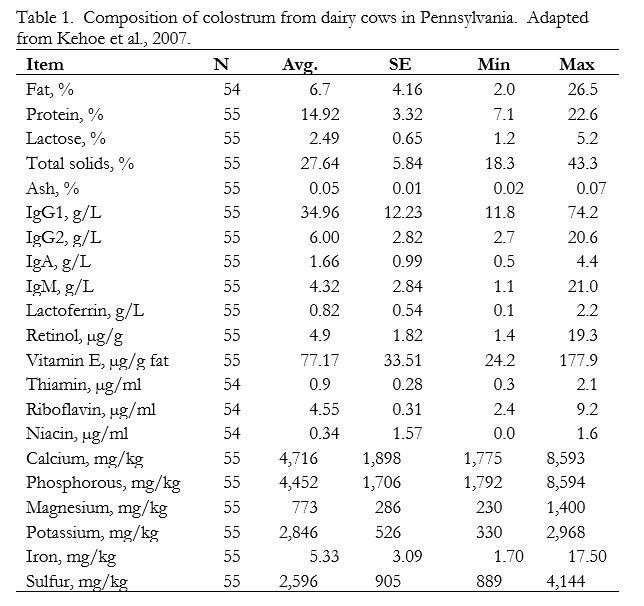
There are several notable concepts in Table 1, which is a excerpt of a large table in the original paper. First, we can see that the average IgG concentration in colostrum was 34.96 + 6.00 = 40.96 g/L. This is below an acceptable average concentration for high quality colostrum of 50 g/L. It is also noteworthy that the range of IgG was (11.8 + 2.7) = 13.5 g/L (the minimum) to (74.2 + 20.6) = 94.8 g/L (the maximum). This kind of variation makes it difficult to determine the amount of total IgG that would be provided by a fixed amount of colostrum (e.g., 4 liters or 1 gallon).
Lactoferrin is a functional protein in colostrum is thought to assist the calf by serving binding iron that may be in the intestinal environment. Iron is required by many gram negative bacteria (e.g., E. coli, salmonella) and removing iron from the environment inhibits their growth. Although a requirement for lactoferrin has never been established, we know that colostrum contains significant amounts of lactoferrin. The average concentration reported by the authors was 0.82 g/L. However, it’s very interesting that the concentration of lactoferrin ranged from 0.1 to 2.2 g/L. This is more than a 20x difference! It’s possible – but at present, still unknown – that differences in concentration of lactoferrin (and other functional proteins in colostrum) could contribute to differences in health of calves consuming different qualities of colostrum.
The vitamin composition of colostrum was also remarkably variable. For example, the amount of vitamin E in colostrum averaged 77.2 µg/g of fat, but ranged from 24 to 178 µg/g of fat. This is particularly important, since fat soluble vitamins (A, D, E) don’t cross the placenta well and calves are born quite deficient in them. Colostrum is an important source of these fat soluble vitamins; however, the variation in colostrum vitamin concentration suggests that calves may not be receiving enough of these important nutrients under certain conditions.
What factors affect colostrum nutrient content? And more important, is there anything that producers can do about it? The authors conducted a survey of test farms to determine whether there were correlations among management factors on the farm and colostrum quality. Generally, there were few significant correlations. However, farms with low (<200,000) herd average somatic cell counts (an indication of good management) had higher concentrations of several nutrients compared to farms that had higher somatic cell counts.
Concentrations of nutrients in colostrum may be affected by the dry cow diet and level of mineral supplementation. For example, it is known that if dry cows are supplemented with vitamin E and selenium, the concentration of colostrum will be higher in these nutrients after the cow gives birth. It’s logical to assume that cows properly fed and managed during the dry period should produce colostrum with greater content of all nutrients; however, there are very few data that show a direct relationship between diet and colostrum content. When beef cows (n = 36) were fed without or with added mineral premix during the dry period, the only minerals in colostrum that were affected by the added mineral feeding were selenium and zinc (Salih et al., 1987).
Summary
Variation in colostrum is not simply related to colostrum immunoglobulin concentration. It’s important to remember that colostrum – in addition to its role as a source of functional immune proteins – is also an important source of nutrition. Proper dry cow nutrition and attention to cow comfort for dry cows may improve colostrum quality – both immunological and nutrition – and produce better calves.
References
Kehoe, S. I. , B. M. Jayarao, and A. J. Heinrichs. 2007. A survey of bovine colostrum composition and colostrum management practices on Pennsylvania dairy farms. J. Dairy Sci. 90:4108–4116.