Introduction
For those of you that feed calf milk replacer (CMR), you are probably aware that the price of a bag of CMR has been going up as of April, 2007. The greater cost of CMR has led many to wonder “at what point is it cheaper for me to feed whole milk instead of CMR”? A very good question. And an important one.
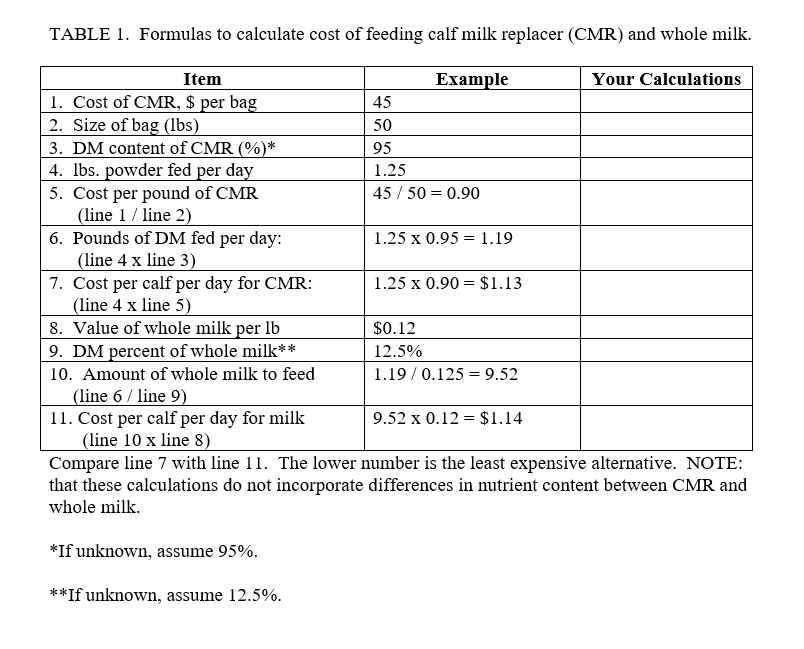
Decisions of feeding programs for commercial dairy producers and calf growers should be based on economics. There is great value in using CMR – it is convenient and easy to use. Most CMR products are very high quality and provide excellent nutrition to the calf. As calf raisers, we generally use CMR because it is cheaper to use than whole milk. As the price of CMR formulas go up, it may become more expensive to use CMR compared to whole milk and the decision on which product to use should be made. Below is an example of how to calculate the difference in price of CMR and whole milk.
NOTE: We are not going to calculate the differences between using waste milk and CMR, but the use of saleable milk from the bulk tank. For other Calf Notes regarding the use of waste milk, see Calf Notes (https://www.calfnotes.com).
Calculations on a solids basis
Let’s say that you are currently feeding a CMR product that contains 20% CP and 20% fat and that the cost of that product is $45 for a 50-lb bag. Currently, you feed 1.25 lbs of CMR powder per day (10 oz per feeding). You would like to compare this cost to the feeding of an equivalent amount of solids to feeding whole milk. You currently are paid $12 per cwt of milk.
There are big differences in DM content of CMR powder and whole milk. The CMR usually contains about 95% DM and whole milk contains about 12.5% solids (DM). So, to determine an equivalent cost, we’ll calculate both on a 100% DM basis.
First, the CMR – if the product costs $45 for a 50 lb bag, then the cost is $0.90 per pound on an as fed basis. You are feeding 1.25 lbs of powder, so we calculate 1.25 x $0.90 = $1.13 per calf daily.
We need to know how much DM each calf is being fed daily. To calculate how much DM a calf eats, we calculate 1.25 x 0.95 = 1.19 lbs of DM per day.
Let’s now calculate the amount of whole milk that we would need to feed an equivalent amount of solids to the calf. In the above paragraph, we calculated that we feed 1.19 lbs of CMR (DM basis) per day. The amount of whole milk on an as fed basis = 1.19 lbs of DM / 12.5%, or 1.19 / 0.125 = 9.52 lbs of whole milk daily. The milk costs $0.12/lb, so the total cost per day = 9.5 x 0.12 = $1.14.
So, to feed CMR, it will cost $1.13 per calf daily and to feed milk, $1.14 per calf daily. As the cost of CMR increases above $45 per bag (and if milk is $12/cwt), it will become cheaper to feed whole milk.
Note that there are usually significant differences in the nutrient content of milk and milk replacer. Milk that contains 3.5% fat and 3.2% protein on an as fed basis actually contains about 28% fat and 25.6% protein on a 100% DM basis (3.5 / 0.125 = 28 and 3.2 / 0.125 = 25.6). If you compare this to a 20/20 CMR, the CMR contains about 21% fat and 21% protein (20 / 0.95 = 21 and 20 / 0.95 = 21).
So, in our example, if you feed 9.52 lbs of whole milk per day, you will be providing 9.52 x 3.5% = 0.33 lbs of fat and 9.52 x 3.2% = 0.30 lbs of protein per day. Compare this with 1.25 lbs of CMR powder. For CMR, you will feed 1.25 lbs x 20% protein = 1.25 x 0.2 = 0.25 lbs of protein. The same calculation for fat: 1.25 x 20% = 0.25 lbs of fat.
Therefore, you will provide:
| Item | CMR | Whole Milk |
| Amount fed, lb/day | 1.25 | 9.52 |
| DM, lb/day | 1.19 | 1.19 |
| CP, lb/day | 0.25 | 0.30 |
| Fat, lb/day | 0.25 | 0.33 |
| Cost, $/day | 1.13 | 1.14 |
In the above example, it would be better to feed whole milk. Although it costs an additional $0.01 per calf daily, the calf will receive more protein and fat.
Summary
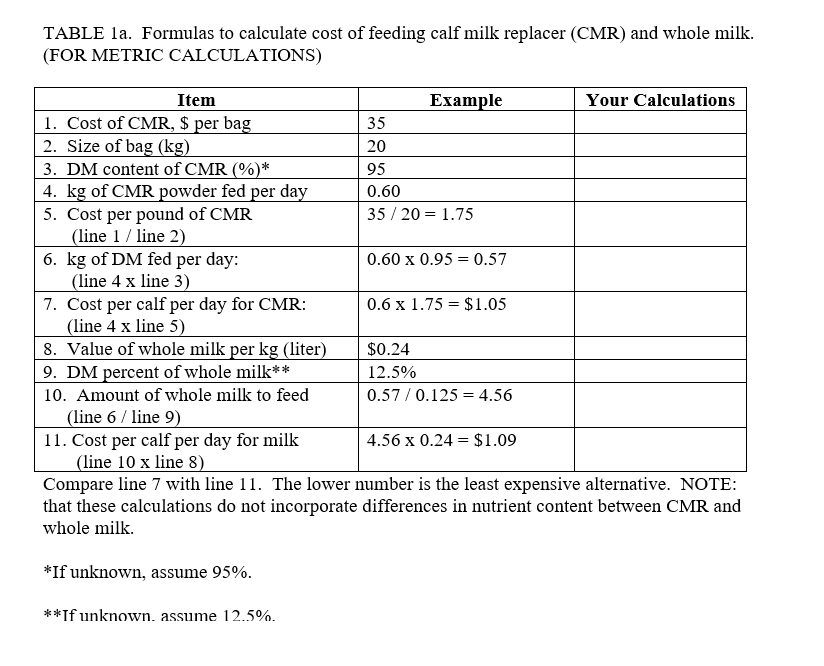
There are many good reasons to use CMR in calf feeding programs. These management considerations should be factored into the decision. Switching from milk to CMR too frequently can cause problems with calves – feed refusals, digestive upset, etc. So, be sure the decision makes sense from all perspectives before making a change. On the next pages are tables that you can use to calculate the cost of CMR for your calves. Good luck!