Introduction
Measuring body weight (BW) of growing calves and heifers can be a challenge on the farm.
While research institutes usually utilize electronic scales and measure BW of calves and heifers individually, these scales can be difficult to use when calves are housed in groups. In addition, scales (like any electronic instrument) need to be taken care of and calibrated from time to time to make sure they’re working properly.
One option for estimating BW in calves and heifers is to use a weigh tape. The tape is based on the statistical relationship between heart girth (the circumference of the animal just behind the withers) and BW. As the heart girth of the heifer increases, BW increases. An important question is “how accurate is the tape in estimating BW?”.
A device called the “hipometer” has been introduced to the market (see photo). The hipometer measures the width of the hips (width at the hip joints at the point of the greater trochanters of the femurs) and uses this to estimate BW. According to previous research (Heinrichs et al., 1992), there is a close relationship between hip width and BW.
So, how do these indirect devices actually correlate to scale BW? We could consider scale weight to be the “gold standard” by which each of these other methods could be evaluated. A study published in the 2006 Journal of Dairy Science (Dingwell et al., 2006) did this evaluation.
The Research
The researchers used 311 Holstein heifers in four research herds in Ontario, Canada. Animals ranged from a low of one month of age to springing heifers at 24 months of age. Calves and heifers were managed according to the normal management of the farms and generally fed diets consistent with NRC requirements for growth.
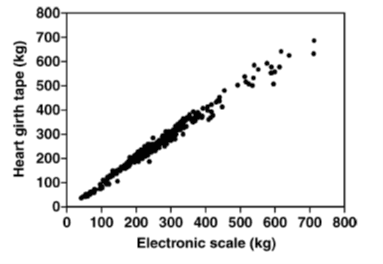
The researchers weighed each calf/heifer and then recorded measurements for hip width and heart girth and used each device to predict BW. The predicted BW were then compared to BW measured on the scale. Overall, both the heart girth tape and the hipometer did an excellent job of predicting BW. The correlation coefficients comparing heart girth and BW and hip width and BW were both 0.99, indicating a very close relationship between the three methods of measurement (see Figures 1 and 2 for the relationships).
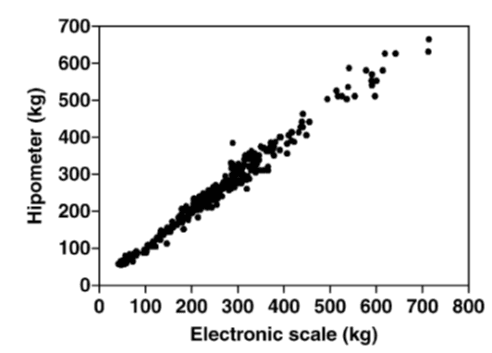
There were some areas of concern, however. The first is the lack of relationship in calves less than three months of age. With these small calves, BW measured on the scale was 74 kg whereas the heart girth tape predicted 58 kg and hipometer predicted 77 kg. While the hipometer was reasonably close, the tape gave estimates that were too low.
Another area of concern for the researchers was heifers between 18 and 21 months. In this group of heifers, scale BW, hipometer and heart girth measurements were 589, 544 and 554 kg, respectively. Both indirect measurements gave results that were significantly lower than the scale. The authors were careful to point out that only a limited number of heifers were included in this group (n = 5), so if there were more measurements, the correlation might have been higher.
Generally, the results of this study suggests that either the hipometer or the heart girth tape can be used to predict BW of calves older than 3 months of age. Both the hipometer and heart girth tape have advantages and disadvantages but either can be a valuable tool in monitoring your calf program.
An important consideration for both the tape and hipometer is consistency of use. Be sure to read the directions for each device carefully and use them consistently. If either the heart girth tape or hipometer is used on the wrong part of the body, you will get inconsistent or incorrect results.
References
Heinrichs, A. J., G. W. Rogers, and J. B. Cooper. 1992. Predicting body weight and wither height in Holstein heifers using body measurements. J. Dairy Sci. 75:3576–3581.
Dingwell, R. T., M. M. Wallace, C. J. McLaren, C. F. Leslie, and K. E. Leslie. 2006. An evaluation of two indirect methods of estimating body weight in Holstein calves and heifers. J. Dairy Sci. 89:3992–3998. http://dx.doi.org/10.3168/jds.016-11072.