Introduction
Treatments for diarrhea caused by disease-causing organisms is a big deal to all calf raisers. It seems that we spend a tremendous amount of our time dealing with keeping baby calves – working to feed them appropriate amounts of colostrum, to keep them isolated from organisms that may cause scours and, occasionally, treating those that do develop disease.
Any new treatment or potential treatment for disease – especially those caused by bacteria should be evaluated carefully. These potential new treatments should undergo rigorous testing prior to widespread use. That’s why a recent paper published in the Journal of Veterinary Medicine (Bampidis et al., 2006) was so interesting. This Calf Note is designed to evaluate this paper and to challenge the conclusions of the authors.
The study
The study was conducted during an acute outbreak of diarrhea from February to April, 2005 at the Research Station Diagnostic Center of the State Veterinary Service (Ministry of Rural Development and Food, Thessaloniki, Greece). Previous necropsies had determined that E. coli was present on the farm and was the likely causative agent.
During the outbreak, the researchers assigned 30 calves that developed acute diarrhea to receive either a treatment of antibiotics as 10 mg neomycin sulphate per kg calf body weight per 24 h or oregano, which was 10 mg oregano essential oil per kg calf body weight per 24 h.
Calves were fed normal milk replacer, followed by their respective treatments approximately 20 min after each milk feeding. Oral solutions for both treatments were administered to calves for the number of days that fecal scores were >2, plus two more days that fecal scores were <2.
Fecal scores and the number of days that calves had scours (fecal score >2) were recorded.
The Results
Calves treated with either neomycin or oregano leaves had scours (fecal score greater than 2) for an average of 6.4 days with no difference between the treatments. The average fecal score during the time when calves were treated with either product were 2.58 and 2.67 for neomycin and oregano leaves, respectively. Again, there was no difference due to treatment.
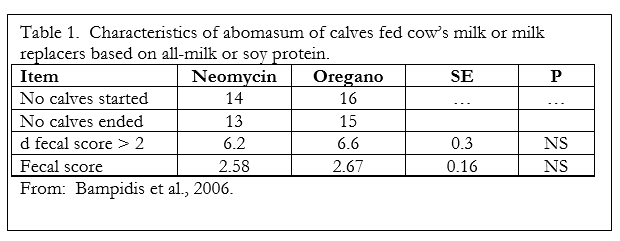
Two calves died during the study – one on each treatment. Both calves were infected with E. coli, which was found during the necropsy.
What’s all this mean?
It has been shown that oregano essential oil may have antimicrobial properties and may act to disrupt bacterial cell membranes. This effectively kills the bacteria. Other researchers have shown that oregano essential oil inhibits the growth of E. coli in vitro.
Unfortunately, however, it’s difficult to determine whether the data in this study indicate that oregano had any effect at all. The authors of the study assume that neomycin was effective in reducing the effects of the E. coli infection on the farm and that the 14 calves that were treated with neomycin got better because of the treatment. We don’t know this to be the case. It’s quite possible that the E. coli were resistant to neomycin and the calves simply developed their own resistance to the disease during the 6 or so days that they had scours. If this was the case, then the oregano was equally ineffective.
The researchers should have included a negative control wherein a group of calves were not treated with any antimicrobial product. This is the only way to determine if the neomycin and oregano treatments had any effect on diarrhea in this study. Without this, it is impossible to know if either of these treatments had any effect on the incidence or severity of disease. As we are all aware, there is a high probability that bacteria are or can become resistant to particular antibiotics, including neomycin. The authors of this study suggest that more than 90% of E. coli isolates in Greece are sensitive to neomycin; however, they did not report whether or not they tested the isolates taken from calves in this study.
The research presented in this paper does NOT prove that oregano can be used as a treatment for E. coli scours in young calves. While the potential exists, based on our understanding of the mode of action of oregano essential oils, more complete research is needed. The research in this study could have been conducted better to show the effects of oregano as an antimicrobial alternative.
Reference
Bampidis, V. A., V. Christodoulou, P. Florou-Paneri and E. Christaki. 2006. Effect of ddried oregano leaves versus Neomycin in treating newborn calves with colibacillosis. J. Vet. Med. A. 53:154–156.