Introduction
Healthy calves are a boon to the dairy industry. Inexpensive, high quality replacements can improve dairy productivity and reduce overall costs. On the other hand, weak and sick calves are the bane of the industry. Although there are no comprehensive figures regarding the actual costs associated with morbidity and mortality of calves (either on dairy farms or calf ranches), the common wisdom is that far too much time, money and energy is spent keeping young calves alive and growing to their genetic potential.
At first blush, the prevalence of twinning would be positive for producers – two calves “for the price of one” so to speak. However, notwithstanding the common problem of infertility of freemartin heifers (heifer twin calves born with a male), twin calves are often regarded as more of a problem than a benefit for dairy producers. Why? Well, a recent study from the University of Minnesota College of Veterinary Medicine and presented at the 2005 National ADSA Meetings suggests at least a partial reason. The results of the study and the implications were very interesting.
The study
Minnesota DHIA calving records were used for the study. In total, 902,380 calving records from 1,754 herds were used from an initial data set of over 2.8 million calving events. The data were from 1,754 herds. The cow records were from 1st calf heifers (35.8%), 2nd calf (26.0%) and older animals (38.2%). No records from cows over 7 years of age were used.
The researchers looked at the incidence of twinning as a function of several parameters, including season, parity of cow, year and herd. Seasons were defined as Winter (Jan-Mar), Spring, (Apr-Jun), Summer (Jul-Sep) and Fall (Oct-Dec). The calf data that was recorded included whether the calf was a singleton or a twin and whether the calf lived or died (the researchers called it “perinatal mortality”).
Increased twinning
One of the more interesting observations was that the incidence of twinning increased over time. At the beginning of the study, the overall incidence of twinning was 3.5% of births. This increased in a relatively linear fashion to reach a high of 4.7% in 2004.
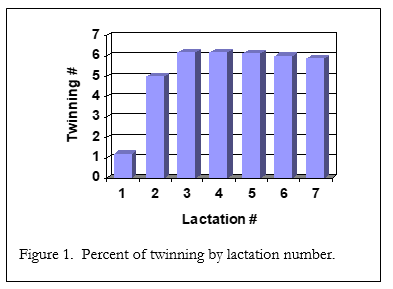
The percentage of twinning was markedly lower in first lactation heifers compared to older cows (Figure 1). Second calf heifers and older cows had many more twins (average for all >1st lactation cows = 5.7%).
Another interesting observation was that there were more twins conceived in summer (July-September) than other periods of the year. It is important to remember that this type of research establishes statistical relationships – it does not provide biological meaning or interpretation to these relationships.
Twins and mortality
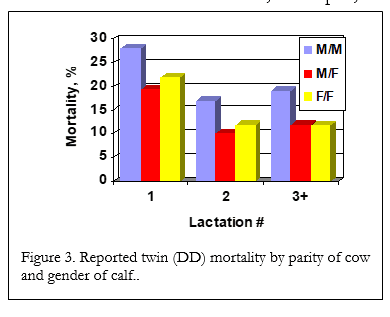
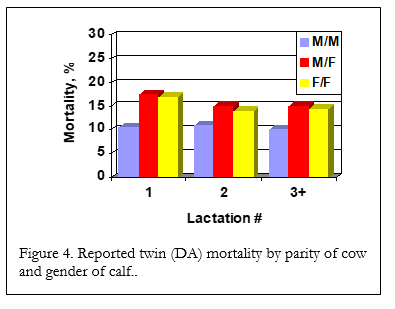
Calf mortality was affected by the rate of twinning. The first important observation was that perinatal mortality was higher in twins than in singleton calves. But, as we will see, there were other important effects, such as the parity of the cow from which the calves were born. Although the researchers did not report overall mortality for singleton calves vs. twins, it is clear by looking at Figures 2 (for singleton calves) versus Figures 3 and 4 that mortality for singleton calves was far lower than for twin calves.
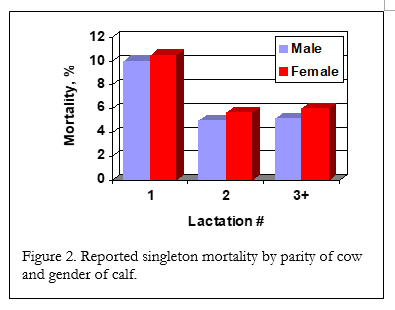
Figure 2 shows reported mortality of singleton calves when these calves were born from 1st, 2nd or 3rd or later cows. Clearly, there is an effect of parity of cow on calf mortality – calves born from 1st calf heifers are much more likely to die shortly after birth than calves born from older cows.
Pairs of twins could either be two males, two females or one of each sex. In addition, with a pair, when mortality occurred, it could occur either to one calf or to both. The researchers evaluated this effect. Figure 3 shows the effect of parity and gender of calf on the mortality of both calves (DD). In this case, there was a strong effect of parity (1st parity cows had higher mortality in their calves) as well as sex. When two bull calves were born – particularly to 1st calf heifers – mortality was higher than when the two heifers were born or when one of each sex was born. This may be due to the larger size of bull calves. Larger size, coupled with smaller size of 1st calf heifers probably contributed to the much higher mortality in these calves.
Mortality of one twin of the pair, classified as DA is shown in Figure 4. Again, parity appears to affect overall mortality, with 1st calf heifers having higher overall mortality. However, in this case, the effect of sex of calf is far less clear.
Summary
These data show several important practical trends. The first is that the incidence of twinning is increasing – at least it increased from 1996 to 2004 in the Upper Midwestern area of the U.S. Whether this observation is consistent with other parts of the world is as of yet unclear.
Another important observation is that twinning results in higher perinatal mortality – especially when twins are born to first calf heifers. This has important implications to calf raisers. If your cows produce twins, you need to be aware that these calves are at much greater risk. Although this study does not attempt to answer the question “why” mortality is higher, there are other studies that suggest that smaller size of first calf heifers, size of twins (especially twin bulls) and unfamiliarity of the process for heifers (which increases stress) can all contribute to increased risk of mortality. Therefore, you should take extra precautions with twin calves — ensure that they are removed from the dam immediately, fed a sufficient amount of high quality colostrum and are raised in a clean, dry and pathogen-free environment. All of these management interventions can go a long way to reducing the risk of calf mortality. Good luck!
Reference
Silva Del Rio, N., S. Stewart, P. Rapnicki, Y. M. Chang, and P. M. Fricke. 2005. An observational analysis of twin births, calf mortality, and calf sex ratio in Holstein dairy cattle. Abstract W162, presented at 2005 National ADSA Meetings.