Introduction
Anyone who raises calves knows (or should know!) the importance of feeding colostrum to newborn dairy calves. Well, just in case you weren’t convinced – or if you’re a calf raiser who has trouble convincing your client dairy farmers to feed colostrum, well, here’s some good news for you. A recent study from the University of Arizona shows that feeding 4 liters of colostrum increased subsequent milk production in calves compared to feeding 2 liters of colostrum.
The study. Here’s what happened. Brown Swiss calves (n = 68) born during a two year period in Wisconsin were used in a study of colostrum feeding and subsequent milk production. Animal were randomly assigned to be fed either two or four liters of maternal colostrum at birth. Colostrum was obtained from the dam shortly after calving and the colostrum was analyzed using a colostrometer. Only samples of colostrum that were “green” were used. If the cow produced fair or poor quality colostrum, then previously frozen colostrum was thawed and used. Overall, about 15% of cows produced fair or poor colostrum that wasn’t used in the study.
All calves were fed by nipple bottle within one hour of birth. When a calf refused to consume the colostrum was fed by esophageal feeder. Calf workers attempted to feed the calf for 10 minutes before using the esophageal feeder. Calves were offered a second feeding of colostrum about 12 hours after the first feeding.
After the first day’s feeding, all calves were fed and managed similarly. During days 2 and 3, calves were fed transition milk (second and third milkings from fresh cows) and then fed waste milk (2 L per feeding) and high quality calf starter until 7 or 8 weeks of age when calves were weaned. From 2 to 4 months of age, calves were fed similarly and fed alfalfa hay, high moisture corn and a grower pellet.
Results
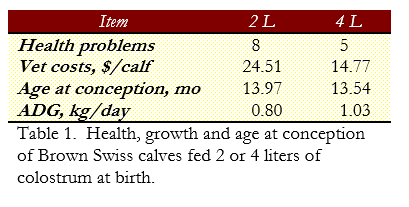
Table 1 shows the effects of added colostrum feeding on health problems and veterinary costs for the two groups of calves. As expected, calves fed more colostrum had fewer problems and cost about $8 per calf less for veterinary costs. It should be noted that the cost of labor for administering the veterinary prescriptions was not included in the vet cost calculation. Therefore, we can expect that the total cost – including labor – would be significantly higher.
We can also see that growth of calves fed more colostrum were better (i.e., better average daily gain) Although the age at conception was numerically lower, the difference was not significant.
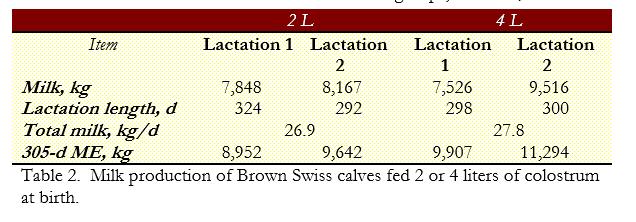
After these heifers were raised and they themselves calved, the researchers followed milk production of the animals through two lactations. There were important differences, as can be seen in Table 2. Actual milk produced in the first lactation was similar between the two groups; however, in the second lactation, cows fed more colostrum produced 1,349 kg more actual milk than calves fed 2 liters of colostrum. It’s also interesting to note (though not statistically valid, due to a small number of animals) that the culling rate of calves fed 2 and 4 liters of colostrum was 24.3 and 12.9%, respectively, during the study.
If we look at milk production data throughout the entire two lactation study, calves that had been fed extra colostrum produced approximately 1 kg more milk per day. This computes to approximately 550 kg more milk. If we assign some economics to this difference – let’s use $0.29/kg (or $13/cwt) – this computes to an additional $160 more gross receipts due to the difference in colostrum feeding. A nice investment.
Summary
Feeding additional colostrum improves health and reduces the risk of disease and death of young calves. This study shows that the effects are long-term and have a permanent effect on the subsequent milk production of calves. Feed more colostrum!
References
Faber, S. N., N. E. Faber, T. C. McCauley, and R. L. Ax. 2005. Effects of colostrum ingestion on lactational performance. The Professional Animal Scientist. 21:420-425.