Introduction
Water is the most important component of the body and makes up > 50% of the total body composition. Some tissues are nearly 90% water. Water is used for a myriad of purposes in the body and it is required in the greatest amount of all nutrients. Water serves to lubricate, dissipate heat, transport nutrients, and dilute toxins. It is the medium in which most metabolic processes in the body take place. The need for water by animals – including calves – is clear.
The importance of water as a nutrient cannot be overemphasized. Consider, for example, a 4 week old calf that is consuming 454 grams of commercial milk replacer (of which approximately 5% is water) and 454 grams of commercial calf starter (of which approximately 12% is water). As a component of the milk replacer, the calf will consume approximately 3600 grams of water. In addition, the calf will consume approximately 1000 grams of water from ad libitum intake. Therefore, the total intake of the calf is:
454 grams + 454 grams + 3600 grams + 1000 grams = 5508 grams
of which (23 + 54 + 3600 + 1000) / 5508 = 85% is water. Therefore, although the calf is consuming over 900 grams of feed per day (and 831 grams of dry matter), the overwhelming majority of its intake is water.
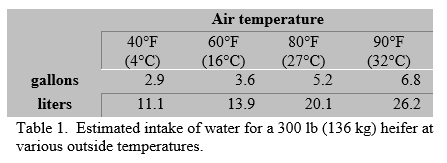
Water is obtained from many sources. In addition to free water, it is the primary component of milk (or milk replacer). However, water is also derived from grain, calf starter or hay (which contain approximately 12% water). Silages contain 50 to 75% water. Oxidation of nutrients in the body produces water as a by-product, also. Needs for water for calves are not very well determined and depend on diet, environmental temperature and humidity and other factors. For example, estimated daily water needs for a 300 lb. (136 kg) heifer are:
Because water is such an important nutrient, it must be available to calves at all times. Offer water to calves from three days of age and, if possible, provide water for free choice consumption. In addition, the quality of the water (presence and amounts of contaminants) can affect the performance and health of calves. (For more information on the performance of calves and availability of water, see Calf Note #04).
Water is lost from the body through feces, urine, sweat, and breath. During the process of rumen development and weaning, fecal volume increases and fecal dry matter usually decreases (except in the situation of scours). Urinary losses of water are highly variable and depend on the regulation of water balance by the kidneys. Sweat does not normally constitute a significant water loss, except in very hot climates. Expired air is saturated with water and represents a substantial route of water loss. Increased physical activity, respiration rate and other factors can influence water loss through the lungs.
Water balance in the body is tightly controlled under normal circumstances and is usually regulated by the kidneys. However, when calves develop diarrhea (scours), the water loss from the body increases dramatically. This is because the secretion of water into the intestine is usually several times the total plasma volume of the animal. If reabsorption of this water is impaired, then hyperfluidity of feces (diarrhea) and dehydration will occur. When the level of dehydration reaches 10%, the calf becomes anorexic and often comatose. Death usually occurs in calves above about 14% dehydration. (For more information on diarrhea in calves see Calf Note #42).
Water quality is important to animals – particularly calves. Safe levels of minerals are in the table below. Levels of contaminating bacteria (e.g., E. coli) and pesticides should be checked, also.
Availability of water to calves is important to health and performance. Water quality should be evaluated regularly and controlled when necessary. Provision of water in cold climates, particularly when the temperature falls to less than 0°C, can be a significant challenge for calf growers. However, the availability of free water is still important during this time. Producers have successfully utilized electrical heaters, non-freezing water bowls, nipple waterers, or frequent feedings as methods of providing water during freezing weather. On the other hand, in very hot weather, strategic supplementation of electrolytes in water and frequent feeding can promote water intake and improve health and performance.