Introduction
For years, we’ve known that difficult births have a dramatic effect on calf survival and health. When cows have to be assisted during birth, there are often lasting effects on the calf. Calves may suffer from anoxia (lack of oxygen) and acidosis and may have damage to joints, bones or organs. They feel poorly and are slow to stand or nurse the cow. As a result many calves suffer from failure of passive transfer and are more susceptible to disease.
This Calf Note provides a summary of an article published in the November, 2003 issue of the Journal of Dairy Science. Researchers from Iowa State University evaluated the effects of several variables on the incidence of perinatal mortality. Perinatal mortality (PM) was defined as calves that were born alive but died within 48 hours. Graphs in this Calf Note are used with permission of the Journal of Dairy Science and are copyrighted by the American Dairy Science Association.
ISU study
The dairy farm at Iowa State University collected data from 4,528 calvings between 1968 and 1999. During this time, all calvings were recorded and several important measures were made on both cow and calf. These calvings were evaluated to determine which factors were associated with PM. These variables might assist dairy producers understand the effects of calving on calf survival and identify those factors that can be controlled or measured by the produceOverall PM was 7.1% and rate of dystocia in cows was 23.7% of cows. In this study, dystocia was defined as each calving where assistance was provided to the cow. Cows were allowed two hours after appearance of the calf’s feet; thereafter, if no progress toward birth was made then assistance was given and the birth was classified as dystocia. There was no distinction of severity of dystocia (i.e., slight pull or severe pull with jacks).
Factors affecting PM
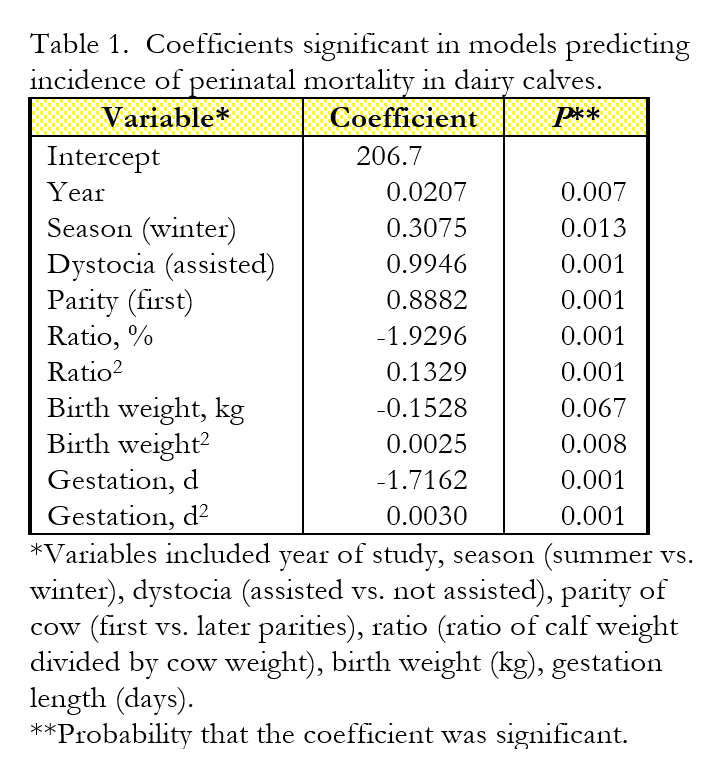
The researchers found that a lot of different variables were associated with PM (Table 1). The effects of year and season were significant and had positive coefficients, which means that as year increased, the chances of PM increased. It is not clear how year influenced PM, except that changes in management over time may have changed which affected PM.
Season also had an effect on PM in this herd. Calves born in winter (October through March) were 36% more likely to die in the first 48 hours compared to calves born in summer (April through September).
In the ISU herd, first calf heifers and dystocia had the greatest effect on PM. Calves born to cows with dystocia had 2.7 times the risk of dying than unassisted calves, and calves born to heifers had 2.4 times more PM in their calves compared to older cows. This information may be useful to other producers – it appears that calves from heifers are more susceptible and so, dairy producers should be more careful to monitor first calf heifers.
Weight ratio and PM
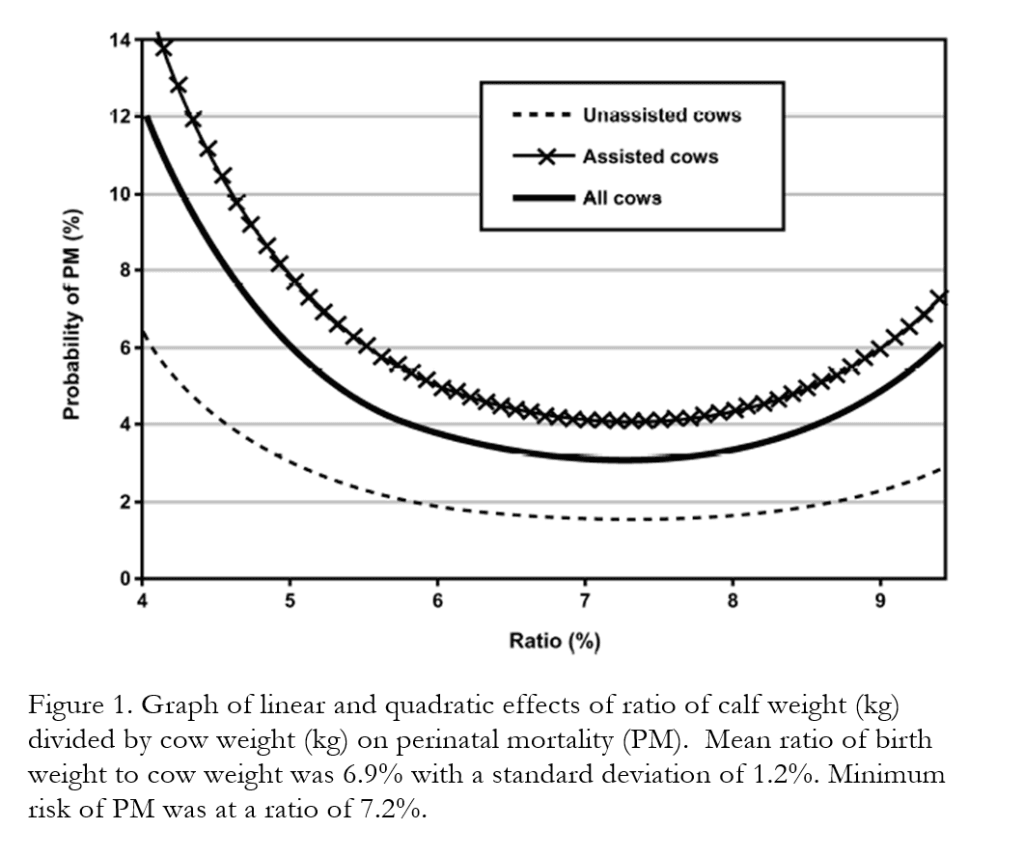
The ISU researchers also calculated a calf weight to cow weight ratio. For example if a 45 kg calf was born to a 600 kg cow, the ratio would be 0.075, or 7.5%. This ratio was highly significant in predicting PM, but in a curvilinear fashion (Figure 1). At very low ratios (big cows giving birth to small calves), the risk of PM was dramatically increased, particularly in assisted cows. Also, as the ratio of calf weight to cow weight exceeded about 7.5% (big calves from small cows), the risk of PM increased again. This might mean a low ratio means that calves are less able to survive. When small calves are born to large cows and assistance is required (see graph), the probability of PM was highest, which might mean that these calves have congenital defects which increased PM.
Birth weight on PM
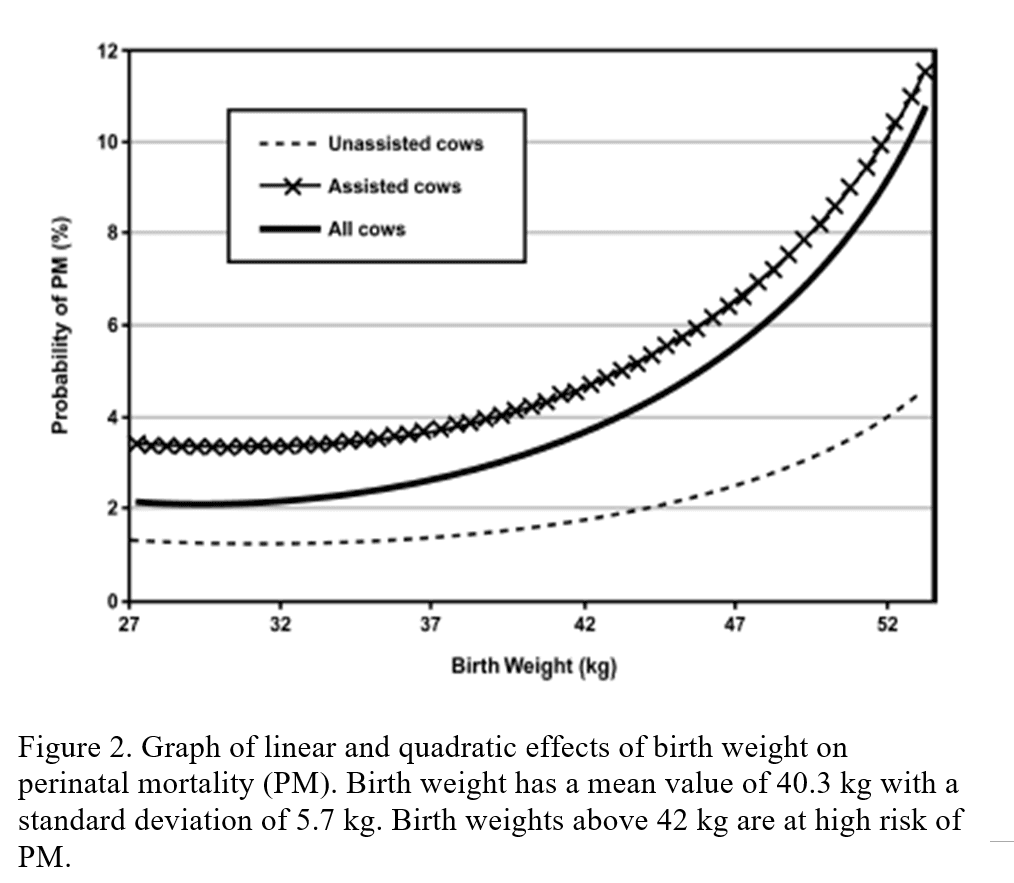
As you can see in Figure 2, as birth body weight increases, the risk of PM increases in a curvilinear fashion. From about 27 kg to about 37 kg of birth weight, there is little change in the increase in the risk of PM. Then, from about 42 kg to >52 kg, each kg increase leads to increasing risk of PM. This makes a lot of sense. It is well known that larger calves generally require additional assistance and calves can be harmed (broken bones, organ damage), particularly if the cow’s pelvic area is small.
Gestation length and PM
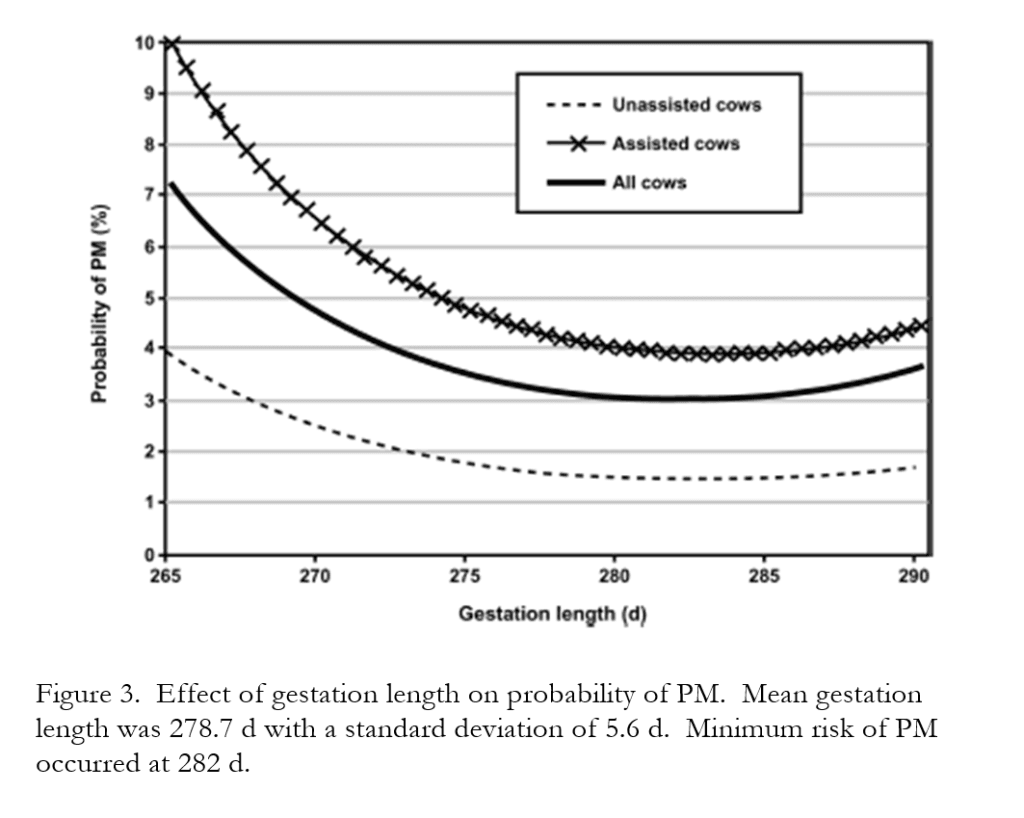
Length of gestation can influence whether newborn calves live or die. As you can see in Figure 3, the ISU researchers found that shorter gestation lengths (particularly less than 275 days) increased the probability of PM in calves.
When calves are born after an abnormally short gestation, the calf’s ability to survive is impaired. Important organ development, particularly lung development, occurs late in gestation.
What does this mean to you?
This research documents several important factors that can influence calf mortality. Here are some suggestions on how you can use this information:
- Understand the risks. Johanson and Berger indicate that there are important factors that influence calf survival after birth. These factors include dystocia, parity, birth body weight, gestation length, season and year, and ratio of calf weight to cow weight. Calves born to heifers, those that have to be pulled and big calves from small cows are candidates for special care.
- Identify susceptible calves. Take the time to mark calves that are at risk – a mark on the head, hutch or pen can be a reminder that the calf will need special attention.
- Monitor susceptible calves. “Marked” calves should get a special look when you monitor calves every day. Watch them a little more closely and be ready to intervene.
- Know what to do. Talk with your vet about a neonatal health plan. Talk about calving ease and how and when to assist the cow. Sometimes too much intervention is worse than too little! Set goals and strategies for achieving the plan and monitor your progress on a regular basis. Best of luck!
Reference: Johanson, J. M. and P. J. Berger. 2003. Birth weight as a predictor of calving ease and perinatal mortality in Holstein cattle. J. Dairy Sci. 86:3745–3755.