Introduction
The National Animal Health Monitoring System (NAHMS) has conducted surveys of practices in animal agriculture to identify key areas needed for improvement and particular risk areas that need to be addressed to improve animal health and farmer productivity. NAHMS conducted the National Dairy Heifer Evaluation Project in 1991-92, followed by Dairy ’96 and Dairy 2002. In all of these surveys, questions were asked about colostrum feeding and colostrum management.
If you’re interested, you can go to the NAHMS web site and see much more information regarding the Dairy 2002. The link is here.
NAHMS researchers evaluated several aspects of colostrum management and compared the data in Dairy 2002 with information from previous surveys. These are summarized below. The overall picture suggests that we’re getting better at managing heifer calves. It’s important to note that the producers were asked about their management of heifer calves, not bull calves. This is important… especially if you are involved in raising bull calves commercially. It’s generally accepted that bull calves are not as well managed as heifers because their value is generally less. So, as you look at the survey, keep in mind that the questions are related only to heifers.
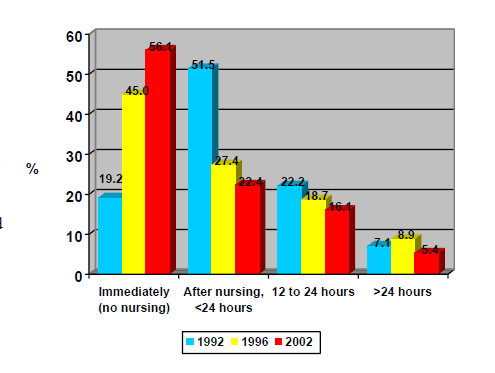
The first question related to the time at which calves were removed from the dam. Generally the information is quite positive (Figure 1). These numbers indicate that a greater percent of calves are removed from the mother prior to nursing and before the calf has a chance to pick up pathogens (bacteria and viruses) from the mother and calving environment. Several studies have shown that a major source of infection is the calving environment. The percent of calves that are left with the dam for more than 24 hours is going down and is just a little more than about 5% today. Overall, this should be helping reduce the risk of disease transmission in heifer calves.
Changes in these numbers may also reflect changes in where calves are housed. As farms get larger, there is more labor available to monitor calvings, meaning that there are fewer unobserved calvings. Many very large (>10,000) dairies have a staff dedicated specifically to calvings, which means that workers are not only present, but have a lot of experience in managing newly fresh cows as well as calves.
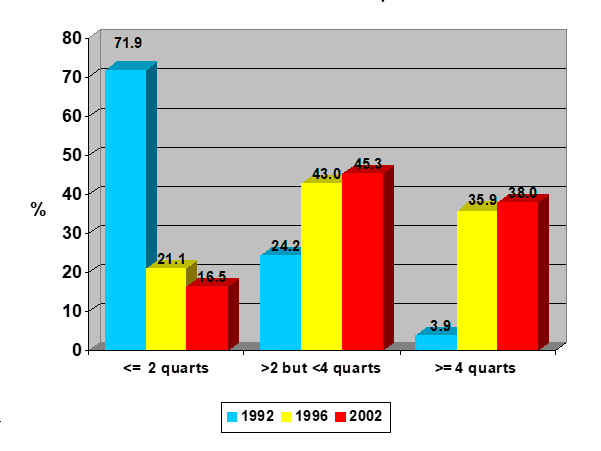
The second question asked of producers was how much colostrum is normally fed to those calves that are fed by hand. Common recommendations in the past were to feed calves 2 quarts of colostrum twice during the first 24 hours after birth, usually at less than 4 hours and about 12 hours. In the days of very high quality colostrum, this (1 gallon or about 3.9 liters) would have been sufficient. However, several studies have suggested that this method of feeding – particularly to Holstein calves – can result in inadequate transfer of immunity. Therefore, many dairy professionals are recommending that calves should be fed greater amounts of colostrum to minimize the risk of failure of passive transfer. Apparently, the message is getting out! Many more producers are feeding greater amounts of colostrum, which SHOULD improve passive transfer. However, there are many other factors that contribute to passive immunity. Feeding more colostrum may help, but it’s not the “silver bullet” to ensuring healthy calves.
There wasn’t a lot of change from Dairy ’96 to Dairy 2002 in these parameters, which suggests that producers are pretty comfortable with the amount of colostrum being administered to their calves.
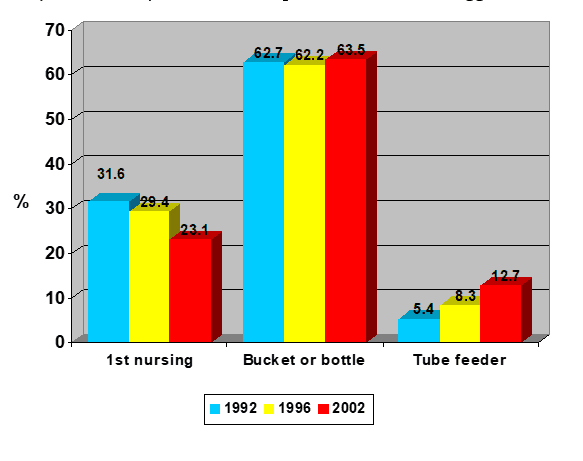
The final questions were related to the method of feeding and storage of colostrum. Traditionally, calves were allowed to nurse the dam (not a good idea, generally) and few were fed by esophageal feeder. However, over time, the percent of calves allowed to nurse is declining and those fed by tube feeder is increasing. This is probably related to the increased amount of colostrum fed. Many calves will not voluntarily consume 4 quarts of colostrum in the first feeding, so producers are increasingly administering colostrum by the tuber feeder. This topic is addressed in a previous Calf Note.
The final question was related to storage of colostrum. There’s good evidence to suggest that the microbiological quality of colostrum (i.e., the amount of bacteria in the stuff) is affected by the method of storage. Colostrum should generally either be frozen or in the process of being fed. Short term storage of colostrum by refrigeration can result in dramatic increases in bacterial counts. Therefore, care has to be taken in making sure that colostrum is stored properly. Fortunately, most producers (68.6%) store colostrum in the freezer. However, 10.9% of producers report storing colostrum without refrigeration and 19.3% store in the refrigerator. It’s the 10.9% of producers that leave the colostrum in the milk house or calf barn that are the greatest concern. The numbers of bacteria in colostrum double rapidly in colostrum that is held at room temperature. When colostrum is allowed to “sit” at room temperature for several hours, it becomes a perfect inoculation medium for bacteria. Tubing four quarts of this into a calf can dramatically increase the risk of disease. Colostrum should be cold, frozen (better) or in the process of being fed. Remember, that a 5 gallon bucket of colostrum will take a long time to get cold if you put the entire container into a refrigerator!
Summary
Generally, this important information indicates that the way colostrum is managed is changing for the better. It also indicates that we have a lot of work to do. Let’s keep up the good work!