Introduction
Intestinal bacteria are an integral component of the intestinal immune system. Intestinal homeostasis relies upon the equilibrium between absorption (nutrients, ions), secretion (ions, IgA) and barrier capacity to pathogens and macromolecules of the digestive epithelium. The intestine, particularly the large intestine, is inhabited by a diverse population of bacteria that perform a variety of functions which contributes to many of these functions. When this homeostatic control is disturbed, chronic inflammation, diarrhea and disease may occur. A normal intestinal bacterial flora is a critical to maintaining health. A key part of their function is to “out compete” the pathogenic bacteria and keep them from becoming established in the gut. When an animal is exposed to significant stress, it is possible for the growth of these normal enteric bacteria to become impaired. This allows for the growth of potential pathogens, thereby increasing the risk of disease.The theory related to the usefulness of probiotic bacteria is pretty simple – the balance of the intestine becomes upset due to some insult. Growth of normal “commensal” bacteria (particularly lactic acid bacteria) are impaired. By providing an exogenous source of bacteria, it is possible that these exogenous bacteria can become established in the gut, thereby reducing the chance for pathogens to become established. Probiotic products are relatively inexpensive and readily available, therefore, they are included in many different types and kinds of combination products.
Research
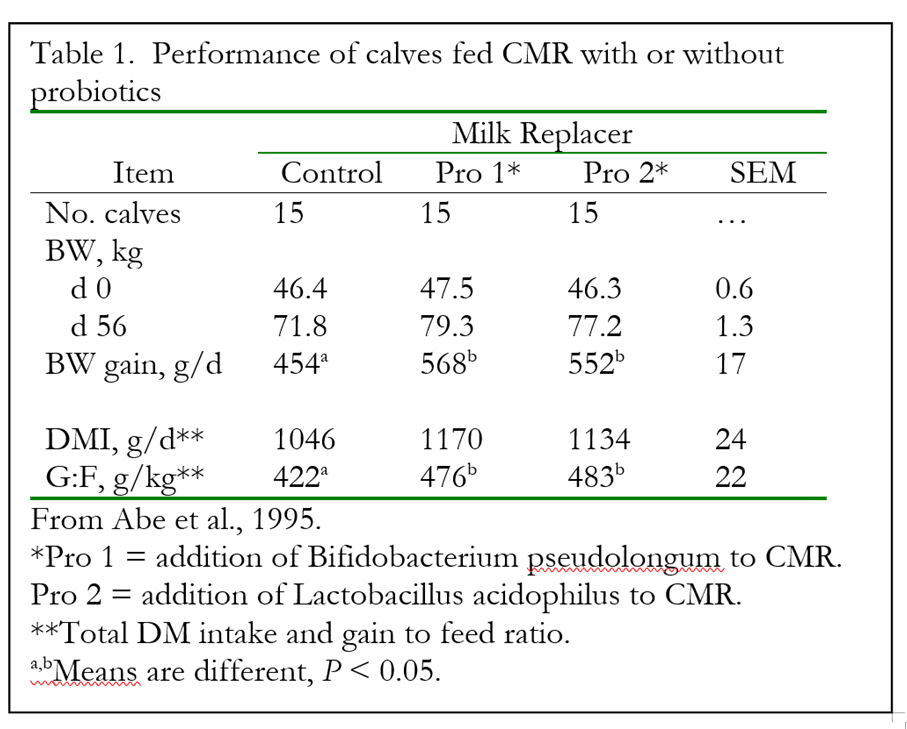
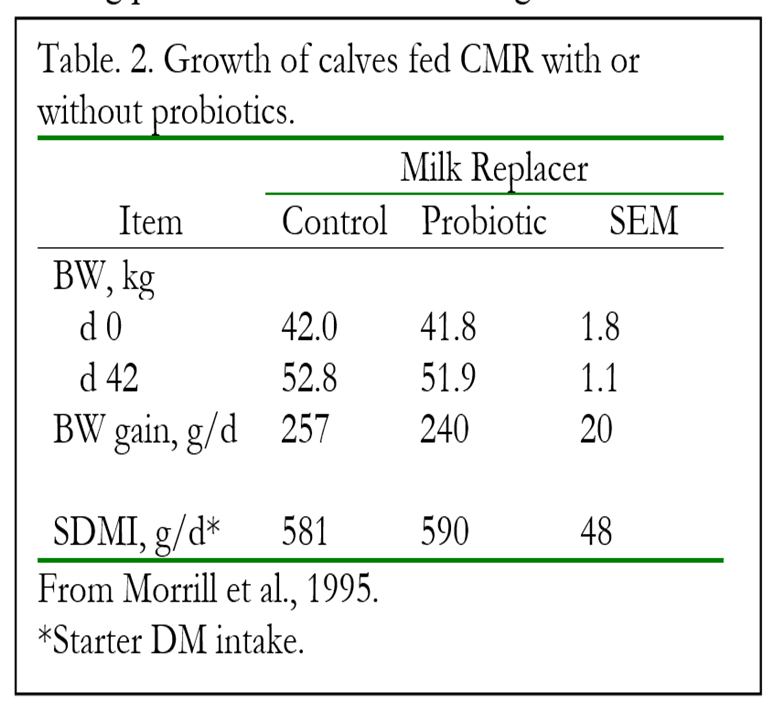
Research with probiotics added to diets of young calves have been equivocal. In some experiments, improvements in animal performance have been reported, in others, no effect of the inclusion of probiotics has been reported. It is probable that, like other potential AB replacements, effects are dependent on environmental conditions. In addition, the selection of specific bacteria may be important. Bacteria typical to the intestine (especially Lactobacilli and Bifidobacterium) have shown improved responses compared to other bacteria (e.g., Bacillus subtillus).Abe et al. (1995) reported improved performance (decreased scours scores, improved growth) when probiotic bacteria (Lactobacillus acidophilus and Bifidobacterium pseudolongum). On the other hand, Harp et al. (1996) reported that feeding probiotics to calves challenged with Cryptosporidium parvum had no effects on fecal scores or oocyst shedding in dairy calves. Morrill et al. (1995) also reported no effect of adding probiotics on health or growth of calves. Some researchers have suggested that probiotics may reduce the shedding of zoonotic pathogens such as E. coli 0157H7 (Ohya et al., 2000; Zhao et al., 1998).
Probiotics are often misused on the farm. Because probiotics are living bacteria, they must be handled carefully to maintain viability. The expiration date is very important to ensure viability. In addition, storage temperatures can influence the viability of the bacteria. Finally, it is important to remember that probiotics are bacteria – adding probiotics to medicated milk replacers will defeat the purpose of including the probiotic in the first place!
Will you see improved health or growth of calves if you feed probiotics to your calves? Well, there are no guarantees. The probability of seeing a response depends on several factors including the level of management on the farm, the amount of stress to which the calves are exposed during the milk feeding period and degree to which the normal bacteria are challenged or damaged during the stress period. Further, handling of the probiotic during storage, mixing and feeding will also affect the responses (if any). However, based on the available research data, the chances of seeing a response are reasonable. I have spoken to many dairy producers that have reported positive responses to feeding probiotics to calves, particularly prior to weaning. Adding probiotics to the diets of young calves appears to be a reasonable approach to intestinal health and reducing the reliance on antibiotics.
References
Abe, F., N. Ishibashi, and S. Shimamura. 1995. Effect of administration of Bifidobacteria and lactic acid bacteria to newborn calves and piglets. J. Dairy Sci. 78:2838-2846.
Harp, J. A., P. Jardon, E. R. Atwill, M. Zylstra, S. Checel, J. P. Goff, and C. De Simone. 1996. Field testing of prophylactic measures against Cryptosporidium parvum infection in calves in a California dairy herd. Am. J. Vet. Res. 57:1586-1588.
Morrill, J. L., J. M. Morrill, A. M. Feyerherm and J. F. Laster. 1995. Plasma proteins and a probiotic as ingredients in milk replacer. J. Dairy Sci. 78:902-907.
Ohya, T., T. Marubashi, and H. Ito. 2000. Significance of fecal volatile fatty acids in shedding of Escherichia coli O157 from calves: experimental infection and preliminary use of a probiotic product. J. Vet. Med. Sci. 62:1151-1155.
Zhao, T., M. P. Doyle, B. G. Harmon, C. A. Brown, P. O. Mueller, and A. H. Parks. 1998. Reduction of carriage of enterohemorrhagic Escherichia coli O157:H7 in cattle by inoculation with probiotic bacteria. J. Clin. Microbiol. 36:641-647.