Introduction
All animals require energy – for maintaining their normal body functions, for growth, production and reproduction. In the case of young calves, energy is used for maintenance and growth. There are many ways to express energy requirements – the latest edition of the NRC guide uses the metabolizable energy (ME) system for calves. This system is the most commonly used method of calculating an animal’s energy requirement and the energy content of feeds. For calves, the total amount of ME – usually expressed as kilocalories/day (kcal/d) or megacalories/day (Mcal/d) – is the sum of the ME requirement for maintenance and the ME requirement for growth (or body weight gain). NOTE: a calorie is defined as 4.184 joules.
The energy consumed by the animal is termed gross energy. When the energy of feces (called fecal energy) is subtracted from gross energy, the result is digestible energy. When the energy in urine and that lost in gasses are subtracted from digestible energy, the result is metabolizable energy. Metabolizable energy is our best estimate of the dietary energy that actually becomes available for metabolism by tissues of the animal.
ME requirement for maintenance. The amount of energy that an animal uses for normal body functions, (digestion, locomotion, heat production, etc.) is termed maintenance energy requirement. This is the amount of energy that an animal needs to maintain its current body weight. The ME requirement for maintenance is commonly abbreviated MEm.
ME requirement for gain. The amount of energy that an animals requires for growth is typically considered ME for gain, or MEg. This value is commonly determined by measuring the amount of energy in 1 kg of body tissue, then determining the efficiency with which energy is deposited in body tissue. The amount of energy deposited in body tissue will vary, depending on the type of tissue deposited. For example, there is more energy deposited in 1 kg of fat tissue compared to 1 kg of protein. As animals age, the composition of gain changes, and therefore, the calculation of MEg depends on the age (and size) of the calf.
The NRC guide divides animals into four categories and considers energy requirements for each:
- young replacement calves fed milk or milk replacer
- young replacement calves fed milk/milk replacer and starter
- veal calves
- ruminant calves (from weaning to 100 kg of BW)
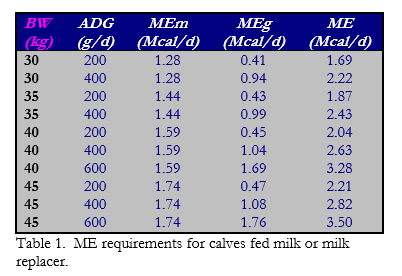
Requirements for calves fed only milk or milk replacer. This category of animals is typically young – weighing between 25 and 50 kg. This is because the normal method of rearing calves in the U.S. is to offer dry feed from an early age and to promote early weaning. The MEm requirement is calculated as: MEm = 0.100 × BW0.75. The MEg requirement for calves fed only milk or milk replacer is based on published research and estimates of MEg are based on the composition of body weight gain (which is affected by the size of the animal) and the rate of gain. The estimate is: MEg = [0.84 × BW (kg)0.355 × (ADG (kg/d)1.2]. The total ME requirements for calves in this category are shown in Table 1.
If we know the energy density of the feeds we’re feeding, we can estimate the amount of feed required to achieve a fixed rate of body weight gain. For example, let’s assume that whole milk contains approximately 12.5% dry matter (DM) and 5.37 Mcal of ME per kg of DM. If we want to feed a 40 kg (88 lb.) calf to gain 600 grams of BW/day, the ME requirement is 3.28 Mcal/day. Then we would need to feed 3.28 ÷ 5.37 = 0.611 kg of milk DM per day, or 0.611 ÷ 0.125 = 4.89 kg of whole milk per day. That equates to 10.8 lbs. of whole milk per day.
If you’re feeding milk replacer, the calculation is a little more difficult. That’s because the ME content of the milk replacer varies, depending on the amount of protein and fat in the formula as well as the digestibility of the ingredients used. An approximate calculation of the ME content of milk replacers may be calculated as:
ME (Mcal/kg of DM) = [0.057 × CP (%) + 0.092 × Fat (%) + 0.0395 × Lactose (%)] × 0.9312.
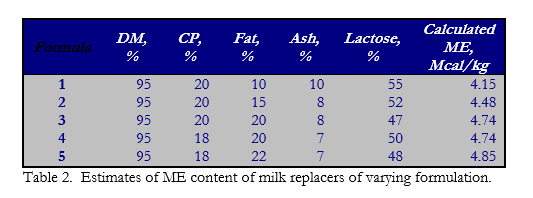
Let’s look at an example. We have a milk replacer containing 95% DM, 20% CP, 20% fat, and 47% lactose. The nutrients listed on the tag are normally expressed on an air-dry basis. Therefore, our first task is to express all values on a 100% DM basis. We do this by dividing the nutrient content by the percent DM in the formula: CP = 20 / 0.95 = 21.1%; fat = 20 / 0.95 = 21.1%; lactose = 47% / 0.95 = 49.5%. We can then estimate the ME content:
ME (Mcal/kg of DM) = [0.057 × 21.1 + 0.092 × 21.1 + 0.0395 × 49.5] × 0.9312 = 4.74 Mcal/kg of DMTo the amount of milk replacer to provide energy for a 40 kg calf to gain 600 grams/day, we would need 3.28 / 4.74 = 0.692 kg of milk replacer DM per day, or 0.692 / 0.95 = 0.728 kg of powder on an air-dry basis. This equates to 1.61 lbs. of milk replacer powder per day.
The above point is very important – all commercially available milk replacers in the U.S. contain less energy than found in whole milk. Table 2 shows the calculated ME content of milk replacers of varying formulations. Typically, milk replacers contain 75 to 90% of the ME founds in whole milk. Producers that typically feed whole milk (or waste milk) can see the difference in calf growth if they switch to milk replacer and feed a similar amount of DM. The fat and protein content of milk is easy to calculate – protein in milk is approximately 3.2% ÷ 12.5% DM = 25.6% protein on a DM basis. Similarly, the fat content of milk (let’s assume 3.5% fat) = 3.5 ÷ 12.5% = 28% fat on a DM basis.
Calves fed limited amounts of milk replacer (in the U.S., typically 1 lb. of powder per day) can gain only limited amounts of body weight from the energy and protein in the milk replacer. For example, we can calculate the potential growth of a 40 kg calf (88 lb.) fed 1 lb. (454 g) of a 20% CP, 20% fat milk replacer. Let’s assume that the milk replacer contains 4.74 Mcal of ME/kg of DM and 95% DM. The amount of ME the calf will consume from the milk replacer will be:
4.74 Mcal/kg of DM × (0.454 kg × 0.95) = 2.04 Mcal/day
The MEm requirement for this calf (weighing 40 kg) = 0.100 × 400.75 = 1.59 Mcal/day
Thus, if the calf eats 2.04 Mcal of ME and needs 1.59 Mcal to maintain its body weight, then it will have 0.45 Mcal available for growth. We can then calculate the amount of BW gain from 0.45 Mcal of ME based on the MEg equation – it’s approximately 200 grams (about 0.4 lbs./day). Thus, if a 40-kg calf consumes only 1 lb. of a 20/20 milk replacer, it will be able to gain only about 200 grams/day.
This is why early intake of high quality calf starter is so important to young calves. Under conventional feeding practices, calves will begin to grow rapidly when they begin to consume calf starter.
Estimates of the energy requirements of milk fed calves can be calculated from the equations listed in this Calf Note. For more information, you can go to http://books.nap.edu/catalog/9825.html to view an on-line version of the NRC guide. The bottom line. The newest NRC publication is a dramatic improvement over previous versions. It provides reasonable estimates of the animal’s nutrient requirements and is consistent with the remainder of the publication regarding tabular values and estimates of nutrient requirements. The estimates of energy requirements for young calves are more consistent with existing literature and can provide nutritionists, veterinarians and other dairy professionals with legitimate means to model dairy animal growth and select management strategies to optimize profitability. Future enhancements to the NRC will depend on the availability of published research related to young calves – their nutrient requirements under varying environmental, nutritional, and management conditions, the composition of diets fed, the environmental conditions within which calves are raised, as well as the immunological state of the animal when it enters the operation.