Introduction
The June 2008 issue of the Journal of Dairy Science contained an interesting article from the research group at Akey, Inc. regarding the amino acid requirements for young milk-fed calves. The authors reported that when standard whey-based (whey and whey protein concentrate) calf milk replacer (CMR) formulas were fed, there was a significant response to addition of crystalline amino acids, including lysine and methionine. When threonine was added to a CMR containing skim milk, there was no response in terms of growth, efficiency or urea nitrogen concentration.
Why is this a big deal? We know the amino acid requirements for various stages of growth down to the third or fourth limiting amino acid in other species of animals such as pigs and poultry. Why don’t we have the same information for young calves? Well, the amino acid “situation” in young calves is far more complex that that for pigs, poultry or even adult ruminants.
Amino acids that reach the abomasum (true stomach) of the adult ruminant consist of a combination of microbial protein produced in the rumen as well as the amino acids of proteins that escape degradation. Nutritionists have developed complex models for predicting the flow of each of these sources of amino acids under various feeding schemes in adult ruminants. Of course, the amount of microbial protein flowing out of the rumen depends on the diet and rate of microbial protein synthesis. The amount of degradable protein, which provides free nitrogen to the rumen bacteria also affects the rate of microbial protein synthesis and amino acids reaching the abomasum.
The situation is more complex in the milk-fed calf for a couple of reasons. The first is the immaturity of the rumen. For the first few weeks of life, rumen bacteria in the neonatal calf are becoming established and the type of bacteria and the amounts found in the rumen change quite significantly for the first few weeks of life.
The second reason that the amino acid “situation” in the young calf is more complex is due to the types of feed offered to the calf. Milk or milk replacer will generally by-pass the rumen through closure of the esophageal groove, so the composition of milk should not change significantly. This is a good thing, since the amino acid profile of milk is quite good. However, if closure of the esophageal groove is incomplete, some or all of the milk may enter the rumen, where it is fermented like dry feed. This phenomenon called rumen drinking (for more information, see Calf Note #113 https://www.calfnotes.com/pdffiles/CN113.pdf) and it will dramatically affect amino acid flow to the abomasum.
Protein in calf starter will be fermented to microbial protein by the rumen bacteria as rumen bacteria become established in the rumen. This phenomenon takes some time, however, and estimates that we use to predict rumen fermentation for cows may be inappropriate for calves. For example, we might estimate that about 35% of soybean meal would escape rumen degradation in adult cows; in a 3 week old calf, 75% of the protein in this same soybean meal might escape rumen degradation. As the calf ages and rumen function becomes more competent, the rate rumen escape of the soybean meal might decline from 75% to 35% as the calf’s rumen becomes mature. Unfortunately, this complex concept has not been seriously evaluated in controlled research.
So, in light of the changing dynamics of rumen development – microbial populations, rumen activity, diet changes, etc. the actual flow of amino acids to the intestine is maddeningly difficult to predict. Therefore, predicting amino acid requirements in young calves has eluded researchers for many years.
Finally, the immune status of the calf may have a significant effect on amino acid requirements. Calves that are immune depressed (i.e., insufficient colostrum consumption) may be forced to use extra energy and protein to support the immune system and fight off disease. Using amino acids for growth is a lower biological priority for these calves. Average daily gain and lean tissue growth may be sacrificed to support the immune system when the calf is in a life or death battle against pathogens.
Many researchers have tried to address these difficulties by feeding only milk to the calves and eliminating the variability in amino acid flow to the abomasum due to rumen development. This makes prediction of the amino acid requirement of the calf easier as the calf only receives amino acids from the diet with minimal rumen interference. In this feeding program, the calf remains a monogastric and predicting the amino acid requirements is relatively straightforward. However, the predicted requirements may be incorrect for the ruminating calf.
A second approach to the problem of predicting amino acid requirements is to feed calves under “typical” conditions – i.e., calves fed CMR plus starter – and expect that these predictions will hold ONLY for calves raised under similar conditions. In this situation, the results of the research depend very much on things like starter intake, rumen development and the amino acid composition of the CMR used in the study.
The research
In the case of the work published in the Journal of Dairy Science in June, 2008, the authors took the second approach to predicting amino acid requirements. In this study, calves (n = 282) were fed various formulations of milk replacer plus a calf starter containing 18% CP, 0.92% lysine, 0.29% methionine and 3.7% fat. The starter consisted of 37% rolled corn, 25% whole oats, 35% protein/vitamin/mineral pellet, and 3% molasses. The starter was offered from day 1 of the study. Calves were also fed CMR. In the first three studies, calves were fed a CMR at 681 g of powder per day, fed in two meals. The calves were fed CMR and starter for 28 days and then only starter and water to d 56.
Because calves were offered calf starter, their intake (127 to 286 grams/day during the first 28 days of the study) would contribute to ruminal development and would change the total amino acid profile reaching the abomasum.
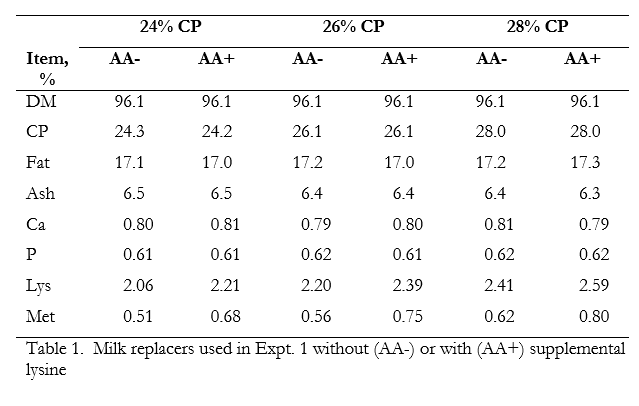
The amino acid profile of the CMR used in the first study is in Table 1. The amount of lysine (Lys) and methionine (Met) ranged from 2.06 to 2.59% and 0.51 to 0.80%, respectively. For comparative purposes, skim milk contains about 3.0% lysine and 1.0% methionine (NRC, 2001). If we calculate this to whole milk (milk contains about 28% fat on a 100% DM basis), whole milk will contain about 2.2% lysine and 0.7% methionine on a 100% DM basis. So, the amounts in the study (Table 1) were similar to amounts found in whole milk. The total CP in whole milk would be about 26%, if we assume that milk is 3.2% CP and 12.5% solids.
Calves fed additional CP as well as additional Lys and Met showed significant improvement in growth (average daily gain) and feed efficiency (Table 2). The best growth and feed efficiency (gain : feed, or G:F) occurred when calves were fed a 26% protein CMR containing 2.39% Lys and 0.75% Met.
These data suggest that the addition of amino acids (either crystalline or as crude protein) improved the calf’s ability to use nutrients for growth. Interestingly, starter intake was not stimulated although growth and efficiency were improved. Other studies have shown that as calves have more nutrients available for growth, they will increase starter intake.
Studies 2 and 3 evaluated increasing amounts of Met with CMR containing 26% CP and 2.34% Lys. Concentrations of Met ranged from 0.64 to 0.80% in these two studies. Optimal performance (increased ADG and G:F) was best when 0.72% Met was included in the CMR.
Finally, in study 4, calves were fed added threonine (1.06 to 1.80%) in a CMR containing 26% CP. There was no improvement in any measure when threonine was added to the CMR, suggesting that 1.06% Thr was adequate for these calves.
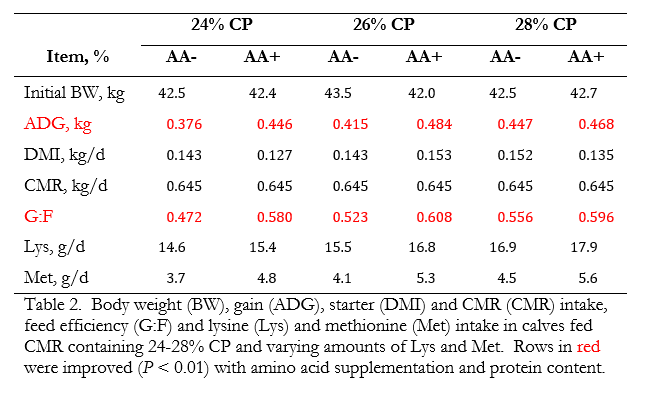
Improved calf performance – ADG and G:F – was observed during the first 28 days of studies 1-3. After weaning, there were no effects of the CMR treatments. This indicates that the improved performance of calves when fed CMR may not carry over after weaning.
Summary
Most monogastric nutritionists formulate rations for animals to provide amino acids at particular levels to meet the well defined amino acid requirements of the animals. In the current studies, using young milk-fed calves fed a limited amount of CMR (680 g/d) and a standard calf starter, performance appeared to be best when calves consumed 2.34% Lys and 0.72% Met.
It’s important to keep these results in context. While it’s tempting to reformulate your CMR to contain additional Lys and Met to meet optimal levels reported in this experiment (2.34% and 0.72%); however, it’s important to consider the amount and type of CMR and starter fed and the amino acid profile of each. These data may not be wholly appropriate for calves fed greater amounts of CMR, for CMR containing skim milk or when calves are not offered calf starter.
Calf milk replacers, like diets for other animals, should be formulated not only to a minimum crude protein concentration, but to include minimal content of essential amino acids. Predicting the total amino acid requirements of milk-fed calves also consuming starter (and a developing rumen) is inherently complex, but the current research indicates clearly that we cannot simply assume that milk proteins provide all essential amino acids for calves.
References
Hill, T. M., H. G. Bateman II, J. M. Aldrich, R. L. Schlotterbeck, and K. G. Tanan. 2008. Optimal concentrations of lysine, methionine, and threonine in milk replacers for calves less than five weeks of age. J. Dairy Sci. 91:2433–2442.
National Research Council. 2001. Nutrient Requirements of Dairy Cattle. 7th rev. ed. Natl. Acad. Sci., Washington, DC.