Introduction
The first few weeks of life, when we typically feed calves whole milk or milk replacer is also the time when calves typically experience episodes of diarrhea, often caused by infectious organisms such as rotavirus, Cryptosporidium parvum or Salmonella. Is this is coincidence? Or is there some relationship between the type and/or amount of liquid fed to calves and the incidence and severity of diarrhea?
For many years, feeding calves was quite simple – recommendations called for feeding approximately 450 grams (1 lb.) of solids of either calf milk replacer (CMR) powder or as approximately 4 liters (1 gallon) of whole milk per day. There was little variation in amounts of liquid fed, so it was assumed that incidents of diarrhea were caused by factors other than the amount of liquid fed to calves.
More recently, we have seen the introduction of higher protein CMR formulations that are fed at much more than 450 grams of powder per day. In addition, research has shown that calves can and will voluntarily drink much more whole milk than 4 liters per day. With these various options now available, calves may be fed different amounts of liquid for different periods of time and amounts of liquid offered may change quite dramatically from week to week. Do these changes in feeding volumes and concentrations predispose the calf to diarrhea or even cause diarrhea?
Older research
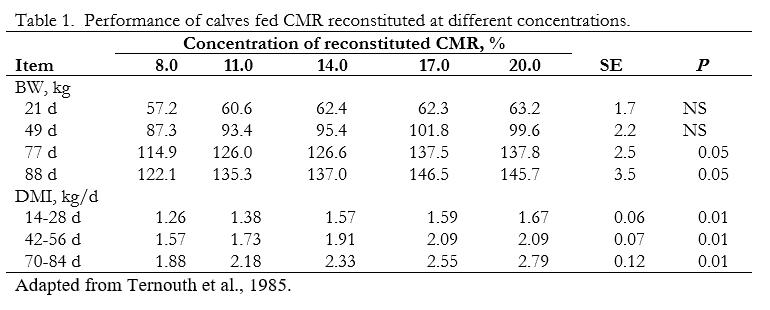
Ternouth et al. (1985) fed calves CMR for ad libitum consumption for 12 weeks. The CMR were formulated from skim milk, fat powder and vitamins and minerals. The CMR were reconstituted to 8, 11, 14, 17 or 20% DM. Calves were offered colostrum for 2 days, then 3.5 L of reconstituted CMR at each feeding on d 3, 4.0 L per feeding on day 4, 4.5 L on day 5, etc., until calves refused milk. Whenever calves consumed all their CMR on a given day, calves were offered an extra 1 L per day on the subsequent days. These calves grew very well although their intake of DM varied by concentration — i.e., calves fed the more concentrated CMR consumed more DM than calves fed less concentrated CMR (Table 1). Body weights also followed intake of DM.
What about scours? There was no change in fecal consistency with diet concentration although there was a softer consistency of the feces with increasing age mainly due to reduced values at 11 and 12 weeks of age which was due to an outbreak of disease.
In an interesting article published in 1973, Lodge and Lister fed Holstein bull calves whole milk and then tried to increase the amount of energy in the milk by adding either butterfat or glucose to change the energy to protein ratio. Their hypothesis was that milk protein might be used more efficiently by young calves if they have more energy available at a given level of digestible protein. They found that the addition of large amounts of glucose tended to increase the rate of scours in some of their experiments.
Finally, way back in 1953, Blaxter and Wood reported that there was a decrease in fecal DM with increased carbohydrate intake, which, could be related to the observations made by Lodge and Lister (1973) of increased diarrhea when excess amounts of glucose were fed to calves. This observation suggests that the composition of the liquid fed may have a greater impact on the looseness of feces compared to the amount of liquid fed per se.
Recent Research
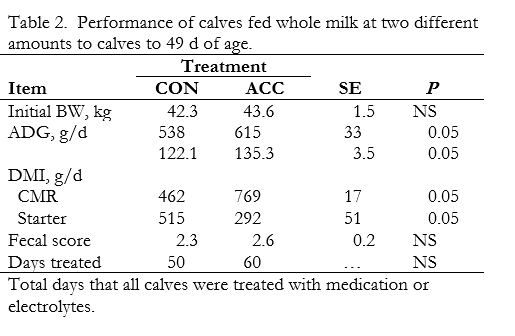
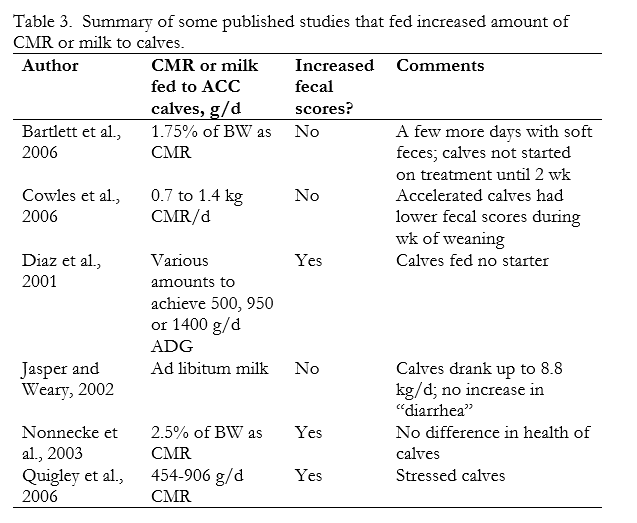
As can be seen from Table 3, there is not a unanimous opinion on changes in fecal scores or in the incidence of diarrhea (NOTE: some authors describe the incidence of diarrhea differently). Though several authors noted that calves had “looser” feces (which would mean increased fecal scores), they noted this didn’t necessarily amount to increased diarrhea. Generally, these authors defined diarrhea as fecal scores of 3 or 4 on the scale of 1 = normal feces to 4 = severe, watery feces.
The data DO suggest that feeding milk replacer does not NECESSARILY mean increased diarrhea – or for that matter, increased fecal scores. As was written more than 20 years ago by Huber et al. (1984), “Sanitary and management conditions probably play a more important role than amount of milk in incidence of diarrhea in young calves.”. This is consistent with our observations (Quigley et al., 2006) that when stressed calves (transported calves with failure of passive transfer) were fed CMR in an accelerated feeding program, there was an increase in fecal scores.
Summary
A review of published research suggests that there have been cases where feeding additional milk or CMR has resulted in increased incidence of “loose feces” or, in some cases, in incidence or severity of diarrhea. However, the research indicates that loose feces is not necessarily related to increased CMR feeding, but may be related to amount of liquid fed, the composition of the diet, and many other factors, most important of which is the degree of microbial contamination in the environment.
References
Bartlett, K. S., F. K. McKeith, M. J. VandeHarr, G. E. Dahl, and J. K. Drackley. 2006. Growth and body composition of dairy calves fed milk replacers containing different amounts of protein at two different feeding rates. J. Anim. Sci. 84:1454-1467.
Blaxter, K. L. and W. A. Wood. 1953. Some observations on the biochemical and physiological events associated with diarrhea in calves. Vet. Rec. 65:889-893.
Cowles, K. E., R. A. White, N. L. Whitehouse, and P. S. Erickson. 2006. Growth characteristics of calves fed an intensified milk replacer regimen with additional lactoferrin. J. Dairy Sci. 89:4835-4845.
Diaz, M. C., M. E. Van Amburgh, J. M. Smith, J. M. Kelsey, and E. L. Hutten. 2001. Composition of growth of Holstein calves fed milk replacer from birth to 105-kilogram body weight. J. Dairy Sci. 84:830-842.
Huber, J. T., A. G. Silva, O. F. Campos, and C. M. Mathieu. 1984. Influence of feeding different amounts of milk on performance, health, and absorption capabilities of baby calves. J. Dairy Sci. 67:2957-2963.
Jasper, J., and D. M. Weary. 2002. Effects of ad libitum milk intake of dairy calves. J. Dairy Sci. 85:3054.
Lodge, G. A., and E. E. Lister. 1973. Effects of increasing the energy value of a whole milk diet for calves. I. Nutrient digestibility and nitrogen retention. Can. J. Anim. Sci. 53:307-316.
Nonnecke, B. J., M. R. Foote, J. M. Smith, B. A. Pesch, and M. E. Van Amburgh. 2003. Composition and functional capacity of blood mononuclear leukocyte populations from neonatal calves on standard and intensified milk replacer diets. J. Dairy Sci. 86:3592-3604.
Ternouth, J. H., I.J.F. Stobo, and J.H.B. Roy. 1985. The effect of milk substitute concentration upon the intake, digestion and growth of calves. Anim. Prod. 41:151-159.