Introduction
Calves are normally fed limited amounts of milk or milk replacer – usually between 454 to 680 grams (1.0 to 1.5 lb) of milk replacer solids per day. The amount of metabolizable energy (ME) in this amount of solids in a typical calf milk replacer (CMR) is enough to provide enough ME for a calf to maintain its body weight and to grow about 200-400 grams of body weight gain per day.
ME requirements of calves
The amount of ME required for calves under normal conditions can be divided into two components – the amount of ME that the calf needs to maintain its body weight (we’ll call it MEm). It is the amount of ME required for movement, heat, and normal functions. The second part of the energy equation is the amount of ME required for growth (MEg). Researchers use both MEm and MEg to calculate nutrient requirements for animals. For young calves fed only milk, the MEm requirement (in megajoules per day or MJ/d) are calculated as a proportion of “metabolic body weight” and is calculated as (0.1 × BW0.75) × 4.184. So, for a 50 kg calf, the MEm requirement is (0.1 × 500.75) × 4.184 = 7.87 MJ/day.
The calculation of MEg – the amount of ME the calf needs for growth – depends both on the size of the calf and the average daily gain. The equation used by the NRC is [0.84 × (BW0.355 × ADG1.2)] × 4.184. So, for a 50 kg calf gaining 500 grams per day, the amount of MEg required is [0.84 × (500.355 × 0.51.2)] × 4.184 = 6.13 MJ/day. Therefore, for a 50 kg calf, the TOTAL ME required per day is 7.87 + 6.13 = 14.00 MJ/day.
Extra CMR feeding
When it gets cold outside, the amount of MEm that a calf needs to maintain its body weight increases. Calves (like all mammals) generate heat to maintain constant body temperature. And, when it gets cold outside, the calf needs more energy to keep warm.
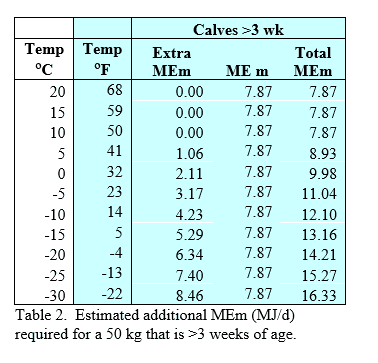
So, the amount of MEm the calf needs increases with colder weather. The amount of extra MEm needed depends on how old the calf is, however. That’s because as calves get older, the are more likely to be eating calf starter. Starter intake drives rumen development and a functional rumen produces its own heat, which helps keep the calf warm. The Lower Critical Temperature (LCT) is the temperature at which animals begin to require additional energy to maintain their body temperature. For calves 0-3 weeks of age, the LCT is 20ºC and for calves older than 3 weeks of age, it’s 10ºC. The LCT is the temperature at which producers should consider feeding extra energy.
The NRC calculated the amount of additional energy calves need in cold weather. They used the LCT for younger (0-3 wk) and older (>3 wk) calves. The formula the NRC used was: additional MEm (MJ/d) = [(2.15 × BW0.75)/0.8] × 4.184 per degree below the LCT.
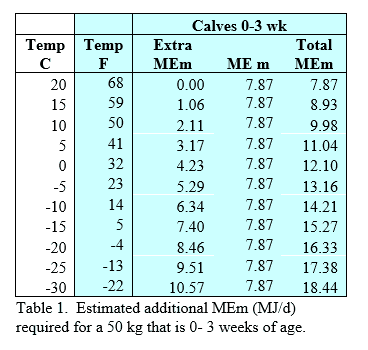
So, for let’s look at an example for a 50 kg calf. In Table 1, when it’s 20ºC outside (68ºF), the calf doesn’t need any additional MEm. However, as it gets colder, the amount of MEm the calf requires to maintain its body weight increases – dramatically. By the time it’s 0ºC (32ºF), the calf needs an additional 4.23 MJ of ME per day. That’s an increase of over 50% of the MEm!
Let’s look at the practical effects of this to the calf. Let’s say that it’s -20ºC outside and we have a 50 kg calf that requires 7.87 MJ of MEm per day. Let’s also assume that the calf is eating 600 grams (0.6 kg) per day of a commercial CMR that contains 19.9 MJ of ME per kg.
The MEm for this calf if 7.87 (normal MEm) + 8.46 (table 1, -20ºC) = 16.33 MJ/day for maintenance. The calf is consuming 0.6 kg × 19.9 MJ/kg = 11.94 MJ/day of TOTAL ME.
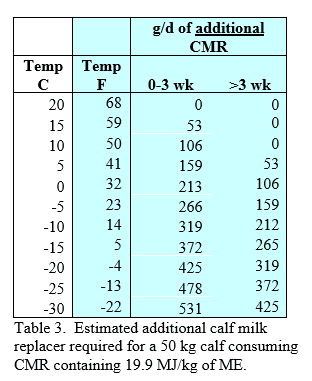
All of these calculations are all well and good, but what’s the practical implication? I’ve put together Table 3, which shows the amount of additional milk replacer solids that calves need to maintain their body weight at various temperatures. I assumed that a “standard” CMR contains 19.9 MJ/kg of ME – the product that you use in your operation may be different. Look for a future Calf Note to show you how to calculate the amount of ME in your CMR.
Table 3 lists the amount of additional CMR required for a 50 kg calf that is either 0-3 weeks of age or >3 weeks of age and consuming a standard CMR containing 19.9 MJ/kg of ME.
So, when it’s 0ºC outside, you’ll need to feed young calves weighing 50 kg an additional 213 grams per day. If you normally feed 454 grams/day under thermoneutral conditions, you’ll need to feed a TOTAL of 454 + 213 = 667 grams per day of CMR for them to continue to grow at the same rate as when it’s warm outside.
Note that there are several variables involved in this calculation – body weight of the calves, outside temperature, age and quality of the CMR.