Introduction
Iron is an essential nutrient for growth. However, free iron in the body may promote the production of free radicals, which can result in tissue damage. Therefore, the body utilizes several different kinds of iron carrying proteins to provide a mechanisms for transporting iron while simultaneously keeping it from causing damage. Iron is also an essential nutrient for many different kinds of bacteria. If iron were removed from the bacterial environment, then growth of the bacteria might be impaired. Indeed, research has been conducted with two different iron binding compounds, lactoferrin and transferrin, to determine if they can contribute to the animal’s immune system and possibly replacing AB.
The strategy goes something like this: “if iron is required for growth by some bacteria (like E. coli), let’s remove the iron from the environment. The growth of bacteria will be decreased”.
Lactoferrin
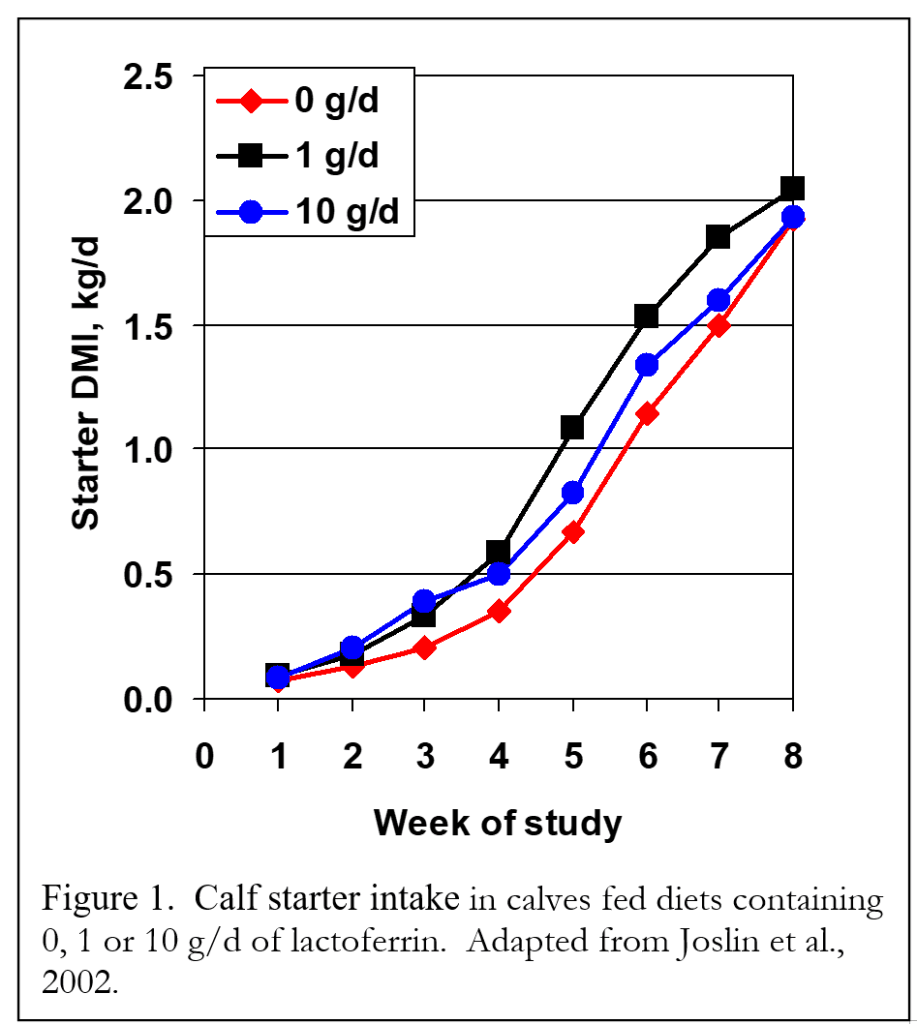
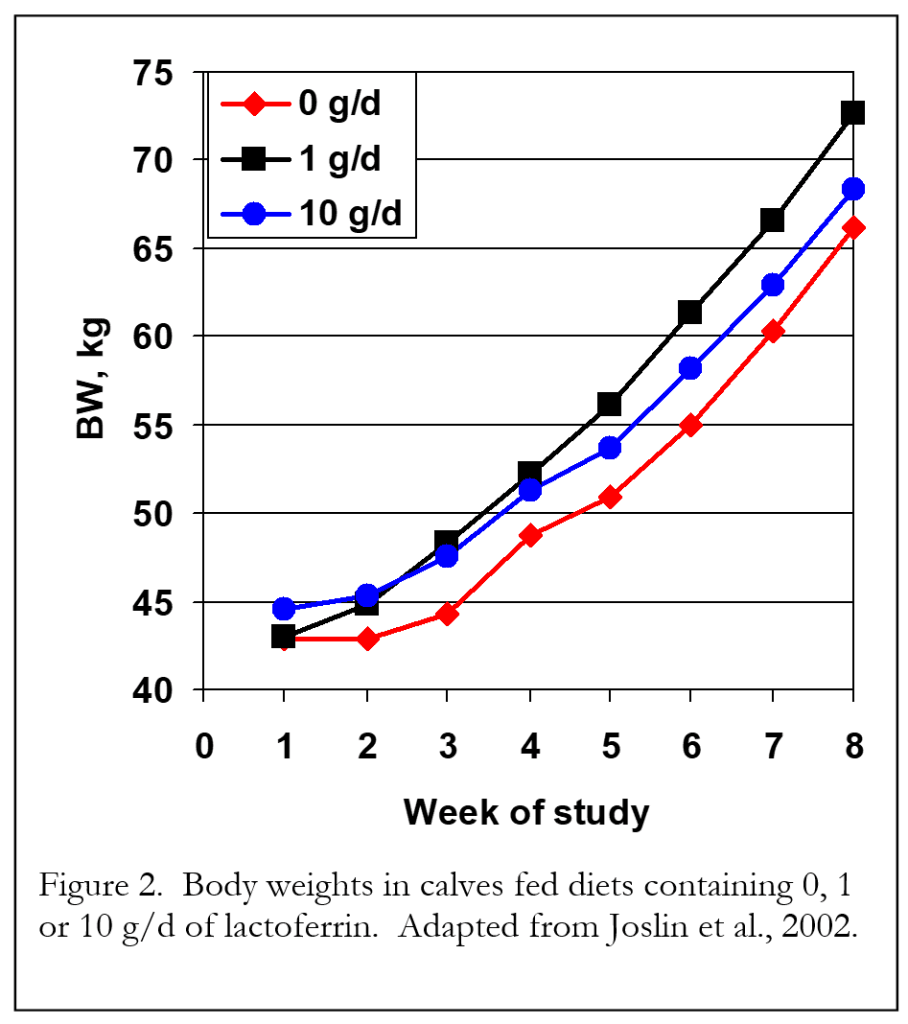
Joslin et al. (2002) evaluated the addition of Lf to CMR (and colostrum) in calves housed in individual pens at the University of New Hampshire Experiment Station. Calves were fed 0, 1 or 10 g/d of purified Lf in the milk replacer. Intake of CMR and starter, BW and gain and fecal scores were measured during the 56-day study.
The authors reported improved ADG and starter DMI (Figure 1) when calves were supplemented with 1 or 10 g of Lf in the CMR. Improvements in BW (Figure 2) and starter intake were particularly evident during the latter weeks of the study. The authors reported that calves were healthier and, consequently, consumed more starter DM, which improved growth.
Based on these data, the question of whether Lf can contribute to animal health and potentially reduce the effects of an enteric challenge (i.e., replace AB) have not been completely addressed and more research is required.
Transferrin
Transferrin (Tf) is an another iron-binding protein that is found in blood. It performs a similar function in blood as lactoferrin in milk. Transferrin has been proposed as a method of reducing growth of pathogenic bacteria (Brock, 1989; Fettman and Rollin, 1985); however, no on-farm trials have been conducted with Tf in calf milk replacers. In vitro work conducted in our laboratory indicates that apo-Tf can reduce growth of pathogenic bacteria including Salmonella typhimurium and E. coli by up to 50%. The use of Tf, like the use of Lf, holds some significant promise to reducing the growth of bacteria under certain conditions.
Summary
Replacing antibiotics in animal agriculture requires numerous alternative approaches to reducing the growth of bacteria and virus in the animal. Of course, the most straightforward approach to reducing growth of pathogens is to remove them from the environment in the first place. A clean, stress free environment is the best medicine! But, sometimes animals can be exposed to them – numerous approaches to reducing growth of bacteria and viruses are possible. One approach is the use of iron-binding proteins to remove iron from the environment and impair the growth of bacteria. Interestingly, iron held by the iron carrying proteins does appear to be available to the animal, which means that the animals are not at risk for iron deficiency.
References
Arnold, R. R., M. F. Cole, and J. R. McGhee. 1977. A bacterial effect for human lactoferrin. Science 197:263–265.
Brock, J. H. 1989. Iron-binding proteins. Acta Paediatr. Scand. Suppl. 361:31-43.
Fettman, M. J. and R. E. Rollins. 1985. Antimicrobial alternatives for calf diarrhea: iron chelators or competitors. JAVMA 187:746-748.
Joslin, R. S., P. S. Erickson, H. M. Santoro, N. L. Whitehouse, C. G. Schwab, and J. J. Rejman. 2002. Lactoferrin supplementation to dairy calves. J. Dairy Sci. 85:1237–1242.
Rejman, J. J., P. M. Torre, K. D. Payne, M. L. Lewis, R. A. Muenchen, and S. P. Oliver. 1992. Influence of apo- and iron saturated lactoferrin and transferrin, immunoglobulin G and serum albumin on proliferation of bovine peripheral blood mononuclear cells. Food Agric. Immunol. 4:253–257.
Shin, K., K. Yamauchi, S. Teraguchi, H. Hayasawa, M. Tomita, Y. Otsuka, and S. Yamazaki. 1998. Antibacterial activity of bovine lactoferrin and its peptides against enterohaemorrhagic Escherichia coli 0157:H7. Lett. Applied Microbiol. 26:407–411. Smith, K. L., and S. P. Oliver. 1981. Lactoferrin: A component of nonspecific defense on the involuting bovine mammary gland. Adv. Exp. Med. Biol. 137:535–554.