Introduction
The What’s Happening? series continues with Episode #8, filmed during a visit to a dairy farm in southeastern Paraguay near Colonel Sommerfeld, not far from the famous Foz do Iguaçu waterfalls.
The photo from this episode shows calves approaching weaning. Like many farms around the world, these calves were offered free-choice forage in addition to grain starter. At the time the photo was taken, no calves were eating, making it easy to see the grain and forage offered separately.
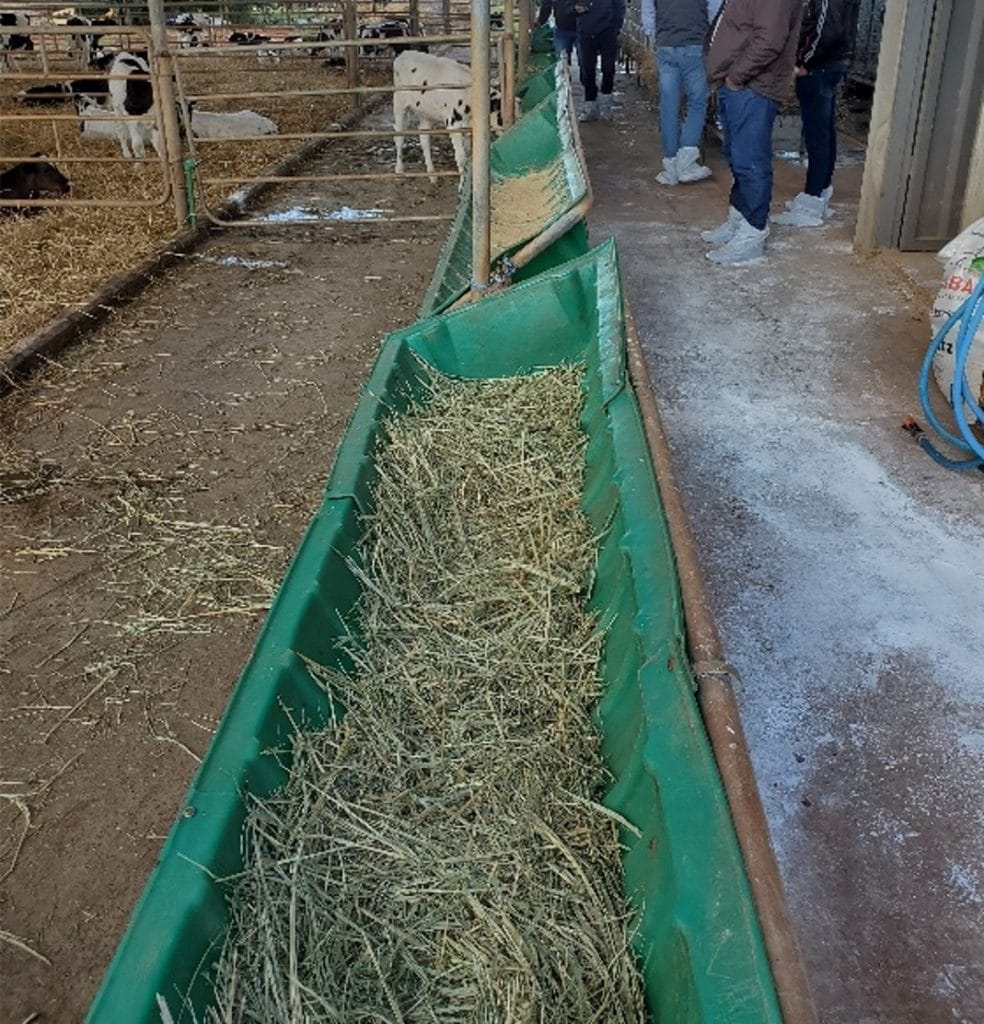
This episode asks a simple question: When calves are offered a choice, what do they prefer — grain or forage?
What’s Happening?
We know calves need forage at some point in their development. Fiber plays a role in rumen health, rumen muscular development, and reducing the risk of acidosis.
But when forage is offered ad libitum (free choice) alongside grain starter, calves do not eat uniformly.
Research shows wide variation in voluntary forage intake during the first two months of life:
- Some calves eat little or no forage.
- Some eat moderate amounts.
- A few consume relatively large amounts.
This variability makes nutrient management difficult during the critical weaning transition.
And when given the choice?
Most calves prefer grain.
It’s not unlike offering a child oatmeal and ice cream at the same time.
Common Forage Feeding Strategies
Around the world, farms use several approaches to introduce forage:
- Free-choice forage, offered in a separate bunk.
- Mixing forage with grain, hoping calves consume both together.
- Top-dressing forage with grain, expecting calves to eat the forage first.
However, experience shows that calves are quite capable of pushing forage aside to reach the grain underneath.
Photos from farms in China, Russia, the UK, Brazil, Paraguay, and the United States all tell the same story: when offered separately, most calves head straight to the grain bunk.
What Does Research Tell Us?
Research from the Provimi group (published by Dr. Mark Hill in 2008) examined voluntary forage intake in calves during the first two months of life.
Results showed:
- Many calves consumed little or no forage.
- Only a minority consumed significant amounts.
- In that study, only 8 out of 24 calves consumed more than 100 grams of forage per day.
Canadian research suggests that intake above approximately 100 grams per day may reduce the risk of ruminal acidosis. However, most calves in voluntary systems do not consistently reach that level.
After about two months of age, calves typically increase forage intake naturally. On average, forage accounts for approximately 8–10% of total dry matter intake, confirming that young calves generally prefer concentrate over forage.
Is Free-Choice Forage Optimal?
Although free-choice forage is common, it is not necessarily optimal during the pre-weaning and early weaning period.
The main challenge is lack of intake control:
- Too little forage may increase acidosis risk.
- Too much forage may dilute energy intake and reduce growth.
- Large variation among calves makes consistent management difficult.
When calves select their own diet, nutrient intake becomes inconsistent across the group.
A More Controlled Approach
A more effective method is feeding a dry TMR (Total Mixed Ration) containing approximately 10% forage blended uniformly with concentrate.
Advantages include:
- Every calf receives the same nutrient profile daily.
- Fiber intake is controlled.
- Risk of extreme under- or over-consumption is reduced.
- Weaning transition is smoother.
Blending forage into the ration ensures that fiber is consumed — rather than left behind.
Practical Take-Home Messages
- Calves generally prefer concentrate to forage.
- Free-choice forage results in highly variable intake.
- Many calves consume insufficient forage when offered separately.
- Nutrient control during weaning is critical for rumen development and growth.
- A blended dry TMR with controlled forage inclusion improves consistency.
Final Thought
When calves — like children — are allowed to select their own diet, they don’t always make the best choices.
We can manage their nutrition more effectively than ad libitum forage systems.
Calves crave concentrate — even when they need some forage. Good management means balancing preference with physiology. See you next time.