Introduction
Colostrum quality is usually measured by the concentration of immunoglobulins (Ig) that the colostrum contains. There is a huge amount of information available on the need for feeding good quality colostrum and its effects on the calf. There are fewer data, however, regarding the factors that affect the quality of colostrum produced by the cow. We know that age and parity (which are indices of disease exposure) will generally improve (increase) Ig concentration of colostrum. However, the effects of the metabolic status of the cow on colostrum quality are less well understood.
A group of Mexican researchers (Lona-D and Romero-R, 2001) conducted a study to evaluate the quality of colostrum in cows that expelled their fetal membranes normally against those that experienced retained placenta. This interesting study indicated the complexities involved with colostrum production by the cow.
The study
Multiparous cows (n = 27) were allowed to calve and first milking colostrum was collected and stored at -20ºC prior to analysis for IgG, total protein, casein and fat concentration. Cows were divided into two groups – those without retained placenta (n = 13; CON) and those with retained placenta (n = 14; RP). Cows were defined as having RP if they failed to expel fetal membranes by 12 h after delivery.
Results of the study were very interesting (Table 1). Cows with RP had higher concentrations of casein and lower concentrations of Ig than CON cows. Total protein concentrations tended (P < 0.08) to be higher in cows with RP, but this was not different at P < 0.05. Fat concentrations were unaffected by RP status.
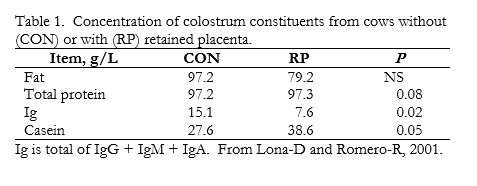
This research suggests a couple of things. First – the hormonal status of the cow (which may predispose her to retained placenta) may have an effect on both the casein and IgG concentration of colostrum. This means that cows suffering from retained placenta, which may have abnormal concentrations of circulating cortisol pre-calving, are destined to produce colostrum with poorer concentrations of Ig.
Colostrum quality was quite low in this study and even CON cows produced colostrum that only contained 15 g of Ig per liter. This is far lower than optimal and could be due to a number of factors, including environmental temperature, immune history of the cows, etc. It’s not known if not similar results could be expected in cows that typically produce colostrum with greater amounts of Ig; however, further studies are warranted to document whether RP affects colostrum quality in cows that generally produce higher Ig colostrum.
Another consideration is that while Ig concentration was lower, casein concentration was higher in cows with RP. This may have important implications in the use of the colostrometer, which measures total solids as an estimate of IgG concentration. Cows with RP may produce colostrum with similar amounts of total solids but lower amounts of IgG. This would add variability to estimates made using the colostrometer and make it less useful as an overall tool for estimating IgG concentration.
Summary
An important message in this research is that the quality of colostrum that we get from cows is controlled by many factors, including the incidence or RP. Because colostrum quality can be so variable, our best option is to carefully measure colostral IgG concentration and minimize the use of poor quality colostrum. Although this study suggests that the colostrometer may have greater variability associated with it, it still remains the best option to estimate total Ig in colostrum on the farm. Other methods include direct measurement of IgG using colostrum “quick tests” that allow calculation of colostrum IgG. Testing colostrum quality is important and will reduce the risk of failure of passive transfer and improve the quality of the calf raising operation.
Reference
Lona-D., V and C. Romero-R. 2001. Low levels of colostral immunoglobulins in some dairy cows with placental retention. J. Dairy Sci. 84:389-391.