Introduction
A consistent and chronic challenge on all dairy farms seems to be the production of flies during the warm months of the year. Flies are known to be in higher densities in calf areas than most other parts of the dairy farm. There are many control measures and most insect experts recommend an integrated pest management program (also called an IPM) that incorporates control of breeding areas (especially bedding), traps, insecticide sprays, tags and bait, and use of biological control agents.
In a 2005 article in the Journal of Dairy Science, Cornell University researchers evaluated the use of large sticky traps as one part of an IPM program for dairy farms raising calves in greenhouses. The particular type of sticky trap, named “Spider Web” is manufactured by Atlantic Paste and Glue (http://www.catchmaster.com/). Because the trap is large (30 cm wide × 7.3 m long) it is generally used in enclosed barns and is not used in individual hutches. This trap is double sided and is high capacity – the manufacturer indicates that one trap can hold up to 100,000 flies. The Cornell researchers unrolled 3 m of each trap, finding that exposing more surface area was unstable.
The study
Five New York dairies participated in the on-farm study. Each used greenhouses to raise calves and the greenhouses housed varying numbers of calves throughout the study. Every Monday, traps were unrolled to 3 m and placed 2.5 m high in the rafters of each greenhouse. The number of traps used depended on how many calves were present at the time. The number of traps used each week ranged from 4 to 20 per barn. The number of calves in the barn each Monday of the study ranged from 16 to 87.
After four days (on Friday), each trap was taken down and the number of flies (house and stable) were determined. Then the number of flies on the legs of calves was also determined when the traps were taken down. For the next 3 days (Friday to Sunday), no traps were in place; then on Monday, the number of flies on legs was again counted.
The results
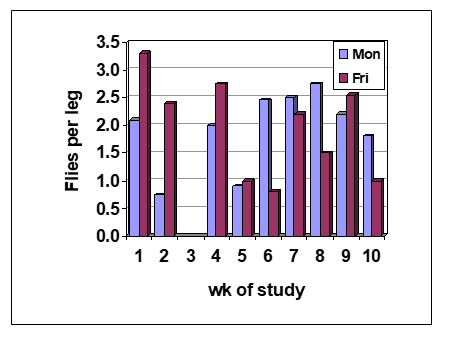
The number of calves on each leg was highest during the first week of the study, then were lower throughout. Note that in week 3 (Figure), no data were recorded as traps were unavailable and were not installed during this week.
During week 6 and 10, more flies were recorded on Monday (following the 3 days when traps were not present) than on Friday when traps were present. There were clear effects of having the traps present on the farms – prior to installation of the traps, calves on many of the farms showed clear signs of leg lesions from flies. However, during the period of the experiment, these lesions went away.
The traps were able to collect a large number of flies at the densities used in the study. The traps were removed after 4 days during the study; however, if the traps were always available, the researchers estimated that the traps would capture more than 240,000 stable flies and 1,500,000 house flies from all five farms.
Sticky traps have a tendency to collect dust in addition to flies. It’s important that the location of these traps (or any traps) be situated such to minimize exposure to dust. In this study, the traps were placed 2.5 m above the floor and were changed often.
Summary
Flies are a significant problem on most calf raising facilities. Large sticky traps were effective in capturing large numbers of flies and reducing leg lesions caused by flies. These traps appear to be a potential for an IPM program on calf facilities. It’s important to remember (and as the researchers pointed out), that traps are only one part of an IPM program. Other important management practices, especially reducing amount of contaminated bedding .
References
Kaufman, P. E., D. A. Rutz, and S. Frisch. 2005. Large sticky traps for capturing house flies and stable flies in dairy calf greenhouse facilities. J. Dairy Sci. 88:176-181.