Introduction
The Calf Notes family of educational resources continues with What’s Happening? — a video series highlighting real-world photos and management situations collected during more than 40 years of working with young calves.
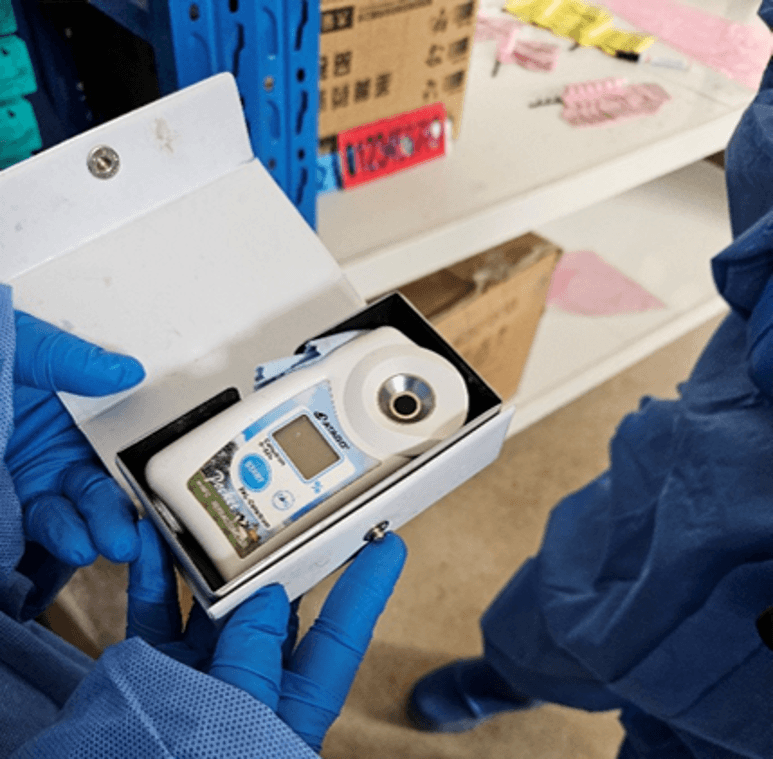
In Episode #7, we travel to a dairy farm outside Hohhot, Inner Mongolia, China, where a simple but powerful tool was purchased with good intentions — and then quietly placed in a drawer. This episode isn’t really about a refractometer. It’s about communication, training, and using data to make better decisions.
What’s Happening?
The photo in this episode shows a BRIX refractometer located in the maternity area. The device was purchased to estimate colostrum IgG concentration and improve newborn calf management.
The managers had read about the importance of testing colostrum quality. They understood that monitoring BRIX values could help identify low-quality colostrum and reserve it for second or third feedings — while ensuring high-quality colostrum was used for first feedings. It was a good idea. But there was one problem.
The workers were not adequately trained on:
- How to properly use the refractometer
- What the BRIX numbers meant
- What actions should follow the measurement
The refractometer was used for a few days. Workers didn’t see much variation in the numbers. They didn’t understand how the information should influence decisions. So, into the drawer it went.
Not Just in China
A similar situation occurred on a dairy farm in New York State, USA.
Again, colostrum was tested for a short period. Again, workers did not fully understand what they were measuring or why the data mattered. And again, testing eventually stopped. These are not equipment problems. They are management and communication problems.
Where Things Break Down
There were two key issues occurring at both farms:
1. Lack of Worker Training
Technology without training is just equipment. If employees do not understand:
- What the numbers represent
- What thresholds are important
- What actions should follow
then the measurement becomes meaningless.
2. Breakdown in Communication
A protocol such as measuring colostrum quality should not be abandoned simply because workers “don’t see value” in the data.
When confusion arises, there should be a conversation between:
- The calf manager
- The farm manager
- The maternity staff
Data collection must be connected to decision-making.
How Are BRIX Values Typically Used?
Often — not very well.
For example, on one farm in Indiana, the birth record for each calf includes:
- Sex
- Twin status
- Live or stillborn
- Date and time of birth
- Date and time of each colostrum feeding
But there was no record of colostrum quality.
The farm labeled each bag of frozen colostrum with the collection date and BRIX value. In theory, workers could select the highest BRIX bags for first feedings.
In practice:
- There was no consistent recording system
- No evaluation of trends
- No monitoring of seasonal variation
- No review of cow age effects
- No assessment of differences among employees collecting colostrum
Measuring BRIX alone is not management.
You Manage What You Measure — If You Use It
There is an old saying:
“You manage what you measure.”
That’s true — but incomplete.
You must also:
- Record what you measure
- Analyze what you record
- Make decisions based on what you analyze
Simply taking a BRIX reading is not enough.
Good colostrum monitoring programs track:
- Seasonal changes
- Differences by parity
- Effects of delayed collection
- Employee consistency
- Overall herd trends
The goal is not just to identify poor-quality samples. The goal is to improve the entire colostrum management system.
Resources for a Deeper Dive
If you’d like to learn more about colostrum quality monitoring, several excellent resources are available, including publications from:
- Penn State Extension
- Michigan State University
- Cornell University
And of course, Calf Notes #39, #183, and #236 provide additional practical guidance.
Practical Take-Home Messages
- Buying equipment does not improve management — training does.
- Workers must understand what BRIX values mean and how to act on them.
- Colostrum quality data should be recorded and reviewed regularly.
- Communication between managers and employees is essential.
- Monitoring trends is more valuable than a single measurement.
Final Thought
Calves crave good colostrum.
But farms need more than tools. They need systems, training, and accountability. Measure. Record. Review. Act. That’s how improvement happens. See you next time.