Introduction
For many years, one of the simplest recommendations for evaluating a calf milk replacer in the United States was to look at the protein sources on the feed tag. Milk-derived proteins were considered good; vegetable proteins, particularly soy proteins, were viewed with suspicion. An “all-milk protein” milk replacer became almost synonymous with a high-quality milk replacer for young calves.
There were good reasons for that recommendation. Research conducted primarily during the 1970s and 1980s showed that young calves often digested soy proteins poorly compared with milk proteins. Some studies reported reduced growth and nitrogen retention, immune responses to soy proteins, and striking changes in the morphology of the small intestine. Those results became part of our collective understanding of calf nutrition and continue to influence milk replacer formulation and purchasing decisions today.
However, much has changed since those studies were conducted. Dairy protein ingredients have changed, processing methods for vegetable proteins have improved, and our understanding of amino acid nutrition is better. Importantly, the economics of dairy proteins have also changed dramatically. The question is therefore not whether vegetable proteins are universally equivalent to milk proteins—they are not—but whether all vegetable proteins should continue to be treated as a single inferior class of ingredients.
The changing economics of whey
Milk replacers once relied heavily on dried skim milk and casein. During the latter part of the twentieth century, whey ingredients increasingly replaced skim milk as the principal protein sources in “all-milk protein” replacers. Dried whey, delactosed whey, whey protein concentrate (WPC), and eventually higher-protein whey fractions became common because they were nutritionally effective and economically attractive. Kertz et al. (2017) described this transition in their 100-year review of calf nutrition.
Thus, the definition of a conventional high-quality milk replacer has already changed once as dairy-processing technology and ingredient economics changed. They are changing again.
Figure 1 shows annual average U.S. prices for Central dry whey and Central/West WPC containing 34% protein from 2016 through 2025. The annual values are averages of USDA Dairy Market News monthly “mostly” prices. WPC-34 averaged about $0.68/lb in 2016 and $1.67/lb in 2025, approximately 2.4 times the 2016 price. Dry whey increased from about $0.28 to $0.58/lb over the same period. The year-to-year pattern is volatile, but the upward pressure on WPC is unmistakable.
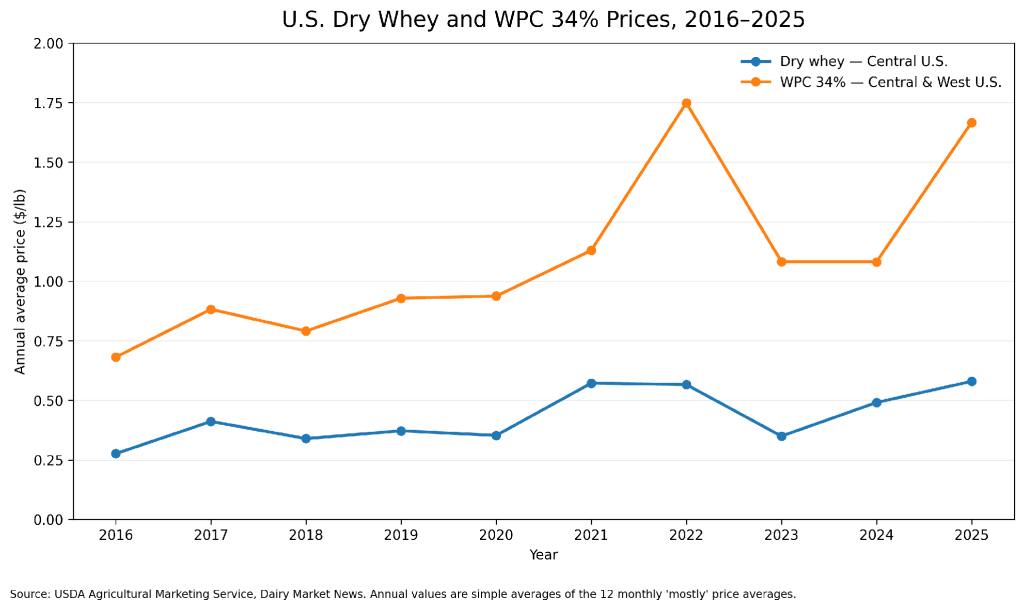
Figure 1. U.S. prices of Central dry whey and Central/West WPC-34 from 2016 through 2025. Values are annual averages of USDA Dairy Market News monthly “mostly” prices. Prices are per pound of ingredient, not per pound of protein.
The current market makes the issue even more obvious. For the week of August 31 to September 4, 2026, USDA reported WPC-34 at $1.90 to $2.80/lb, with a mostly range of $2.16 to $2.55/lb. Central dry whey was $0.62 to $0.73/lb, while animal-feed whey was $0.35 to $0.38/lb (USDA-AMS, 2026).
Whey has found a more valuable customer
Historically, whey was a relatively low-value by-product of cheese manufacturing. Drying whey or concentrating some of its protein created useful ingredients for animal feeds and comparatively inexpensive food applications. Today, whey is increasingly a feedstock from which high-value proteins are produced for sports nutrition, protein beverages, bars, infant nutrition, medical foods, and other human-food markets.
This shift is not new. USDA reported in 2016 that processors were already moving some whey away from ordinary dry whey and lower-protein WPC and toward higher-protein concentrates and isolates. Dairy Market News made the same observation repeatedly during 2016: processors with the capability to do so were choosing higher protein concentrations because of their greater value.
The trend has intensified. In September 2026, USDA described WPC-34 production as “extremely limited” because manufacturers were diverting whey streams toward WPC-80 and whey protein isolate (WPI); inventories of WPC-34 were described as exceptionally tight. The U.S. Dairy Export Council likewise reported that low-protein WPC exports declined because processors were choosing to manufacture WPC-80+ to meet strong U.S. and global demand. Food Business News summarized the same market reality: plants that can upgrade whey to WPC-80 or WPI are prioritizing those higher-value protein streams.
The calf milk replacer industry therefore competes increasingly with human nutrition markets for dairy protein. That does not make vegetable protein nutritionally superior, but it changes the economic incentive to determine exactly how much dairy protein is biologically necessary and where other high-quality proteins might be used safely.
Why did vegetable proteins get such a bad reputation?
Before deciding that old recommendations are obsolete, it is important to understand why they were made. Some of the early results were not subtle. Selected examples are summarized below.
| Study | Vegetable-protein treatment | Key finding |
|---|---|---|
| Seegraber & Morrill, 1982 | About one-third of protein from soy protein concentrate or soy flour | Shortened, blunted, convoluted or absent intestinal villi; markedly reduced xylose absorption compared with milk protein. |
| Huber & Campos, 1982 | Up to 33% of protein from soy protein concentrate or other nonmilk proteins | Soy-containing treatments produced lower weight gains than the all-milk-protein control. |
| Akinyele & Harshbarger, 1983 | Soy protein concentrate or soy flour versus milk protein | At 10–15 d, apparent protein digestibility was 90.1% for milk protein but 56.6% for soy concentrate and 61.3% for soy flour; nitrogen retention was also markedly poorer. |
| Campos & Huber, 1983 | 50% of milk replacer protein supplied by soy protein concentrate | Weight gain was reduced about 20%; DM and protein digestibility and protein retention were lower. |
| Seegraber & Morrill, 1986 | One-third of protein from soy concentrate or soy flour | Progressive deterioration of intestinal villus integrity; villus morphology improved after calves returned to milk protein. |
| Dawson et al., 1988 | 75% of total protein from several processed soy products | All-milk protein supported better growth, digestibility, nitrogen retention and intestinal morphology; calves also developed humoral responses to soy proteins. |
Table 1. Examples from older calf studies that helped establish the poor reputation of vegetable proteins in milk replacers.
The numerical results reported by Akinyele and Harshbarger (1983) are particularly difficult to ignore. Protein digestibility near 57 to 61% in calves 10 to 15 d old, compared with approximately 90% for milk protein, is a major nutritional disadvantage. Interestingly, digestibility and nitrogen retention improved considerably when the same calves were evaluated at 30 to 35 d of age. Young calves became more capable of utilizing the soy proteins as they matured.
The intestinal studies provided another reason for concern. Seegraber and Morrill (1982, 1986) observed long, relatively uniform villi in milk-fed calves, whereas calves receiving soy proteins developed areas of shortened, blunted, convoluted, or absent villi. Dawson et al. (1988) also reported poorer intestinal morphology and an antibody response to soy proteins when soy supplied most of the dietary protein.
These findings were real. They provided a sound biological basis for caution, and the recommendation to favor milk proteins in very young calves was reasonable for the ingredients and formulations being evaluated at the time.
But what, exactly, was being tested?
The problem arises when results from those experiments are converted into the much broader rule that “vegetable protein is bad.” At least four considerations make that conclusion too simple.
1. Processing matters
A soybean contains protein, but it also contains fiber, oligosaccharides, trypsin inhibitors, antigenic proteins, and other components that may affect digestion or intestinal function. Soy flour, soy protein concentrate, soy protein isolate, enzyme-treated soybean protein, fermented soy protein, and hydrolyzed soy protein are not nutritionally identical ingredients. The same principle applies to wheat, pea, potato, rice, and other plant proteins.
Even the older research showed that processing mattered. In Dawson et al. (1988), all soy treatments were inferior to the all-milk diet when soy supplied 75% of total protein, but soy protein concentrate and experimentally heat-treated soy flour performed better than a commercially heated soy flour. The phrase “contains soy” therefore did not fully describe nutritional quality even in the 1980s.
Modern processing can remove or reduce many nonprotein components and antinutritional factors, change protein solubility, and in some products hydrolyze proteins into smaller peptides. Ansia and Drackley (2020) concluded that much of the historical literature on soybean proteins does not necessarily predict the performance of modern, extensively processed soy ingredients. The 2021 Nutrient Requirements of Dairy Cattle similarly recognized processed soy protein concentrate, hydrolyzed wheat gluten, and pea protein as potentially useful nonmilk proteins in calf milk replacers.
2. Partial replacement is not total replacement
A second issue is inclusion rate. Many classic experiments deliberately tested large substitutions: approximately one-third of total protein, one-half, or even 75% of total protein from a vegetable source. Those studies appropriately asked whether a vegetable protein could function as a major or predominant protein source. They do not necessarily answer a different question: can a highly processed vegetable protein replace a modest portion of expensive dairy protein without reducing calf performance?
Those are biologically different questions. Failure of a diet in which 50 or 75% of total protein came from an older soy ingredient does not demonstrate that a modern formula in which a processed vegetable protein supplies 10 or 20% of total protein will fail. Conversely, success at a low inclusion rate should not be interpreted as evidence that the same ingredient can replace all milk protein. The response need not be linear.
A modern study illustrates the distinction. Ansia et al. (2020) compared an all-whey-protein milk replacer with one in which 50% of crude protein was supplied by enzyme-treated soybean meal. Apparent ileal digestibility of several amino acids was lower with the soy ingredient because endogenous protein losses were greater, but true ileal digestibility was similar for most amino acids, average daily gain did not differ, and fecal consistency improved. That result does not establish equivalence under every circumstance, but it demonstrates why modern ingredient, processing, and inclusion rate must be specified before judging “soy.”
3. Age matters
The digestive system of the newborn calf is not static. Enzyme secretion, intestinal function, endogenous protein losses, microbial populations, starter intake, and eventually rumen function all change rapidly during the first weeks of life. The early soy studies repeatedly showed that vegetable-protein utilization improved with age.
Consequently, an ingredient that is inappropriate as a major protein source for a 7-d-old calf might be satisfactory as a partial protein source later in the milk-feeding period. Age should therefore be part of any recommendation about a nonmilk protein rather than an afterthought.
4. Amino acid balance matters
Protein source is only part of protein nutrition. The calf ultimately requires absorbable amino acids. Plant proteins differ from milk proteins in amino acid profile, and lysine, methionine, threonine, or other amino acids can become limiting as vegetable-protein inclusion increases. Modern formulation allows these differences to be recognized and, when necessary, corrected with supplemental amino acids.
A poorly balanced formulation using a vegetable protein can therefore produce poor calf performance without proving that the ingredient itself is inherently unusable. Ingredient quality, digestibility, inclusion rate, and amino acid balance have to be considered together.
So, should we abandon all-milk protein?
No. Milk proteins remain highly digestible, nutritionally excellent protein sources for young calves. Nothing in the newer literature suggests that a poorly processed soy flour should suddenly replace whey protein in neonatal calf milk replacer simply because soy is cheaper.
The useful question is narrower. For decades we often evaluated milk replacers by asking, “Does it contain vegetable protein?” Perhaps the better questions today are: What vegetable protein is it? How was it processed? How digestible is it? What antinutritional or antigenic components remain? How much of the total protein does it supply? Is the amino acid profile properly balanced? And how old are the calves that will consume it?
That is a much higher bar than simply accepting vegetable protein because dairy protein is expensive. It is also more scientifically defensible than rejecting an ingredient solely because its protein originated from a plant.
Summary
The economics make this discussion increasingly relevant. Whey was once a relatively inexpensive by-product looking for markets. Today, dairy processors can direct whey toward high-value WPC-80 and WPI, and USDA now reports that this diversion is constraining supplies of WPC-34. The calf industry is competing with human nutritional markets for the same protein stream.
At the same time, we should not rewrite history. Older vegetable-protein studies documented very poor digestibility, reduced nitrogen retention, intestinal damage, immune responses, and reduced growth under some conditions. Those results explain why vegetable proteins acquired a poor reputation in calf milk replacers.
The important distinction is that “vegetable protein” is not one ingredient. Protein source, processing, inclusion rate, amino acid balance, and calf age all influence the response. The nutritional challenge is not to find the cheapest replacement for milk protein; it is to determine whether modern processing allows some lower-cost proteins to be used without sacrificing digestibility, health, growth, or overall calf performance.
The next three Calf Notes will examine those questions more closely. Calf Note #286 will review soy ingredients, including soy flour, soy protein concentrate, soy protein isolate, and newer treated soy products. Calf Note #287 will examine wheat proteins, particularly hydrolyzed wheat gluten. Calf Note #288 will consider less commonly used alternatives such as pea, potato, rice, and other potential protein sources.
Popular Press and Market Reports
Protein boom powering dairy powder market dynamics (Food Business News)
July exports decline 5% (U.S. Dairy Export Council)
Dairy Market News Weekly Report (USDA Agricultural Marketing Service)
References
Akinyele, I. O., and K. E. Harshbarger. 1983. Performance of young calves fed soybean protein replacers. J. Dairy Sci. 66:825–832. Link
Ansia, I., H. H. Stein, D. A. Vermeire, C. Brøkner, and J. K. Drackley. 2020. Ileal digestibility and endogenous protein losses of milk replacers based on whey proteins alone or with an enzyme-treated soybean meal in young dairy calves. J. Dairy Sci. 103:4390–4407. Link
Ansia, I., and J. K. Drackley. 2020. Graduate Student Literature Review: The past and future of soy protein in calf nutrition. J. Dairy Sci. 103:7625–7638. Link
Campos, O. F., and J. T. Huber. 1983. Performance and digestion by calves from limestone added to milk replacers containing soy protein concentrate. J. Dairy Sci. 66:2365–2372. Link
Dawson, D. P., J. L. Morrill, P. G. Reddy, H. C. Minocha, and H. A. Ramsey. 1988. Soy protein concentrate and heated soy flours as protein sources in milk replacer for preruminant calves. J. Dairy Sci. 71:1301–1309. Link
Huber, J. T., and O. F. Campos. 1982. Enzymatic hydrolysate of fish, spray-dried fish solubles, and soybean protein concentrate in milk replacers for calves. J. Dairy Sci. 65:2351–2356. Link
Kertz, A. F., T. M. Hill, J. D. Quigley III, A. J. Heinrichs, J. G. Linn, and J. K. Drackley. 2017. A 100-Year Review: Calf nutrition and management. J. Dairy Sci. 100:10151–10172. Link
National Academies of Sciences, Engineering, and Medicine. 2021. Nutrient Requirements of Dairy Cattle. 8th rev. ed. National Academies Press, Washington, DC. Link
Seegraber, F. J., and J. L. Morrill. 1982. Effect of soy protein on calves’ intestinal absorptive ability and morphology determined by scanning electron microscopy. J. Dairy Sci. 65:1962–1970. Link
Seegraber, F. J., and J. L. Morrill. 1986. Effect of protein source in calf milk replacers on morphology and absorptive ability of small intestine. J. Dairy Sci. 69:460–469. Link
USDA Agricultural Marketing Service. 2026. Dairy Market News, August 31–September 4, 2026. Volume 93, Report 36. Link
USDA Economic Research Service. 2016. ERS data provide first government estimates of commercial domestic disappearance of whey products. Amber Waves. Link