Introduction
The What’s Happening? video series looks at photos and situations observed on dairy farms around the world and asks a simple question: What’s happening here? Often the answer reveals something important about calf management.
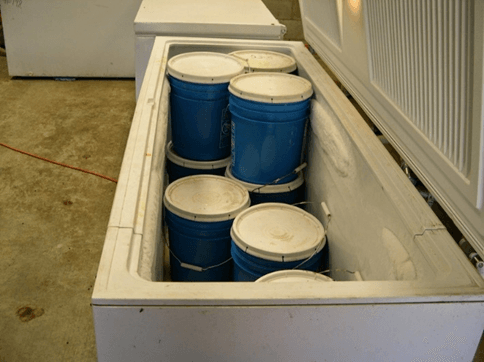
Episode 9 begins on a dairy farm outside Boise, Idaho, in the United States. Idaho has become one of the fastest growing dairy regions in North America and now ranks among the top milk-producing states. The farm in this episode appeared well managed at first glance. Colostrum from fresh cows was being collected and frozen for later use—an important practice that helps ensure calves receive adequate high-quality colostrum even when the dam’s colostrum is unavailable or inadequate.
The colostrum was stored in a freezer, but it was frozen in large blue plastic buckets. Each bucket held about five U.S. gallons—nearly twenty liters of colostrum.
That is where the problem begins.
Freezing colostrum is a common and useful practice, but the size of the container used for storage can make a major difference in the quality of the colostrum that calves ultimately receive. When large volumes of colostrum are placed in a freezer, the outside of the container cools quickly, but the center of the liquid cools very slowly. The result is that the colostrum in the middle of the container can remain warm for many hours—even while the outer layer is already frozen.
Why does this matter? The answer lies in bacterial growth.
Colostrum leaves the cow at approximately 39°C (about 102°F). At this temperature, bacteria grow extremely rapidly. Even relatively clean colostrum may contain around 10,000 bacteria per milliliter, and many samples contain far more than that. If conditions allow bacteria to double every 20 minutes—a reasonable estimate under warm conditions—the population grows very quickly. Within just a few hours, bacterial numbers can increase dramatically.
The challenge with large containers is that the colostrum remains in the bacterial “growth zone” for a long time before it cools sufficiently to slow microbial activity.
To illustrate the problem, imagine placing a large bucket of warm colostrum in a calf barn where the air temperature is about 25°C (77°F). We can create “cooling curves”, using Newton’s Law of Cooling, modeling the surface and center of the container as separate exponential cooling processes. These will give us a reasonable estimate of what’s happening at these two areas within the bucket.
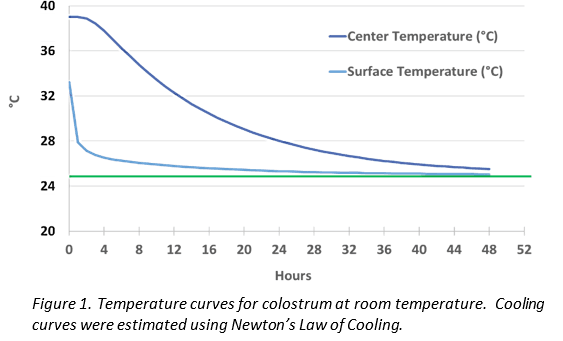
The surface of the liquid cools fairly quickly and soon approaches the temperature of the surrounding air. But the center of the bucket behaves very differently. Because heat moves slowly through a large volume of liquid, the center can remain near body temperature for many hours. In some situations, it may stay above 28°C (82°F) for nearly an entire day. During this time bacteria have an ideal opportunity to multiply.
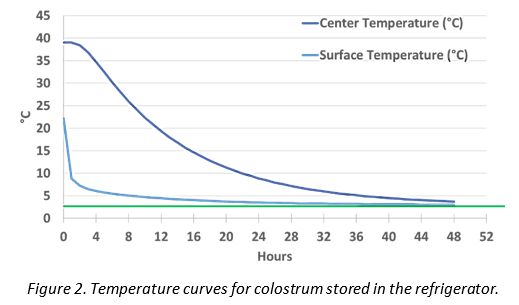
Refrigeration improves the situation, but not as much as many people expect. If the same large bucket of colostrum is placed in a refrigerator at 3°C (37°F), the outer portion cools rapidly, but the center of the bucket cools very slowly. Even after several hours, the middle of the container may still be warm enough to allow bacterial growth. In fact, it may take nearly two days for the entire container to reach refrigerator temperature.
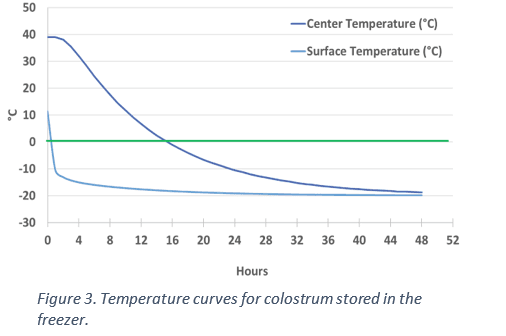
Freezing large buckets creates a similar problem. When a bucket of warm colostrum is placed into a freezer at –20°C (–4°F), the surface may freeze relatively quickly, but the center can remain warm for many hours. The outer layer of the colostrum becomes frozen while the interior is still liquid and warm. It may take fifteen hours or more before the center finally freezes and as long as two days before the entire container reaches the temperature of the freezer.
In other words, even though the colostrum eventually freezes, it may spend many hours at temperatures where bacteria can multiply rapidly.
This bacterial growth matters because contaminated colostrum can interfere with the calf’s ability to absorb immunoglobulins and can expose the calf to pathogens. One of the main goals of colostrum management is to provide calves with clean colostrum that contains high concentrations of antibodies and low bacterial counts. Slow cooling works directly against that goal.
Fortunately, the solution is simple: store colostrum in smaller containers.
Many farms successfully store colostrum in plastic freezer bags, bottles, or other containers holding two to four liters. Smaller volumes cool much more quickly than large buckets, which greatly reduces the time colostrum spends in temperatures favorable for bacterial growth. Specialized colostrum storage systems are also available that use durable storage bags and equipment designed to pasteurize, cool, freeze, and thaw colostrum safely.
Another useful practice is rapid chilling before storage. Some farms place freshly collected colostrum into bottles or bags and cool them in refrigerators or ice baths before freezing. Rapid cooling helps prevent bacterial growth and preserves colostrum quality.
The goal of good colostrum management is simple: calves should receive clean, high-quality colostrum as soon as possible after birth. How colostrum is stored between collection and feeding can have a major impact on whether that goal is achieved.
Large buckets may seem convenient for storing colostrum, but they cool too slowly and create an opportunity for bacteria to multiply. Smaller containers allow colostrum to cool rapidly, helping preserve its quality and ensuring that calves receive the clean colostrum they need for a healthy start.
Sometimes the difference between good management and poor management is surprisingly small. In this case, it may simply be the size of the container.